

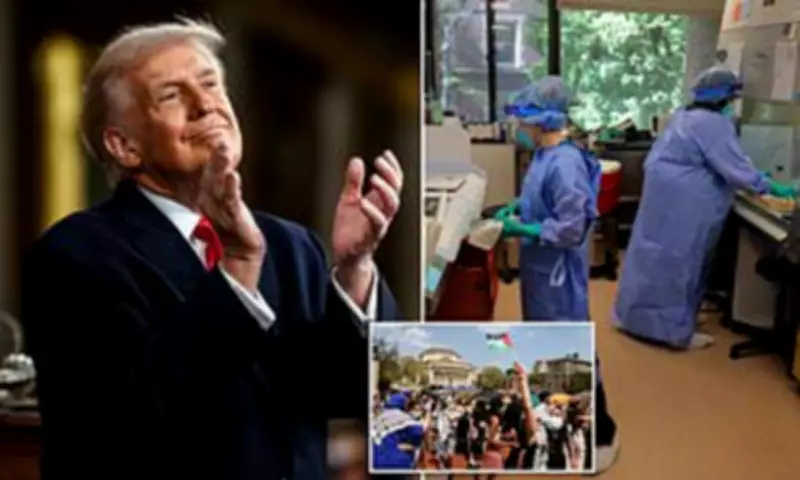
From Funding Crisis to Fiscal Triumph: The NIH's Remarkable Turnaround
In the spring of 2025, the scientific research community faced what many described as an impending apocalypse. The White House, through Elon Musk's government cost-saving initiative DOGE, proposed devastating cuts approaching 40 percent to the National Institutes of Health's annual budget of approximately $48 billion. As the world's largest public funder of biomedical research, supporting institutions across all 50 states, the NIH stood to lose nearly two-fifths of its vital funding.
Radical Restructuring Plans and Wider Cuts
The proposed restructuring would have consolidated the NIH's 27 specialized institutes and centers—including critical entities like the National Cancer Institute and National Eye Institute—into just eight streamlined organizations. This dramatic downsizing formed part of President Donald Trump's broader governmental reshaping initiative, targeting what he termed wasteful federal spending and eliminating support for diversity, equity, and inclusion programs.
Beyond the NIH, other scientific agencies faced similarly severe reductions. NASA was slated to lose 24 percent of its $25 billion budget, while the National Science Foundation confronted a staggering 57 percent cut from its $9 billion allocation. President Trump simultaneously criticized academic institutions for failing to address campus antisemitism, administrative inefficiencies, and what he described as excessive devotion to 'woke' ideologies and political correctness.

Community Outcry and Brain Drain Fears
The proposed measures triggered immediate alarm throughout the research community, with many experts predicting a catastrophic 'brain drain' as American scientists sought opportunities in the European Union and other regions. The potential dismantling of America's biomedical research infrastructure appeared imminent, threatening decades of scientific progress and global leadership.
However, the narrative took an unexpected turn just one year later. Through what observers describe as strategic negotiation tactics reminiscent of Trump's 1987 book The Art of the Deal, the administration achieved its reform objectives while ultimately increasing research funding.
The Funding Reversal and Bipartisan Agreement
On February 3, 2026, President Trump signed a bipartisan $1.2 trillion funding package that allocated $48.7 billion to the NIH for the fiscal year—representing a $400 million increase from previous levels. Crucially, the NIH's 27 institutes and centers remained intact, preserving the specialized research structure many feared would be dismantled.
The new budget specifically allocated additional resources to critical health priorities, including an extra $128 million for cancer research and $100 million for Alzheimer's disease studies. Meanwhile, NASA's budget was trimmed by just 1.6 percent and the NSF's by only 3.4 percent—far less severe than originally proposed.
Strategic Negotiation and Institutional Reform
Administration officials described the approach as using the presidency as a 'bully pulpit'—a term popularized by Theodore Roosevelt—to force necessary reforms. By presenting maximalist positions with threats of extreme cuts, the White House compelled research institutions to address long-standing concerns about waste, administrative bloat, and ideological programming.
'We're working to remove ideological influence from science,' explained Dr. Jay Bhattacharya, Trump's appointee as NIH Director. 'NIH funding must be based on provable, testable hypotheses, not ideological narratives. Projects that don't meet that bar are discontinued so we can focus on rigorous, impactful research.'
Campus Reforms and Antisemitism Crackdown
The administration's reform campaign began immediately upon Trump's second-term inauguration, with an executive order requiring federally funded universities to terminate DEI programs potentially violating civil rights laws. Subsequent actions included freezing research grants to institutions perceived as inadequately addressing antisemitism, with Columbia University losing $400 million, Brown University $510 million, Princeton $210 million, and the University of Pennsylvania $175 million.

Congressional hearings brought university leaders before Republican lawmakers, compelling commitments to substantive change. During one hearing, DePaul University President Robert Manuel assured Congress that future campus encampments violating policies would be removed immediately—a marked departure from previous institutional equivocation.
Internal Dissent and the Bethesda Declaration
Within the NIH itself, resistance coalesced around the 'Bethesda Declaration,' signed by 92 identified researchers and 250 anonymous colleagues. The document protested the cancellation of approximately 2,100 research grants totaling $9.5 billion during the reform period. However, administration officials maintained these cuts targeted wasteful or ideologically-driven projects rather than legitimate scientific inquiry.
White House Budget Director Russell Vought highlighted specific examples of questionable expenditures, including '$2 million for injecting dogs with cocaine that the NIH spent money on, $75,000 for Harvard to study blowing lizards off of trees with leaf blowers.'
Republican Support and Funding Release
By summer 2025, key Republican senators including Katie Britt, Susan Collins, Shelley Moore Capito, and Lindsey Graham urged the administration to release paused NIH funding, noting that reforms had positioned the agency to 'uphold gold standard research.' Their letter emphasized ensuring NIH awards were 'grounded in transparency, scientific merit, and a clear alignment with national interests.'
Institutional changes followed nationwide, with the University of Pennsylvania removing DEI content from its websites and pledging to 'adopt biology-based definitions for the words "male" and "female"'—a response to controversies including transgender swimmer Lia Thomas's 2022 NCAA championship.
Economic Impact and First Lady's Visit
A March 2026 report from United for Medical Research revealed minimal economic disruption despite the previous year's confrontations. NIH funding in 2025 was just $360 million less than 2024 levels—less than 1 percent difference—while generating $94 billion in economic activity and supporting nearly 391,000 jobs nationwide.
By Valentine's Day 2026, rather than facing cuts, the NIH hosted First Lady Melania Trump for her fourth visit to the Bethesda campus, where she participated in craft activities with children undergoing clinical trials for serious diseases. The symbolic visit underscored the administration's renewed commitment to biomedical research.
Legacy and Global Competition
The Trump administration's approach—initially perceived as hostile to science—ultimately strengthened America's research ecosystem according to White House sources. 'The Trump administration's efforts to slash taxpayer funding of waste, fraud, and abuse in research grant spending are strengthening what's driven America's dominance in research and development,' one official noted.
With China accelerating its scientific investments, the reformed NIH positions America to maintain its leadership in the global research race while addressing critical health challenges including cancer and Alzheimer's disease. The dramatic journey from proposed cuts to increased funding demonstrates how strategic pressure can drive institutional reform while preserving—and even enhancing—scientific capability.





