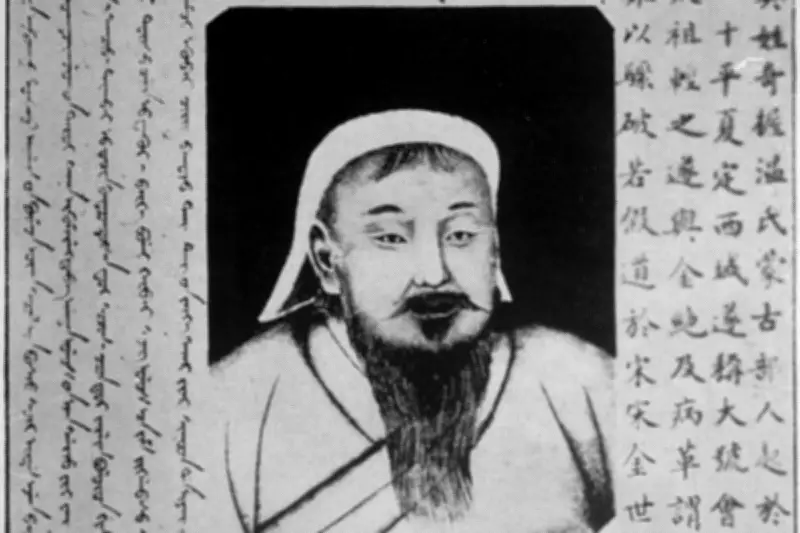
New Genetic Research Challenges Long-Held Belief About Genghis Khan's Descendants
A groundbreaking new study has upended the popular myth that one in every 200 men alive today is a direct descendant of the legendary Mongol conqueror Genghis Khan. The research, published in the journal PNAS, reveals a far more complicated genetic story that suggests the common lineage shared by many Asian men likely originated about 1,000 years before Khan built his vast empire.
The Origins of a Persistent Myth
For two decades, a widely cited 2003 study has shaped our understanding of Genghis Khan's genetic legacy. That research found that approximately 8 percent of men across a large portion of Asia shared a remarkably similar Y-chromosome lineage that appeared to originate around 1,000 years ago in Mongolia – coinciding with Khan's lifetime. When extrapolated to the global population, this suggested that roughly 0.5 percent of all men worldwide, or about one in 200, could trace their ancestry directly to the Mongol emperor.
Genghis Khan, who unified Mongol tribes and conquered territories stretching from Korea to the Caspian Sea, founded the largest contiguous land empire in history. Historical records indicate he had numerous wives and concubines and fathered dozens of children, with some estimates suggesting he may have had as many as 100 offspring. His successors expanded the empire further into Persia, Russia, and parts of the Middle East and Europe, creating conditions that could theoretically have spread his genetic material widely.

Ancient DNA Evidence Tells a Different Story
The new study takes a different approach by examining ancient DNA evidence from the Golden Horde – the northwestern extension of the Mongol Empire founded and ruled by Genghis Khan's eldest son, Joshi, and his descendants. Archaeologists focused on remains from four tombs in present-day Kazakhstan, with local folklore suggesting one of these might belong to Joshi himself.
"We believe this is the first ancient DNA evidence to support the genomic ancestry of ruling elites in the Golden Horde," said Ayken Askapuli, lead author of the study. The researchers discovered that while the buried individuals were indeed part of the same Y-chromosome lineage identified in the 2003 study, they belonged to a specific sub-branch that is "not as common as the larger branch" seen in living men today.
A Lineage That Predates the Conqueror
This crucial finding indicates that the Y-chromosome lineage observed in modern populations may not represent Khan's direct genetic line after all. Instead, researchers now suspect this lineage likely appeared approximately 1,000 years before Genghis Khan built his empire, meaning it was already established in the region long before his birth.
The study's authors emphasize that definitive proof about Genghis Khan's specific genetic contribution remains elusive until his own burial place is discovered – a challenge complicated by historical accounts. According to legend, the emperor was buried in complete secrecy in an unmarked grave that was trampled flat by hundreds of horses. Seeds were then sown over the area to help it blend seamlessly into the surrounding wild grassland. Folklore further claims that the slaves who built Khan's tomb and the soldiers who escorted them to the grave site were subsequently massacred to protect its location.
Advancing Our Understanding of Eurasian Genetics
Despite these limitations, the research represents significant progress in understanding the genetic history of Central Eurasia. "In essence, this study provides ancient DNA evidence that advances our understanding of the genetic background of the Mongolian elites and the population dynamics in Central Eurasia," the researchers concluded.
The findings challenge not only popular assumptions about Genghis Khan's genetic legacy but also demonstrate how ancient DNA analysis can reshape our understanding of historical population movements and elite lineages. While the Mongol conqueror undoubtedly left an indelible mark on world history through his military conquests and empire-building, his genetic contribution to modern populations appears to be more modest than previously believed.