
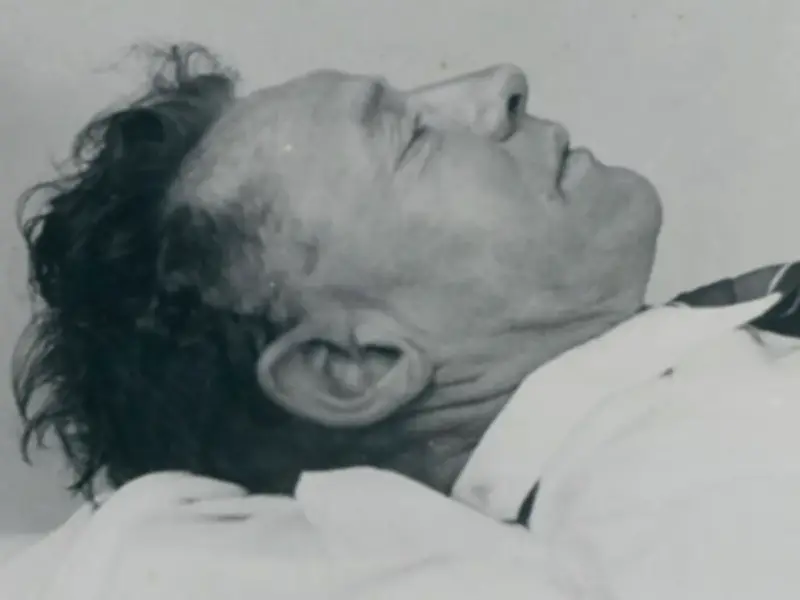
Advanced DNA and genealogical analysis have finally identified the Somerton Man, whose body was found on a beach in Adelaide, Australia, in 1948, as Carl 'Charles' Webb, a 43-year-old electrical engineer from Melbourne.
Discovery and Initial Mystery
On the early evening of November 30, 1948, a couple walking on Somerton Beach found the man and claimed they saw him raise his right arm and then drop it. Assuming he was drunk, they left him, according to Discovery. The next day another walker saw the man, with an unlit cigarette on his collar, a bus ticket, an unused train ticket from Adelaide to Henley Beach, an American-made comb, a packet of chewing gum, and a box of cigarettes containing cigarettes from another brand.
A scrap of paper in his jacket bore the phrase 'Tamám shud' – a Persian phrase meaning 'it is over' – later identified as being from a book of Persian poetry called the Rubiyat. Travel tickets suggested he had travelled from a nearby town, while labels from his clothes had been oddly cut out, leading detectives to suspect foul play.
Investigation and Key Clues
A suitcase later retrieved from a locker, believed to be his, contained more clothing with tags cut out and cryptic writings. A phone number found among his belongings belonged to a local nurse named Jessica Ellen Thomson, who claimed she didn’t know the dead man, didn’t know why her phone number would be in the book, nor why he would be a mile or so from her house the night he died. She persistently denied knowing him, and according to a policeman present, she was “completely taken aback, to the point of giving the appearance that she was about to faint.”
As far as the pathologist was concerned, the body was a man between forty and forty-five, around five feet eleven tall and in excellent physical condition. He was clean-shaven and, unusually for the late 1940s, without a hat. He carried no identification, and his dental records remained unmatched. At the autopsy, it was believed the pathologist said, “I am quite convinced the death could not have been natural.”
Identification Through DNA
No one ever claimed the man's body, so a cast was made of his face before he was laid to rest in an unmarked grave. In 2022, scientists extracted around 50 hairs from the cast and followed a complex forensic trail, ultimately identifying him as Carl 'Charles' Webb. The identification was made after Professor Derek Abbott from the University of Adelaide collaborated with genealogists to create a family tree spanning over 4,000 people, which led them to identify a distant cousin of Webb. Familial DNA technology then traced the DNA from the cast back to the relative, confirming with almost certainty that the body was that of Mr Webb.
Dr Abbott told the Australian Broadcasting Corporation, "It's a triangulation from two different, totally distant parts of the [family] tree." He added that solving the case felt like conquering "Everest". South Australian police have yet to officially comment on the development, which comes three years after they exhumed Mr Webb's body for further analysis.
Unresolved Death
How Webb died and whether his death is suspicious remains unconfirmed, although pathologists at the time suggested the most likely cause of death as heart failure. A coroner, however, refused to rule out murder. Little is currently known about Mr Webb, other than he was born in 1905 in Victoria and had been married to a woman named Dorothy Robertson. The couple had separated, with Mrs Robertson relocating to South Australia. It's possible that Mr Webb had been trying to locate his ex-wife when he died.




