Whether you prefer subtle charm or direct chat-up lines, there are numerous ways to signal romantic interest. Now, a scientific study has revealed that all flirting tactics can be classified into six fundamental categories. Researchers from the University of Augsburg in Germany conducted an extensive analysis of flirting behaviours, using the popular television show Love is Blind as their primary dataset.
Analysing Flirting in a Controlled Environment
The research team examined 140,000 instances of words used in flirtatious contexts during the reality dating series, where contestants engage in dates through a wall without visual contact. This unique setting allowed scientists to isolate verbal flirting techniques from physical cues, providing unprecedented insight into how people communicate romantic interest through language alone.
The Six Distinct Flirting Styles
Through meticulous analysis, the researchers identified half a dozen distinct flirting styles that people employ when expressing romantic or sexual interest. 'In our analysis we found that contestants make use of six vehicles to signal sexual and/or romantic interest,' the researchers wrote in the Journal of Pragmatics.

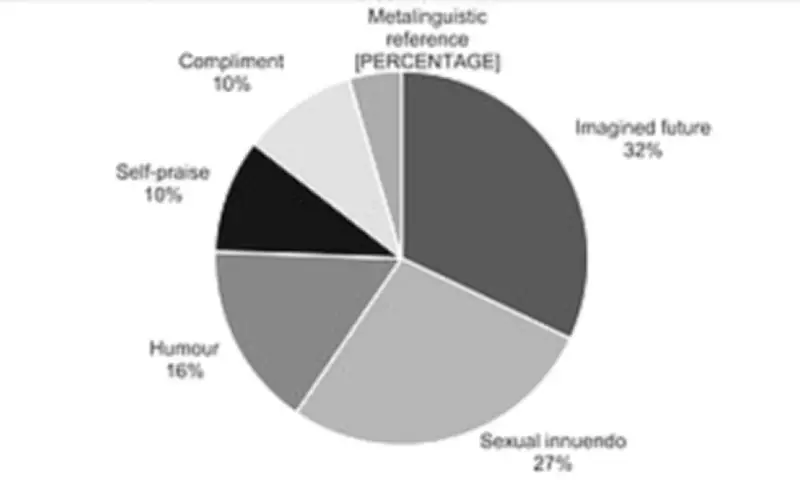
The most prevalent style across both genders was 'imagined future', where individuals create playful references to hypothetical joint endeavours. This technique typically employs words like 'we' and 'can' to construct shared scenarios that generate excitement about potential possibilities rather than concrete plans.
Detailed Breakdown of Flirting Techniques
1. Imagined Future
This style involves constructing imaginary joint future scenarios, such as saying 'If we were on a date, I would take you for sushi.' The researchers explained that its primary function is to create an 'excitement of possibility' without making actual arrangements.
2. Metalinguistic Reference
This technique involves directly referencing flirting itself or using flirting-related terminology. For example, someone might say 'Look at us getting flirty' to make previously implicit romantic intentions explicit. The researchers noted that such statements serve dual purposes: they acknowledge existing flirtatious undertones while simultaneously advancing the flirtation.
3. Self-Praise
This style employs positive self-evaluations that can trigger reciprocal compliments or teasing sequences. An example from the study shows a participant playfully describing themselves as a worthy partner. According to the research team, this tactic can effectively manipulate the other person into flirting back.
4. Humour
The flirtatious use of humour encompasses various forms including teasing, banter, and self-deprecating jokes. Interestingly, the researchers found that participants predominantly used idiosyncratic humour—highly personal and unconventional comedic styles—rather than traditional jokes. Only one instance of a conventional joke was identified throughout the entire series analysed.
5. Sexual Innuendo
This tactic involves shifting a non-sexual conversation to a sexual level. The researchers provided an example where a participant discussing kitchen cleaning was asked 'Are you dirty?' and responded with 'I'm always dirty.' This style 'allows fewer possibilities of deniability, as it oftentimes explicitly sexualises topics,' the researchers noted. Throughout the study, men used sexual innuendo twice as frequently as women.
6. Compliment
Compliments represent positive statements about the other person and are commonplace in flirting contexts. Examples from the research include 'You're so hot' and 'You have such a sultry voice.' The researchers explained that 'It is due to its sexualised nature that the compliment can be considered flirtatious, escalating the current relationship and moving towards a more intimate relationship.'

Gender Differences in Flirting Approaches
The comprehensive analysis revealed significant gender variations in flirting style preferences. While both men and women most frequently employed the 'imagined future' technique, men demonstrated a pronounced tendency toward sexual innuendo, using this style twice as often as their female counterparts. This finding suggests distinct communication patterns in how different genders express romantic interest.
Broader Implications for Relationship Science
This groundbreaking research provides valuable insights into human mating communication strategies and offers practical applications for understanding relationship dynamics. By categorising flirting behaviours into six distinct styles, the study creates a framework for analysing romantic interactions across various contexts beyond reality television.
The researchers' methodology of analysing verbal communication in isolation from physical cues represents an innovative approach to studying human attraction. Their work contributes significantly to the growing body of literature on interpersonal communication and relationship formation, offering both academic insights and practical understanding of how people navigate romantic interest in contemporary dating environments.