The Cosmic Mystery Inspiring Faith and Science
When invisible entities constituting 95% of the universe's mass baffle even the most brilliant scientific minds, a sense of awe becomes an entirely reasonable response. Physicists refer to this enigmatic substance as "dark matter"—the cosmic scaffolding that uses gravity to shape and bind together stars, planets, and galaxies. Yet its true nature remains elusive, detectable only through gravitational effects on visible matter. Together with dark energy, the mysterious force accelerating universal expansion, these phenomena represent the most profound scientific puzzles of our era.
Where Physics Meets Faith
It should come as little surprise that dark matter and dark energy—potentially holding keys to the universe's origins and ultimate fate—have ignited deep religious and philosophical dialogues. For some researchers, these conversations provide inspiration; for others, they provoke discomfort. The perceived divide between scientific inquiry and spiritual practice proves far less absolute than commonly assumed.
Many scientists describe how contemplating cosmic majesty complements rather than conflicts with their faith traditions. The late astronomer Vera Rubin, whose pioneering 1970s observations of galaxy rotations first provided robust evidence for dark matter's existence, embraced her Jewish faith as a framework for understanding her place in the cosmos.
Jewish Tradition Informs Scientific Inquiry
When astrophysicist Chanda Prescod-Weinstein met Rubin as a doctoral student in 2009, the esteemed scientist posed a surprising question: "So how do you think we solve the dark matter problem?" This gracious inquiry helped steer Prescod-Weinstein toward studying theoretical axion particles as potential dark matter candidates.
"The stories in the Torah are about people who lived in a very intimate relationship with the land and with the night sky," Prescod-Weinstein explains, drawing on Reconstructionist Jewish teachings for scientific inspiration. "They possessed a sense of all that as part of creation and the creation narrative."
Celestial Navigation and Cosmic Connection
Brittany Kamai's fascination with dark matter and dark energy propelled her into astrophysics, making her only the second Native Hawaiian to earn a doctorate in the field. After developing Fermilab's Holometer instrument to investigate space-time's fundamental nature, Kamai returned to her spiritual heritage as an apprentice navigator on traditional Hawaiian voyaging canoes.
Training in celestial navigation using stars, winds, and waves, Kamai contemplates whether spirituality—often dismissed by scientists—might hold missing clues to cosmic mysteries. "When you boil down physics, it's all a bunch of waves—particles, sound waves," she observes. "Why wouldn't we need to be in the deepest part of our ocean to have the deepest connection to the entire universe?"
Hindu Texts and Quantum Parallels
During postdoctoral research on dark matter, Doug Watson experienced profound doubt and burnout. His wife introduced him to the International Society for Krishna Consciousness (ISKCON), a Hindu tradition venerating Lord Krishna as the Supreme Being. Watson, previously nonreligious, embraced a faith encouraging doubt, curiosity, and scientific investigation.
Studying sacred texts like the Srimad Bhagavatam, Watson noted descriptions of Krishna's transcendental gaze animating the universe—strikingly reminiscent of quantum mechanics' observer effect, where measurement alters a quantum system's state. "I definitely don't think drawing direct lines between religious texts and scientific facts is the right approach," Watson clarifies. "Rather, I see how these stories could inform and inspire new ways of thinking about the universe's origins."
Scientific Caution and Spiritual Awe
Astrobiologist Adam Frank, a Zen Buddhist, cautions against anchoring spirituality in scientific concepts that constantly evolve. "You don't want to base your faith or spirituality on a graph in a scientific paper that goes up or down," he warns. For Frank, the true connection between science and spirituality lies in the awe both endeavors inspire.
Islamic scholar Caner Dagli notes that for the faithful, accepting a purely material universe remains impossible. "Transhumanists and other philosophers might think that if we just had enough computing power, we might be able to get the equations to really understand the universe completely," Dagli explains. "But that's off the table for Muslims because we believe God intervenes in history, he answers prayer."
Buddhist Compatibility with Modern Cosmology
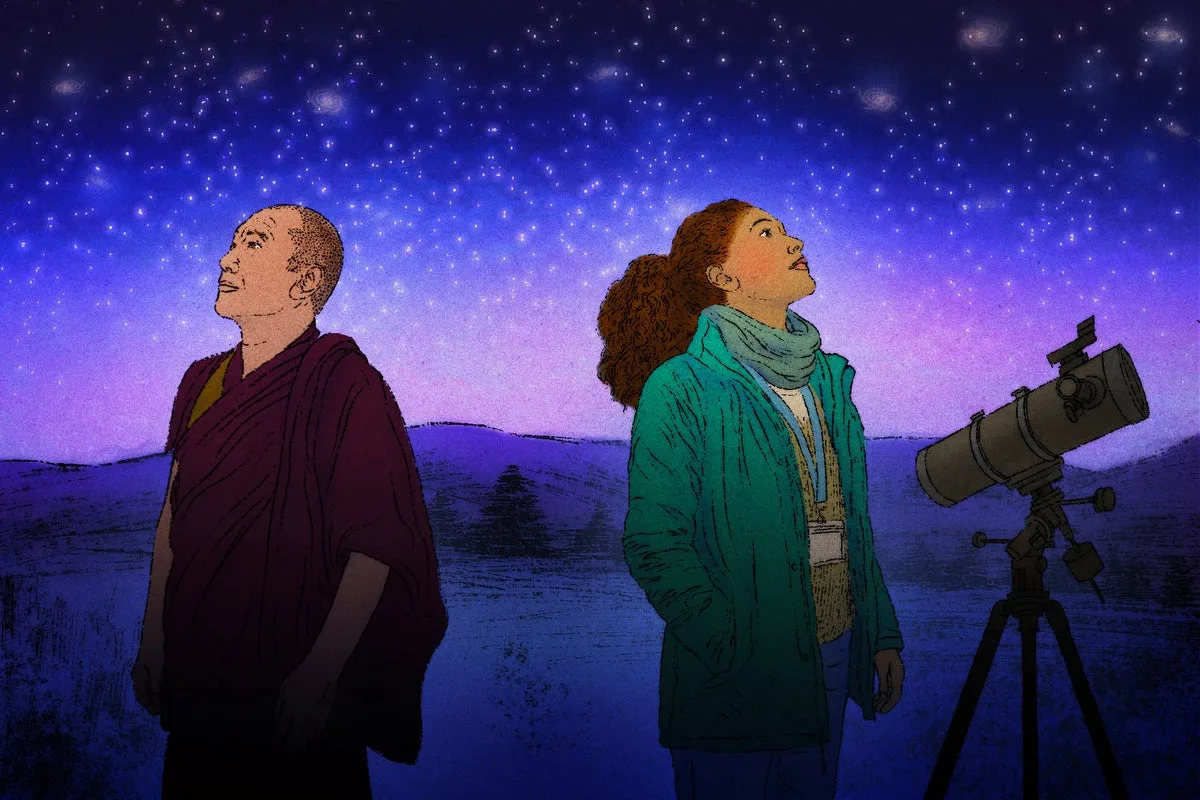
University of Arizona astronomy professor Chris Impey, an agnostic, has taught Tibetan monks and nuns at the Dalai Lama's invitation. He finds many Buddhist concepts remarkably compatible with contemporary cosmology. "They can accommodate in their tradition an ancient universe, billions of years old," Impey notes. "They can accommodate many worlds, life in other worlds, life more advanced than us."
Christian Perspectives on Cosmic Contemplation
Jesuit priest Adam Hincks, who teaches at the University of Toronto and serves as a Vatican Observatory adjunct scholar, believes contemplating dark matter and dark energy can elevate minds toward the divine. "As the creator, God is present in all of creation," Hincks suggests, "and contemplating creation is a portal to contemplating the divine."
Australian astrophysicist Ken Freeman, celebrated as a dark matter pioneer for his 1970 research on invisible galactic mass, reflects on intuition's role in scientific discovery. "You wake up in the middle of the night with a thought and you have no idea where that came from," Freeman muses. "People of faith might look at it as the action of the Holy Spirit."
Christian astrophysicist Jennifer Wiseman draws on her faith for wisdom while investigating cosmic mysteries. "Studying the deep universe may make us feel insignificant," Wiseman acknowledges. "But it also gives us a sense of unity that we're all on the same planet. The hope is we get a sense of joy, humility and love from these contemplations."






