

Scholar Reconstructs Jesus' Final Journey Through Jerusalem Before Crucifixion
A theologian has meticulously reconstructed what he believes to be the precise path Jesus Christ walked during his final days in Jerusalem, culminating in his crucifixion. This sacred journey, now known as Holy Week, has been mapped using a combination of biblical scripture and archaeological findings, offering new insights into one of history's most significant events.
The Temple Mount: Beginning of the Sacred Path
The reconstructed journey commences at the Temple Mount, located in the Old City of Jerusalem. According to the Gospel of Matthew 21:12–17, Jesus visited this site seven days before his death, where he famously cleansed the temple of merchants and money changers. This act symbolized a purification of the 'house of God' just prior to his ultimate sacrifice.
The Temple Mount, a 35-acre platform originally constructed by King Herod between 37 and 4 BC, remains one of the holiest sites in Judaism, Islam, and Christianity. Today, it features the Dome of the Rock to the north and the Al-Aqsa Mosque to the south. For Christians, this location is where Jesus taught daily during his final week.

The Last Supper in the Upper Room
Within that same week, Jesus and his disciples traveled approximately one mile from the Temple Mount to the Upper Room, also known as the Cenacle, situated in the southern part of the Old City on Mount Zion. This journey would have taken between 20 and 30 minutes on foot.
The Upper Room, described in the Book of Luke 22:11-13, was a large, furnished space capable of accommodating over 120 people. Here, Jesus shared his final meal with his apostles, known as the Last Supper, believed to have occurred one to three days before the crucifixion. The Cenacle, constructed with large branching columns and a vaulted ceiling topped by a sloping red roof, still stands today above the southern gate.
Arrest in the Garden of Gethsemane
The next significant stop was the Garden of Gethsemane, located roughly half a mile from the Upper Room. As recorded in Luke 22:39, Jesus and his disciples walked this path after the Last Supper. Scholars suggest they may have skirted the southern wall to avoid city guards, passing near the Valley of Hinnom, the city's ancient garbage dump.
In 2020, archaeologists uncovered a ritual bath at Gethsemane dating back to Jesus' time, possibly used by workers operating an oil press or by pilgrims praying on the hill. It was in this garden that Jesus was betrayed by Judas and arrested by Roman soldiers.
Trial and Sentencing
According to the map, Roman soldiers then took Jesus to the House of Caiaphas, a biblical site believed to be where he was accused of blasphemy. This journey would have involved a 40-minute walk, ascending from the Kidron Valley up to Mount Zion.
From there, Jesus was brought to Herod's Palace, situated against the western city wall, a 30-minute walk due to Jerusalem's hilly terrain. The palace housed the praetorium, where Pontius Pilate, the Roman governor of Judea, sentenced Jesus to death.
The Crucifixion and Burial
Following his sentencing, Jesus was forced to carry a massive wooden cross through the city to Golgotha, or Calvary, approximately 2,650 feet away. While the Bible does not specify the duration, theologians estimate this painful journey took at least three hours.
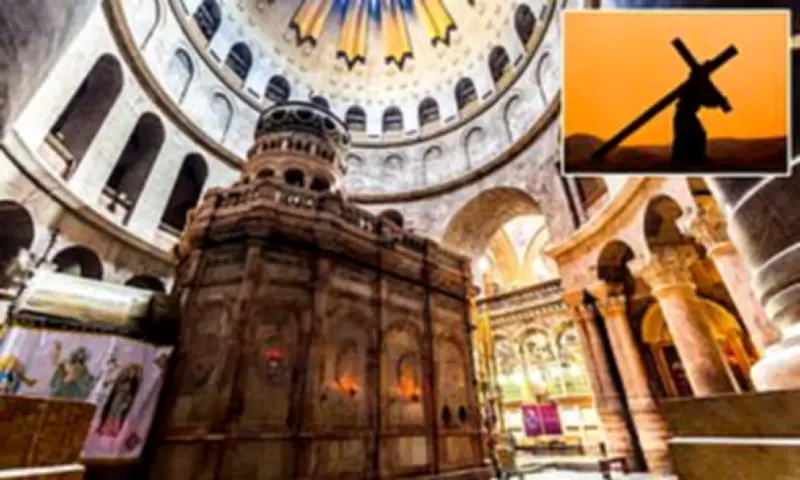
The site of the crucifixion is now identified as the Church of the Holy Sepulchre, built in 326 AD. After his death, Jesus was laid to rest in a rock tomb about 300 feet from Calvary. While many Christians believe the Church of the Holy Sepulchre marks his burial place, others point to the Garden Tomb, located outside the Old City walls near the Damascus Gate.
Christian tradition holds that Jesus' body was placed on a limestone slab within a structure called the Edicule, meaning 'little house.' Scholars propose that this entire journey began late on Thursday evening and concluded with Jesus' death on Friday, mapping a path that continues to resonate deeply with believers worldwide.






