
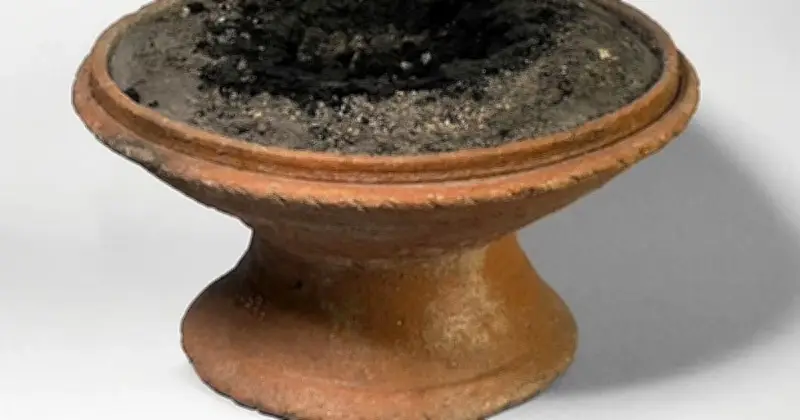
Scientists have uncovered new clues about what the ancient city of Pompeii may have smelled like before it was destroyed by the catastrophic eruption of Mount Vesuvius nearly 2,000 years ago. The findings suggest that the people of Pompeii burned a variety of natural materials as incense, filling homes, temples, and public spaces with fragrant aromas.
Rare sensory glimpse into daily life
The study provides a rare sensory glimpse into daily life in the ancient Roman city, helping historians better understand the scents and cultural practices that were part of Pompeian society before it was buried under volcanic ash in AD 79.
Researchers from the University of Zurich studied two terracotta incense burners that had been excavated decades earlier from Pompeii and the nearby town of Boscoreale.
Incense burners found in Pompeii and Boscoreale
One of the burners was discovered in a building that was in the process of being converted into an inn when Mount Vesuvius erupted in AD 79. The second incense burner was found still in place within a household shrine at a rural villa, offering a rare snapshot of domestic religious practices in ancient Roman society.
By analysing residues preserved inside the two terracotta incense burners, researchers discovered traces of several woody plants, including oak and laurel, as well as stone-fruit species such as mulberry.
Chemical analysis reveals aromatic substances
Co-author Philipp W. Stockhammer, from LMU Munich, said: "The combination of advanced chemical and microscopic analytical methods makes the religious daily life of the people of Pompeii tangible."
Lead author Dr Johannes Eber said: "Ancient literary sources and visual representations show that the Romans burnt aromatic substances, such as frankincense, as well as various plants and herbs on their altars as offerings to the gods. At several Pompeian altars, ashes and burnt residues have been preserved, though they have only rarely been subjected to detailed analysis."
Trade networks revealed
Using advanced chemical analysis techniques, the researchers examined organic residues preserved inside the ancient vessels to determine which plants and aromatic substances had originally been burned. They compared the chemical signatures of these residues with those of modern plant materials and known resins, enabling them to identify a blend of woody plants, members of the stone-fruit family, and various grasses.
Their investigation also revealed that a frankincense-like substance used more than 2,000 years ago did not originate from southern Arabia, the primary source of frankincense throughout much of the Roman Empire. The evidence also suggests that it was likely imported from either India or sub-Saharan Africa, highlighting the extensive trade networks that connected the Roman world with distant regions.




