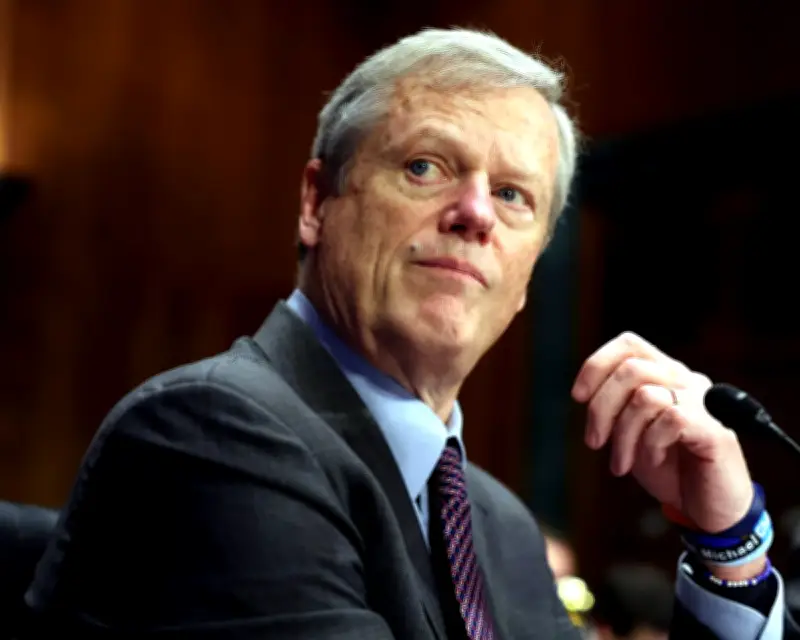
NCAA president Charlie Baker said Sunday that the organization does not plan to change its rules on transgender athletes following a recent U.S. Supreme Court decision that allows states to ban them from school sports.
NCAA's Current Policy on Trans Athletes
In an interview with CBS News' Face the Nation, Baker noted that the NCAA effectively banned transgender athletes from women's sports in late January 2025 by barring athletes assigned male at birth or those undergoing testosterone therapy. There are no restrictions for men's sports, which Baker called "the open network."
The policy was adopted in response to an executive order signed by President Donald Trump early in his second term. "We needed some sort of clarity around what the national standard for this would be – and we adopted and comply with the standard that was put forth by the administration," Baker, a former Republican governor of Massachusetts, told CBS senior political correspondent Ed O'Keefe.

Supreme Court Ruling and Its Impact
The Supreme Court ruled 6-3 on June 30 to uphold laws in West Virginia and Idaho that exclude transgender girls and women from female sports. The decision overturned lower court rulings in favor of two transgender students who had sued after being barred from competing. The majority held that such bans do not violate Title IX, the federal law prohibiting sex-based discrimination in education.
At least 25 other states have similar laws, and the ruling is expected to encourage further restrictions. However, its effect on ongoing litigation in states like California and Connecticut remains unclear.
Baker's Remarks on Inclusivity
O'Keefe noted that Baker told Congress in 2024 that only 10 transgender athletes were among more than 500,000 NCAA student athletes. The issue gained prominence partly due to former collegiate swimmer Riley Gaines, who tied for fifth place with transgender swimmer Lia Thomas at the 2022 NCAA championships.
When asked to rank the importance of the transgender issue among challenges facing the NCAA, Baker said, "I can tell you that having talked to people on both sides of this issue – to those who are involved in it, it matters a lot." Asked if the NCAA's policy is inclusive enough, Baker replied, "Yeah, I do. I don't have a problem … with the way that policy currently operates. And frankly, I don't think many of our schools do either."
Broader Context
Many female sports at high school and lower levels are governed by organizations outside the NCAA. The Supreme Court's decision represents a victory for Trump, who campaigned on the issue of "men in women's sports." Liberal justices dissented from the ruling.