
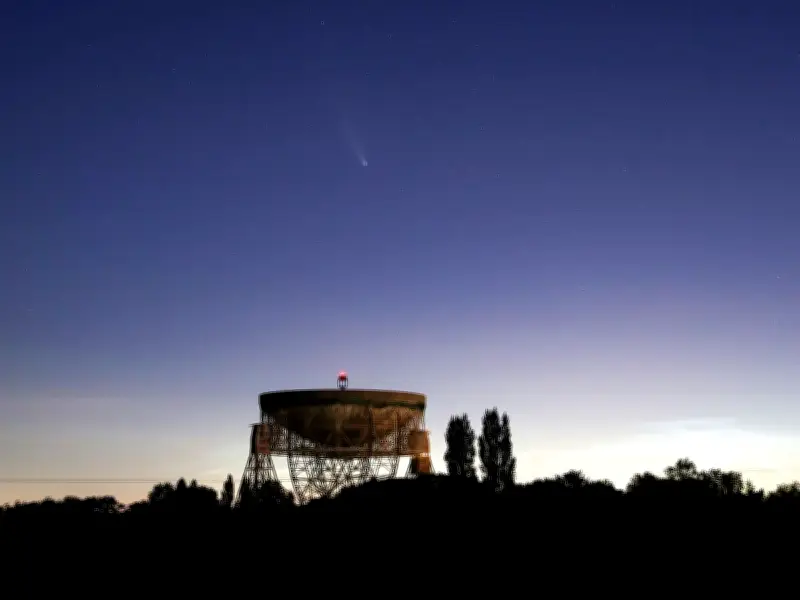
Jodrell Bank Observatory, home to the Lovell Telescope, could halt all scientific observations from April 2028 after UK Research and Innovation (UKRI) announced it will end its £2.8m-a-year funding for the e-MERLIN radio telescope network. The University of Manchester warned this would end the space telescope's role as an "active scientific instrument for radio astronomy", putting 28 jobs at risk.
Five landmark contributions
From capturing the first Moon pictures to a secret Cold War role, here are five of the Cheshire observatory's biggest contributions.
1. World's third-largest steerable radio telescope
Standing since 1957, the Lovell Telescope is the UK's largest and the world's third-largest steerable radio telescope. It earned Jodrell Bank UNESCO World Heritage status in 2019.
2. First images from the Moon
In 1966, Jodrell Bank received the first images from the Moon's surface, taken by the Soviet Union's Luna 9. The observatory intercepted and released them before the Soviets.
3. Cold War early warning defence
The telescope was the UK's only device able to detect long-range missile attacks, serving as an early warning system for five years at the height of tensions, providing a four-minute alert for a nuclear strike.
4. Unlocking cosmic mysteries
Jodrell Bank has pioneered radio astronomy since the 1940s, studying distant galaxies, black holes, quasars, pulsars and gravitational lenses.
5. Leading deep space research
The Lovell Telescope leads e-MERLIN, a network of seven radio telescopes across 135 miles, connected by high-speed fibre. This research now faces extinction unless alternative funding is found.
Funding uncertainty
The Jodrell Bank Centre for Engagement remains unaffected and open for educational trips. A UKRI spokesperson said: "STFC has undertaken a rigorous prioritisation process to focus investment on the areas that will deliver the greatest long-term scientific capability, impact and value for the UK, while maintaining a sustainable PPAN portfolio. The decision to withdraw funding from e-MERLIN at the end of its current funding agreement is the result of a comprehensive, evidence-based prioritisation process. As part of this, STFC is focusing investment on the areas that will deliver the greatest long-term scientific capability and value, including the next generation of world-leading radio astronomy facilities. STFC continues to invest in Jodrell Bank's future through its support for the UK's hosting of the SKAO headquarters, which is already delivering significant benefits to the University of Manchester and the North West. The current e-MERLIN funding agreement runs until March 2028, providing time to explore alternative funding arrangements."




