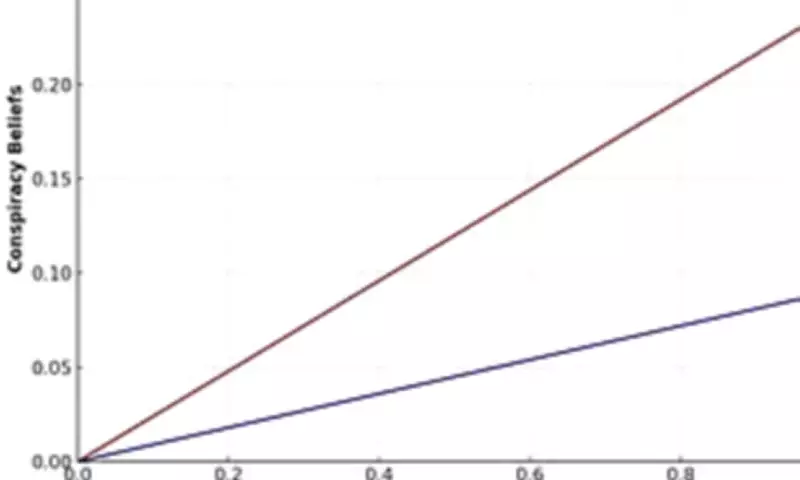
Individuals who subscribe to flat Earth theories or believe in alien-controlled governments may be exhibiting a deep-seated need for control and structure, according to groundbreaking new psychological research. A comprehensive study has uncovered that conspiracy theories often appeal to people who prefer rule-based, ordered explanations for events that otherwise appear random or chaotic.
The Role of Systemising in Conspiracy Belief
Led by Dr Neophytos Georgiou, an expert in conspiracy belief research at Flinders University in South Australia, the investigation examined more than 550 participants to understand the psychological drivers behind conspiracy thinking. Contrary to common assumptions, the findings suggest that belief in such theories is not necessarily linked to poor reasoning or lack of critical thinking.
Instead, the study highlights the significant influence of a cognitive style known as 'systemising' – a trait strongly associated with autism spectrum conditions. This thinking style involves a powerful drive to identify patterns, establish consistent rules, and create orderly frameworks to interpret complex or unpredictable occurrences.

Pattern-Seeking Minds and Conspiracy Appeal
'People often assume conspiracy beliefs form because someone isn't thinking critically,' Dr Georgiou explained. 'But our findings show that for those who prefer systematic structure, conspiracy theories can feel like a highly organised way to understand confusing or unpredictable events.'
The research team identified distinct thinking profiles among participants and discovered that individuals with strong preferences for patterns and structure demonstrated significantly higher likelihoods of endorsing conspiracy narratives. Remarkably, this correlation persisted even among those who exhibited robust scientific reasoning abilities.
'What stood out is that people who systemise strongly want the world to make sense in a very consistent way,' Dr Georgiou noted. 'Conspiracy theories often offer that sense of order. They tie loose ends together in what appears to be a logical, comprehensive framework.'
Rigidity in Belief Updating
The investigation further revealed that individuals with pronounced systemising tendencies displayed reduced flexibility when confronted with contradictory evidence. In experimental tasks requiring participants to revise their views based on new information, those scoring high on systemising measures demonstrated significantly lower willingness to adjust their perspectives.
'This may help explain why conspiracy beliefs can persist even when contradictory information is available,' Dr Georgiou added. 'Even when someone has strong reasoning ability, their desire for strict, consistent explanations can overshadow their capacity to question those beliefs.'
Psychological Needs and Misinformation Interventions
For people who naturally seek structure and predictability, conspiracy theories prove particularly appealing because they 'feel ordered, logical and consistent for events that feel chaotic,' the researcher explained. The team published their comprehensive findings in the academic journal Cognitive Processing, hoping their insights will inform more effective approaches to combating misinformation.
'Rather than relying only on fact-checking or logic-based interventions, strategies may need to reflect how people prefer to process information,' Dr Georgiou concluded. 'Conspiracy beliefs meet psychological needs for order and control, and if we ignore that fundamental aspect, we overlook what actually makes these narratives persuasive to certain individuals.'
Understanding Conspiracy Theory Psychology
Previous research from the University of Kent has identified additional psychological factors contributing to conspiracy belief, including connections to narcissism and self-esteem levels. Their studies revealed that individuals scoring high on narcissism scales while exhibiting low self-esteem demonstrated increased susceptibility to conspiracy narratives.
Psychological experts generally identify three primary motivations driving conspiracy belief:

- The desire for understanding and certainty – Humans naturally seek explanations for significant events, and conspiracy theories provide seemingly comprehensive answers.
- The desire for control and security – Believing in hidden patterns can create an illusion of predictability and control in an uncertain world.
- The desire to maintain positive self-image – For socially marginalised individuals, conspiracy communities can offer validation and a sense of belonging.
These psychological needs, combined with systemising thinking styles, create powerful conditions for conspiracy beliefs to take root and persist despite contradictory evidence. The new research suggests that effective interventions must address these underlying psychological drivers rather than simply presenting factual corrections.