
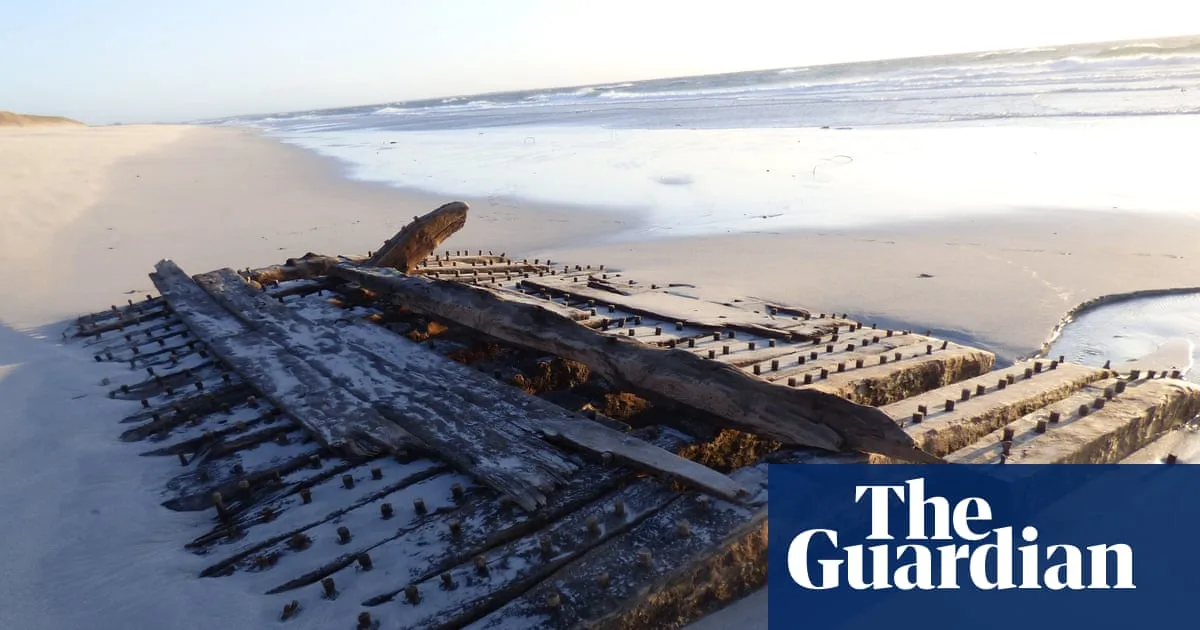
A shipwreck discovered on a beach on the island of Sanday in Orkney has been identified as an 18th-century Royal Navy frigate that later became a whaler. The timbers, exposed after a storm in February 2024, were examined by archaeologists and local volunteers who determined they belonged to HMS Hind, a 24-gun frigate built in Chichester in 1749.
The Hind had a remarkable career, serving off Jamaica in the 1750s and taking part in the sieges of Louisbourg (1758) and Quebec (1759) during the Seven Years' War. It later served in the American Revolutionary War and as a training ship in the Irish Sea before being decommissioned and sold to become a whaling vessel named The Earl of Chatham.
On 29 April 1788, the ship was wrecked in a North Sea storm off Sanday, but all 56 people on board survived, according to the Aberdeen Journal. The wreck was identified through dendrochronological analysis of wood samples, which showed the timber originated from southern and south-western England, with the earliest sample felled in spring 1748.
Ben Saunders, senior marine archaeologist at Wessex Archaeology, described the Hind as 'an amazingly long-lived and lucky ship'. The project, led by Wessex Archaeology and Historic Environment Scotland, involved 20 volunteer researchers who combed maritime archives to narrow down the vessel among at least 270 shipwrecks on Sanday.
The timbers are now being preserved underwater at the Sanday heritage centre. Alison Turnbull of Historic Environment Scotland praised the community's role, saying 'communities hold the keys to their own heritage'.




