
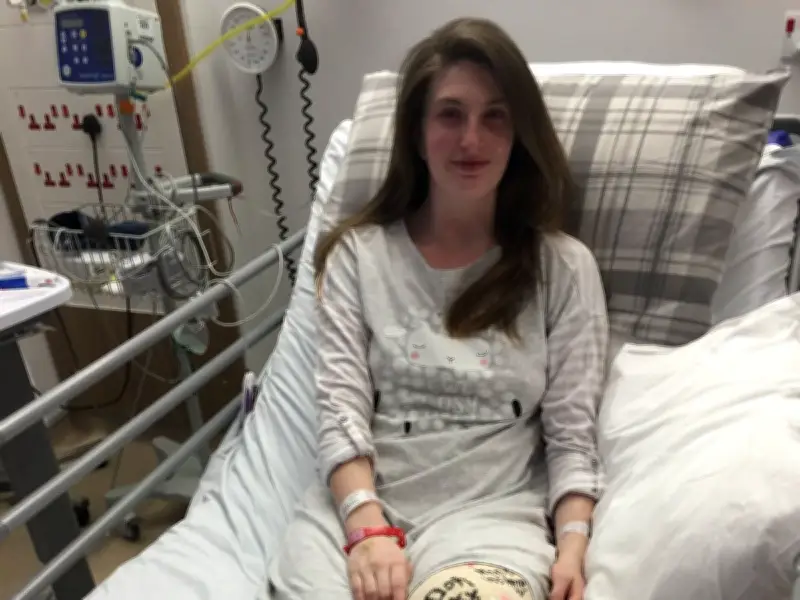
A woman from Bromborough who experienced a "dull ache" in her knee was later diagnosed with a "one in a million" disease. Bethany Middleton, now 29, first noticed symptoms when she was 19. The pain was initially "intermittent" and would "occur out of the blue." However, one Christmas, she struggled to bend her knee and get down on the floor.
Struggle for Diagnosis
In January 2017, Bethany noticed a lump and went "back and forth" to doctors. She was told it might be arthritis, a pulled muscle, or a strain. Dissatisfied, she made another appointment and was referred for an X-ray. Before she could get the results, her condition worsened while staying at her boyfriend Ashley's house. "I went to take a break upstairs. And as I sat down, my knee shattered," she said.
Emergency and Diagnosis
Bethany knew something was wrong and was taken to hospital. The call handler initially thought she had a pulled muscle and suggested paracetamol. Paramedics fitted a brace, which broke her leg further. X-rays confirmed a pathological fracture caused by a tumour. Transferred to a bone cancer centre, she broke her leg again. A biopsy revealed a giant cell tumour of the bone, a rare and aggressive condition.
Surgery and Recovery
Bethany underwent surgery to fit an artificial knee and thigh bone, with a risk of amputation. The surgery was successful, but she was told 99% of patients struggle with full mobility. "I said, 'well, 1% can,'" she recalled, determined to prove them wrong.
Life After Diagnosis
Nine years later, Bethany is married to Ashley with two children, Noah (5) and Jude (1), and expecting a third. Reflecting on her journey, she said, "Time stops when you get a diagnosis, your life stops, everything stops, but everything around you still keeps moving." She urged others to keep pushing for answers.
Charity Gala
Bethany is organizing a charity gala at Thornton Hall Hotel on July 4, hosted by Dr. Liz O'Riordan, with support from healthcare campaigner Chris Pointon and comedian Matt Forde. According to Sarcoma UK, giant cell tumours are usually not cancerous but can grow quickly and damage bone.




