
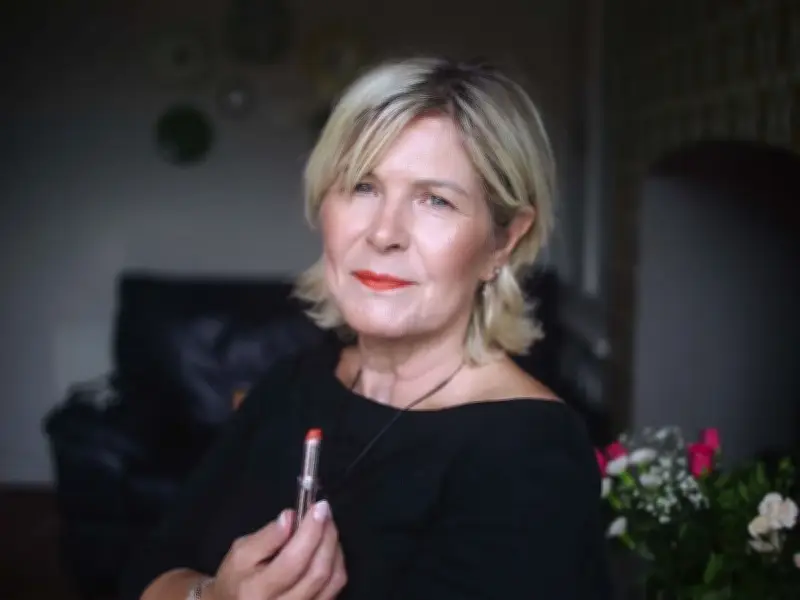
A woman from Low Fell who lives with a rare form of terminal cancer has defied doctors' predictions that she would never walk again and is now backing a campaign highlighting the importance of rituals such as her make-up routine during illness.
Anita Geldard, 66, was diagnosed with a rare form of terminal lymphoma in 2024. The cancer, which affects her central nervous system, left her unable to walk and profoundly deaf. Doctors told her she was unlikely to walk again, but through sheer determination she has managed to do so.
Anita has now starred in the new campaign from end-of-life charity Marie Curie, which highlights the vital rituals – in her case make-up – that help people in similar situations to get through tough days and dark diagnoses.
Three-year struggle to diagnosis
Anita, who worked as a civil servant on Tyneside for 42 years, told ChronicleLive how a three-year struggle to find out what was wrong with her culminated in the shocking news that she had a rare cancer. As symptoms worsened, she was left in a hospital bed unable to even raise her leg.
She said: "The first symptom I had was the hearing loss. Then I started walking 'funny' - and experienced balance problems. In my case, with the symptoms I did feel there were some missed opportunities and in the end my daughter took me up to A&E on a Friday night. My right leg had effectively started collapsing."
Anita was eventually taken to the RVI in Newcastle, where an MRI scan revealed that she had cancer. She spent two weeks at the city centre hospital before being transferred to the Freeman in Gosforth, where she spent more than three months.
Defying the odds
Anita said it was during this time that the prognosis did not look good. She said: "It's such a rare disease but the consultant said I literally tick all the symptoms. After two weeks in the RVI, I was transferred to the Freeman where I spent three-and-a-half months. When I came out I had to be in a care home for a period - and was told I wasn't going to walk again."
She added: "I was in the home for about five weeks then, with care support, was able to go home. I think this is the case for any major and traumatic experience, but in my case I don't think I really processed it all at the time, you do that in little bits. I believe that's how our brains protect ourselves from the trauma. I was so ill I couldn't even lift my leg off the bed."
"Everyone tells me that walking again is due to the determination. The consultants have been blown away. I remember hearing them tell me I wouldn't walk again and thinking 'that's hard to hear'. But it took me a week and I thought 'stuff that, I'm going to do this'."
Anita's attitude and intensive rehabilitation have seen her surpass all expectations – she is now able, with a few breaks, to walk to local shops, and retaining elements of independence despite her illness has been vital to her.
She added: "To look at me, you'd not think there's anything wrong. From where I was to where I am now, I have come on leaps and bounds."
"It's a new normal - I had to give up driving and I had lots of adaptations in the house, such as a stairlift, but I live independently, I walk around the house independently. I have had to carve out a new normal - and in that the hardest thing is the loss of independence. But I have lots to keep me busy: I read, I cook, I potter!"
The Last Lipstick campaign
Anita was invited to take part in the campaign by Marie Curie in Newcastle – she is a regular attendee at hospice services and is even looking forward to taking part in yoga in the coming weeks.
She said taking part in the "last lipstick" campaign had meant a great deal to her. She said: "This campaign is very important. When I was in hospital, I had to have everything done for me and I couldn't get out of bed. And of course, they're not going to come and give you a facial! And then this disease takes so much from you as a person."
"When I came out of hospital, I went on a bit of shopping spree, to be honest - and I got my skin back! It's always been important to me, to have that routine. If I don't get ready and do my routine properly, it's the sort of thing that makes me anxious! Even if I'm not going out, I put on a bit of blusher, a bit of lippy and it gives me confidence. I can't put into words how important that is, in terms of being who you are."
"I can't speak highly enough of Marie Curie. It's the most amazing organisation." Anita added: "From the age of 12, I've always loved makeup and old-fashioned glamour. Always glow up and show up, which is what I do every day. And grab life while you can because things can change in an instant."
The Last Lipstick campaign has been inspired by a photography collection by Stacy Greene called Lipstick. Photographer Alexandra Cameron has taken pictures of people including Anita to highlight how make-up can "provide comfort and help people hold on to a sense of identity and normality in the final chapter of their lives".
It comes amid polling shared by Marie Curie and retailer Superdrug which highlighted how 80% of bereaved people believe beauty and self-care rituals help people at the end of their lives to maintain a sense of independence.
Photographer Alexandra Cameron said: "Photographing this series has been a powerful experience. Each lipstick represents a woman, but also a lifetime of memories, routines and moments of self-expression. These are not simply lipsticks; they are products that form part of people's identities and how they choose to show up in the world – right up until the end."
Stacy Greene, whose work inspired the collection, said: "When I created Lipstick, I was interested in the individuality contained within these small objects: the way each one is shaped by the person who uses it and the life they lead. It is wonderful to see that idea revisited through The Last Lipstick."
"What makes this series so powerful is the reminder that our sense of identity does not disappear at the end of life. The smallest, most familiar rituals can continue to bring comfort, connection and a sense of self right up until those final moments – and these photographs capture that beautifully."
Pavla Crowley, a Marie Curie Healthcare Assistant who features in the collection, said: "After my mum died, I couldn't bear to get rid of the makeup bag she used to leave at my home when she visited from the Czech Republic, including her favourite lipstick."
"As a Marie Curie Healthcare Assistant, I see every day how small comforts like lip balm or a touch of colour can help women feel more like themselves at the end of life. For my mum, lipstick was part of who she was, and I see that same importance in so many of the people I care for. Sometimes these little rituals help us hold on to who we are, right until the end."
Simon Comins, chief operating officer at Superdrug, said: "At Superdrug, we believe beauty is about much more than appearance. It can be a source of confidence, comfort and self-expression at every stage of life. We are proud to support Marie Curie in sharing these remarkable stories and shining a light on the importance of something as small as a lipstick."




