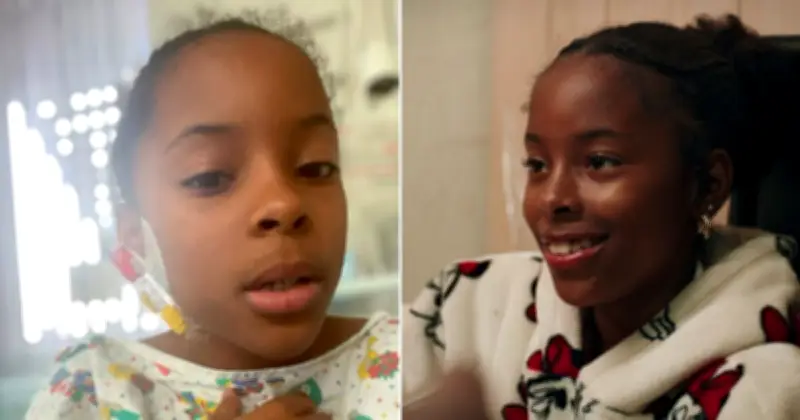
Tayshelice Hewitt, 12, is raising awareness that children can have strokes too, as an ice sculpture inspired by her brain goes on display. The schoolgirl has been left with lasting effects, including memory loss, after suffering two strokes linked to sickle cell disease at the age of eight.
She is the youngest of five survivors whose brain scans inspired the sculpture unveiled on London’s Southbank ahead of World Stroke Day on Thursday. Tayshelice said her friends were “very understanding” when she explained what had happened, but she wants more people to know that “not only older people have strokes”.
Two Strokes at Age Eight
She told the Express: "Not many people know that younger children or smaller babies can have strokes. It has had a very big effect on me because I was off balance for a while, I couldn’t hear, my memory was off, and the left side of my body dropped. It was scary."
Tayshelice’s mum, Tameka, 45, realised something was wrong when her daughter woke her up in the middle of the night. Tameka said: “I noticed that she couldn’t hear me properly. I had to repeat myself four or five times, and she was lip-reading. She was falling over, unbalanced. She wasn’t able to walk in a straight line. I knew that it could be a possibility for children with full-blown sickle cell to have a stroke.”
Brain scans confirmed Tayshelice had suffered two major silent strokes linked to sickle cell disease, an inherited blood disorder that affects red blood cells. She spent a month in hospital and underwent a red cell exchange to replace abnormal cells with healthy donor ones.
Recovery and Ongoing Effects
Tayshelice’s recovery process included regular hearing tests and physiotherapy to regain muscle strength in the left side of her body. But a psychological assessment last month showed her cognitive function has not recovered. The youngster now raises awareness of sickle cell and strokes in videos on YouTube and social media.
Tameka said: “We just try to cope on a daily basis. Tayshelice is very resilient – she doesn’t let anything hold her back.”
More than 100,000 people have a stroke every year in the UK. Despite one in four strokes happening to people of working age, a survey of 2,000 people for the Stroke Association found a third of Brits aged 18-34 (34%) and almost a quarter of 35-44-year-olds (24%) thought they were too young to have one.
Another Survivor's Story
Another survivor whose brain scan was used to create the 2.5m ice sculpture is Jim Hunter, 70, from County Tyrone. He had a stroke three years ago after leading an active lifestyle playing, coaching football and training at the gym. It left him with chronic fatigue, reduced independence, and psychological challenges.
Jim said he wants more people to know that a stroke can take a heavy mental toll, as well as having physical effects. He struggled with intense emotions that triggered meltdowns he could not understand. He said: “It was so intense. It got to the stage where my family were afraid to be seen out with me in case I had another breakdown, and it really affected them."
Jim eventually learned to cope with such episodes by understanding that they are a side effect of the damage his brain sustained. He added: “Psychologically, more needs to be done for stroke survivors because it’s such a big part of recovery. I wish I’d understood sooner that the emotional changes and meltdowns I was experiencing were part of what can happen after a stroke. Knowing I wasn’t alone made a huge difference.”
Campaign's Message
Stroke Association chief executive Juliet Bouverie said: "We’ve created this ice sculpture as a stark reminder of how fragile the brain can be. A stroke isn't only a medical emergency from which you either die or survive, but instead the start of a long and gruelling journey to rebuilding a life. For so many stroke survivors, the fight doesn’t end when their lives are saved, yet every day survivors and their families are left traumatised and without the long-term rehabilitation and support they need. After everything a stroke takes, no-one should have to fight for essential support to recover and live a full life again."