
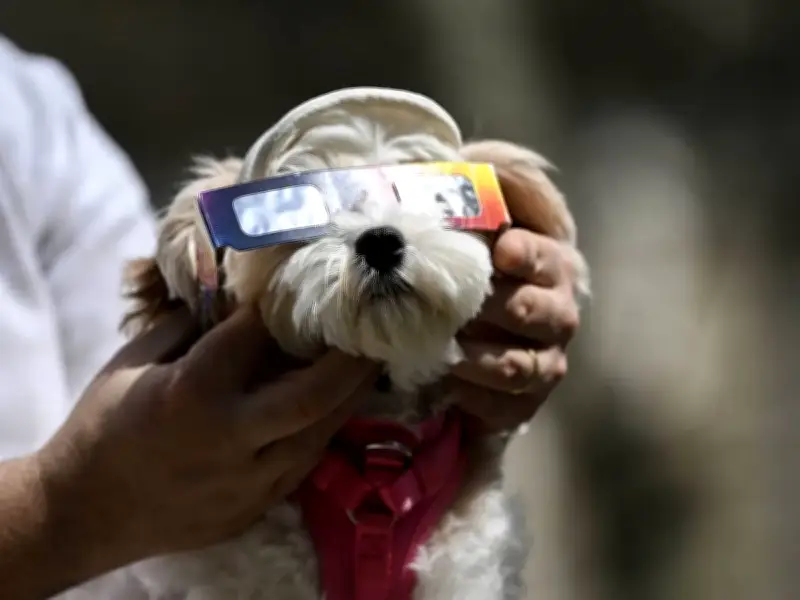
Pet owners have been warned that today's solar eclipse could spark some strange behaviour in their furry companions. Owners are being advised to keep their pets safe during the event, with a vet also urging cat and dog owners not to bother buying them safety glasses because they won't need them like humans.
Vets advise against pet eyewear
With massive crowds expected to gaze upwards, veterinarians warn the genuine threat to animals isn't the eclipse itself - it's owners attempting to involve their pets in the experience, or bringing them to crowded viewing locations where the abrupt shift in lighting and commotion could disturb them.
Specialists emphasise that most pets won't stare directly at the Sun the way humans might, making the risk of eye damage that can affect people remarkably minimal. The most straightforward strategy, they suggest, is to handle the evening like any ordinary day: maintain control of dogs if you're outdoors, avoid encouraging animals to gaze upwards, and if a pet appears frightened by the temporary darkening of daylight, lead it somewhere familiar and peaceful until conditions return to normal.
What experts say about animal behaviour
Ángela González, associate professor at the Faculty of Veterinary Medicine at the University of Santiago de Compostela and a veterinary surgeon at the Rof Codina University Veterinary Hospital in Lugo, Spain, said animals are guided by instinct. "There would be risks if they were to stare at it, but they wouldn't normally do that," she said. "Normally, a dog would just be sniffing around and wouldn't be staring up at the sky."
She also urged owners not to buy protective eyewear for pets. "There's no need to put glasses on them, and besides, most of them aren't used to wearing them," she said, adding that owners should never force an animal to look at the eclipse. Prof González said some particularly sensitive pets could be startled by the sudden darkness. "It is true that a sudden change in light may frighten them, but normally nothing happens," she said. If an animal does become anxious or disorientated, she recommends simply keeping it in a familiar, quiet environment until it settles down.
Advice from US groups and past eclipse observations
Similar advice has been issued by US veterinary groups, including the American Kennel Club, which states pets don't require eclipse glasses because they're not naturally inclined to gaze at the Sun. Instead, owners are advised to avoid taking nervous animals into crowded public viewing events, keep dogs close during walks and allow pets to behave as they normally would.
Studies of previous eclipses indicate that animals primarily respond to the sudden onset of "night-time" rather than demonstrating any particular foresight. During the 2017 total solar eclipse in the United States, researchers observed birds falling silent and returning to their nests, while crickets and cicadas started making their typical evening noises. Dogs often sought reassurance from their owners or lay down, cats usually sought shelter, and livestock headed back towards barns — all behaviours interpreted as normal responses to a brief reduction in daylight.
Experts also debunk old myths about animals "predicting" eclipses, stating they don't hold up scientifically. The behaviours observed are better explained as reactions to unusual light levels and changes in routine.
Human safety reminders and eclipse timings
The UK Health Security Agency has also cautioned people not to confuse guidance intended for humans with advice for pets. People should never look directly at the Sun during an eclipse without certified ISO 12312-2 eclipse glasses or another approved method, as permanent eye damage can occur within seconds. Ordinary sunglasses are not safe.
The guidance emerges as Britain braces for what's being described as the most spectacular eclipse witnessed here in almost 30 years. Throughout substantial areas of the UK, approximately 90% of the Sun is anticipated to be obscured on the evening of August 12 - the most profound eclipse visible since the widely recalled 1999 event. The partial eclipse will start at around 6.17pm in London, reach its peak shortly after 7.12pm and conclude just after 8pm, although timings may vary slightly across the UK. The further south-west you are, the larger the portion of the Sun that will be obscured.




