
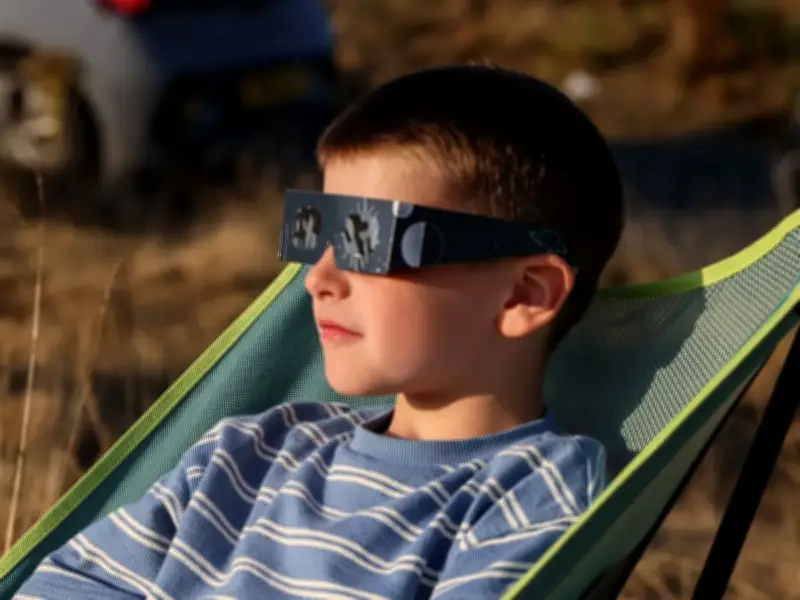
Eye health experts have warned that people who stared directly at the solar eclipse without certified filters risk damaging their vision. The partial eclipse, which saw the Moon pass between the Earth and the Sun, was viewed by thousands across the UK.
Why direct viewing is dangerous
Nkosi Yearwood, optometrist and council member for Wales at The College of Optometrists, explained that the Sun emits more than visible light. "There are also ultraviolet rays, infrared rays, and it’s this whole spectrum that is harmful to our eyes," he said.
"Because the sun starts dimming in the eclipse, many people think that it’s safe to look at, but actually even if it’s a 90% coverage, you’ve still got 10% of the sun that you’re staring at, and that’s still a lot of energy."
Patrick Laidlaw, optometrist at Optegra Eye Clinic Sheffield, said looking directly can cause "damage to the back of the eye" and lead to retinopathy. "If you look at it for too long you could even develop a central bit of field loss," he added.
Symptoms to watch for
Damage occurs because intense light can burn the macula, the part of the eye responsible for central vision. Yearwood noted that in the days after the last eclipse in the 1990s, around 70 people in the UK presented to eye departments with solar retinopathy, and about 40% had looked at it for less than a minute.
Symptoms can be delayed by hours or days. "The retina doesn’t have any pain receptors, so you can do this damage and not know about it," said Yearwood. Signs include "blurring in vision, distortion, a dark spot or a change in your colour vision." Laidlaw also advised watching for "severe light sensitivity or any reduction in vision."
Treatment and recovery
Optometrists check for changes to the macular region, which "generally shows up as a yellowish spot," according to Yearwood. There is no treatment, but the damage can heal itself in most cases, similar to sunburn. "The length of time to heal and how high the chance of healing depends on how long you look at the eclipse for," he said.
"So, if you did end up staring at it for too long, you do risk permanent vision damage. If you are worried, go to your local opticians and let them assess you."




