
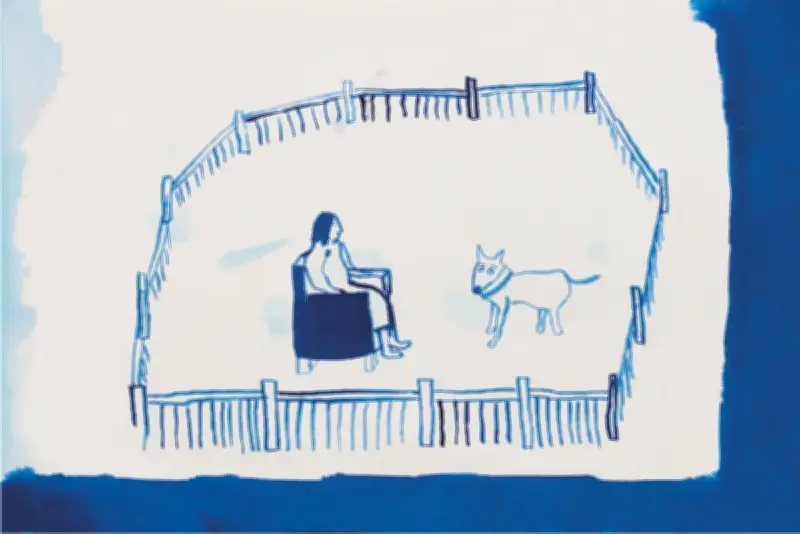
Carrie Tiffany was unable to visit her mother in Perth during the two-year Covid border closure, but a rescue dog named Sally helped her glimpse her mother's emotional state as dementia progressed. Tiffany's new novella, The Lady with the Dog, with illustrations by Noel McKenna, is published in Australia by NewSouth Books, $29.99.
A Dog Long Wanted
My mother had wanted a dog for years. She lived in Perth, far from her grown children and grandchildren. She had retired early, had few interests, and didn't go out much. She imagined a sleek whippet curled at her feet while watching television, with a pretty collar and a knitted coat. My stepfather was less keen. He stalled the dog issue for over a year while building a high fence, then spent another six months fine-tuning a solar-powered sliding electronic gate. I would ring and berate him, saying, "Please, why can't you just get on with it. She wants a dog. Just get her a dog."
What I didn't know was that the forbidding fence and keypad-operated gate weren't just to contain a dog. They were to contain my mother.
Meeting Sally
Dogs became scarce during the Covid pandemic. In the winter of 2020, my mother and stepfather drove several hours to collect Sally from a rescue shelter in a distant town. She was a chunky, ageing German shepherd, perhaps 10 or 11, with dense black fur, a grey muzzle, hard of hearing and stiff hips. Sally had been let go from a farm as she could no longer jump into the back of the ute. My stepfather lifted her onto a picnic blanket on the backseat and they drove home.
A few days later I rang my mother to ask about the new dog. "It's a little yellow puppy," she said. "It's very naughty, but it might be better when its tapes have been tied."
My stepfather had decided to wait to tell my brother and me about my mother's diagnosis until our next visit. But there was no visit. The West Australian border closed in March 2020 and did not open for two years. My mother's telephone calls became increasingly strange. Our grandmother had died of Alzheimer's disease. We guessed correctly that our mother was dying from it too.
Animals as Portals
We had always been a dog family. The men in my mother's West Yorkshire childhood had tough little terriers. After migrating from the UK to Perth in the early 1970s, we acquired an Irish setter, later an English springer spaniel. Even as a child I knew that animals were portals and metaphors. My mother was often unhappy and struggled to show affection, but she would stroke the family dog and speak gently to it. When I was nearby, I understood that this was meant for me.
The dog had the ability to make each member of our fractured family feel that it loved them the best. I hatched many plans to run away from home with him, but they foundered on the issue of the dog. I felt my loss would be barely noticed, but it was too cruel to deprive my brother and mother of him.
Difficult Conversations
My mother's condition worsened quickly. I spoke to her multiple times a day on the special dementia phone she wore on a cord around her neck. Sometimes she would call me by accident, and I would listen in as she chatted to the dog on their walks around the fence. Some evenings I would hear snoring, unsure if it was Sally or my stepfather asleep in front of the black stove.
Conversation was difficult. We spoke mainly about the dog. I would ask her how it was, what it was up to, hoping to glean something about her own emotional state. The dog, according to my mother, stole from her, told lies about her, could barely be trusted. It only liked men. It was 55 years old. It drove a Cortina. It had gotten a new job. It was a baby that had broken her best cups. Sometimes there were two dogs, or even three. They were always fighting. They didn't get on.
Too Late
My stepfather stopped attending appointments with his heart specialist as my mother became too difficult to manage. She would open the car door on the highway at speed and once hit him in the waiting room when she thought he was too friendly with the receptionist.
I tried to get into WA to help look after my mother, but the government authorities refused my applications. Alzheimer's is a terminal condition. They agreed that my mother was dying, but she wasn't dying fast enough to risk allowing me across the border.
I finally arrived in March 2022, the day after the border re-opened, but it was too late. My stepfather had suffered a serious heart attack several days earlier. He'd managed to call an ambulance using the special phone that hung around my mother's neck. They were admitted to different hospitals and were both dead within weeks.
A kind neighbour took the dear old dog into his home. After a difficult day of hospital visits – my stepfather palliative and struggling to die, my mother climbing walls and attempting to escape – I went across to the neighbour to finally meet Sally. I patted her and thanked her and pressed my face into her dusty old neck. She seemed confused. She didn't know what she had done.




