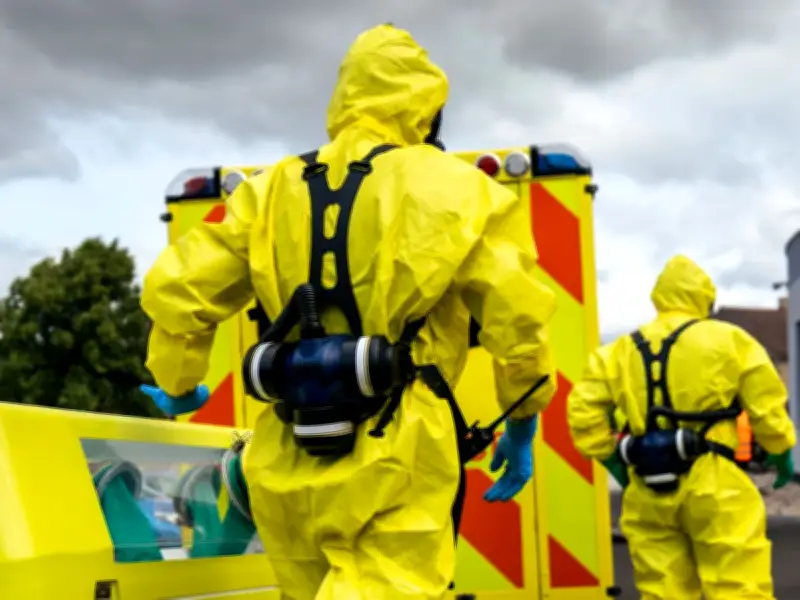
A microbiologist says the illness that was reported to have killed a Russian worker at a plague lab - leading to 200 people being quarantined - is 'rare but severe'. Russian authorities have quarantined a hospital and are monitoring contacts of an employee at a plague research institute in Siberia who contracted pneumonia from an “unknown” cause.
Authorities said they found no evidence that her illness was caused by any of the pathogens she worked with, but there were unconfirmed media reports suggesting she might have died of pneumonic plague. The illness can spread from person to person and has a 100% fatality rate if left untreated.
Quarantine and official response
The woman worked at the Irkutsk Anti-Plague Research Institute of Siberia and the Far East in Irkutsk, south-eastern Siberia. The hospital has been placed under quarantine, Mayor Maxim Modin said, no longer admitting or discharging patients, and its laboratory halted carrying out routine tests.
Anna Popova, head of Russia’s public health watchdog, Rospotrebnadzor, flew to Irkutsk and met with governor Igor Kobzev and other officials on Friday. Mr Kobzev said everyone who came into contact with the woman is under medical supervision. He called it a suspected case of “a particularly dangerous infection”. Rospotrebnadzor was implementing “a full range of anti-epidemic measures”, he added.
What authorities and experts say
Rospotrebnadzor said the woman was diagnosed with “pneumonia of unknown etiology”, or origin, and said “extensive” testing found “no microorganisms associated with the patient’s professional activities”. The agency also said it did not uncover any incidents at the institute “involving pathogenic microorganisms”.
The World Health Organisation describes pneumonic plague as a less common but severe form of plague — a disease caused by Yersinia pestis, a bacterium usually found in small mammals and their fleas. “In the event of a potential laboratory exposure, it would be normal to identify individuals who might have been exposed and to monitor them according to the assessed level of risk,” said Dr Malick Gibani, clinical associate professor in bacterial vaccinology at the Imperial College London.
Ian Jones, professor of virology at the University of Reading, said that “plague carries a huge history and is still present in many parts of the world, including Russia”, although because of modern living conditions and antibiotics, “its potential is therefore limited”.
Thomas Jeffries, Senior Lecturer in Microbiology at Western Sydney University, said a senior Russian official posted on social media last week that Shipilova “had died from the plague” – before editing the post to add “possibly”. Local media reports suggested she was infected following an accident at the lab where she worked.
What is plague and should you worry?
Jeffries said: "Plague is caused by the bacterium Yersinia pestis. The bacteria generally live in ground-dwelling rodents such as rats and prairie dogs, but can also infect humans. The same Y. pestis bacteria can cause three different types of plague. Bubonic plague is spread from animals to humans by fleas, and causes swelling (called buboes) in the lymph nodes. Other symptoms include fever, headache, chills and weakness."
"Bubonic plague can kill within a few days if antibiotics are not used. Between 30–60% of people who contract this form of plague will die. Septicemic plague occurs if bubonic plague is left untreated, or it can occur directly if the disease enters the bloodstream. Septicemic plague causes bleeding into the organs; the name refers to the serious blood infection, septicemia, that this form of the disease can cause."
Pneumonic plague – the suspected but unconfirmed cause of Shipilova’s death in Siberia – can occur when bubonic plague spreads to the lungs. But pneumonic plague can also spread from person to person via tiny respiratory droplets. Pneumonic plague is the rarest but most severe form. The fatality rate is up to 100% if left untreated.
Bubonic plague killed tens of millions of people in the western Mediterranean between 541–750CE and up to half of Europe’s population in the middle ages (the Black Death). A third pandemic spanning the end of the nineteenth century and beginning of the twentieth killed up to 12 million people.
Plague is still endemic to Central Asia, Africa, the Americas and Siberia, where the Russian lab worker died last week. This means it is present at a steady, consistent level in these regions. Cases typically occur in rural and agricultural areas which makes a potential lab leak in an urban area unusual.
Jeffries said: "A 10–14-day course of antibiotics (either oral or intravenous) treats the plague – as long as they are taken soon after infection. However, since 1995, several antibiotic-resistant strains have been detected in the wild.
"In the 1980s, Soviet Union scientists also engineered resistant strains – this history forms the basis of hypothetical scenarios involving biological warfare. However, there is no evidence the strain alleged to have killed Shipilova could not be treated by antibiotics or that the lab is researching biological weapons."
There has only been one documented major outbreak of the pneumonic plague, in the 1910s in China. We still don’t know much about the case in Siberia. But at this stage, there’s little evidence to cause concern about potential for an epidemic (which is localised) or a pandemic (which involves multiple countries).