
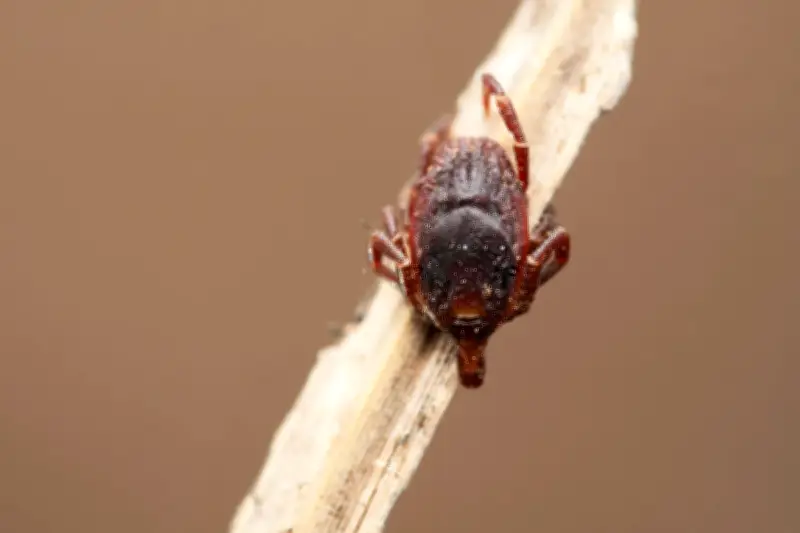
Disease-carrying ticks are living for longer in the UK thanks to heatwaves, an expert has said.
It has previously not been warm enough for hyalomma ticks to survive into adulthood. While still rare, it is something health officials are “starting to pick up a bit more”, according to Dr Jolyon Medlock, head of medical entomology at the UK Health Security Agency (UKHSA).
How ticks arrive in the UK
Hyalomma ticks are the main transmitter of Crimean-Congo haemorrhagic fever, a potentially severe and life-threatening virus. They sometimes arrive in the UK by latching on to migratory birds from the Mediterranean and Africa as nymphs.
This is the middle stage of a tick’s life cycle when they are roughly the size of a poppy seed. Ticks reach the next stage of their life cycle in a process called moulting, when they shed their hard outer covering.
Heatwaves enabling survival
Dr Medlock told the Press Association: “They would normally come in on migratory birds as a nymph, and then fall off, and they wouldn’t be able to moult. It’s not warm enough.
“What we’re seeing now in heatwave years is that they can moult through to the adult stage, and we then could be able to pick up records of adults through our tick surveillance.
“These have happened less than probably five times in the last 10 years or so, but it’s something that we and colleagues across northern Europe are starting to pick up a bit more.
“It doesn’t mean the tick will survive, and it doesn’t necessarily mean it’s an infection risk.”
Surveillance and potential risks
The UKHSA’s Tick Surveillance Scheme was set up in 2005 to map and monitor ticks across the UK. Dr Medlock said there have been records of hyalomma nymphs on migratory birds from observatories over the last 50 years.
He added: “In their native area, they’re vectors of Crimean-Congo haemorrhagic fever virus, which is a relatively common virus that occurs in the Balkans that started to emerge in Spain recently.
“So these are the sort of climate-sensitive tick-borne disease pathogens that we might see.”
According to the World Health Organisation, Crimean-Congo haemorrhagic fever is endemic in Africa, the Balkans, the Middle East and Asia, with a fatality rate of up to 40%.
The virus can incubate anywhere from one to nine days following a tick bite. It can also be transmitted through contact with infected animal blood or tissues.
The onset of symptoms is sudden and can include fever, dizziness, neck pain, a headache and sore eyes, as well as nausea, vomiting, mood swings and confusion.
Shift in tick seasonality
Elsewhere, milder winters and hotter summers may also lead to a “shift in the seasonality” of ticks more broadly in the UK, according to Dr Medlock.
He told PA: “The simple way of collecting ticks is to go and drag a blanket through the undergrowth, and if it’s a hot, humid day, they’re running around quite quickly.
“If you’ve got mild winters, then they will remain active throughout the winter.
“Usually they say 7C is the critical temperature for activity, I’ve seen them active at 3C.
“So as we have milder winters, and hotter, drier summers, we’ll see a shift in the seasonality of ticks.”




