
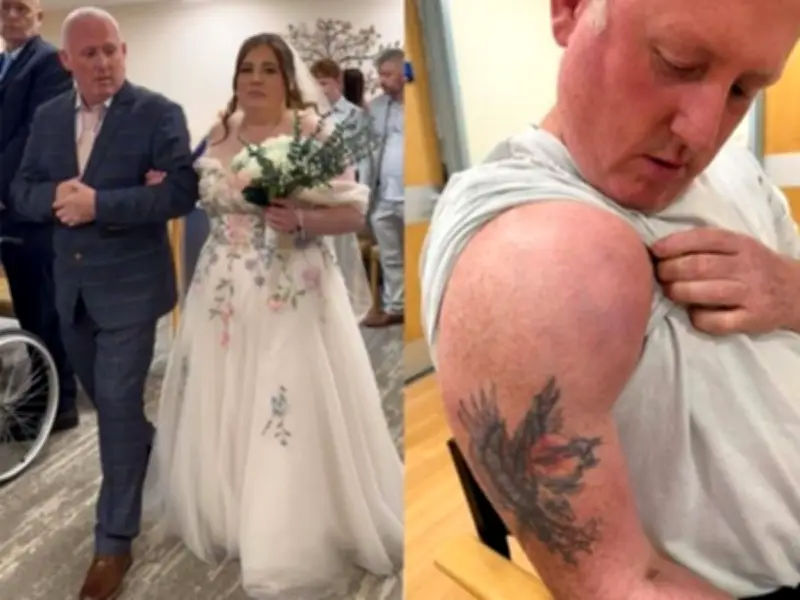
Lee Brain, a school caretaker from Caerau in Bridgend county, said he "couldn't believe it" when doctors diagnosed him with sarcoma this year. The father-of-two first noticed a pain in his shoulder in February while helping to organise staging for a school concert. A small lump developed, but he initially thought nothing of it.
By April, however, the lump had doubled in size. Concerned by the rapid growth, Lee's wife, Emaleen, urged him to see his GP. He was referred for scans and a biopsy, which confirmed the devastating diagnosis.
Devastating diagnosis
"When the doctor told me, I thought he was wrong," Lee said. "Then it sunk in and I started crying. I thought, 'This can't be real.'"
Sarcoma is an uncommon cancer that develops in the body's connective tissues, including fat, muscle, nerves, blood vessels and bone. Patients with confirmed or suspected soft tissue sarcoma across South and Mid Wales are cared for by the South Wales Sarcoma Service, hosted by Swansea Bay.
Consultant plastic, reconstructive and sarcoma surgeon Thomas Bragg carried out the six-hour operation at Morriston Hospital on June 2 after Lee's tumour was found to be growing rapidly.
Six-hour surgery and recovery
"He had a microsurgical reconstruction which involved taking soft tissue from his thigh and placing it onto his shoulder," Mr Bragg shared. "This involved suturing blood vessels into his shoulder using a microscope."
"Because we operated so quickly we hope we have managed to save structures in the shoulder to not only clear the tumour but also maintain function. The next step will be recovery, physiotherapy and radiotherapy."
Despite facing weeks of recovery before beginning radiotherapy, Lee was determined not to miss two of the biggest family milestones of his life.
Family milestones
"I had some incentives," he said. "I had the operation on June 2 and on June 6 our youngest daughter, Bethan, had a little boy, Cian Lee Joseph Page, our first grandchild."
"Then on June 13 our older daughter married her partner, Sean, and I was determined to walk her down the aisle. It was a bit of a struggle and I was in a lot of pain, but I did it."
"So there was a lot happening and if I hadn't had the surgery so quickly I don't think I'd be here now."
While his recovery continues, Lee said he is focusing on staying positive.
Staying positive
"You've got to think positive," he said. "You can't just go and sit in the corner and try not to think about it."
"I'm so grateful to Mr Bragg and all the staff here. They've been amazing. I have felt like I'm in really good hands."
Lee has shared his story to coincide with Sarcoma Awareness Month, which takes place throughout July, and hopes it will encourage others to seek medical advice if they notice anything unusual.
He will also be taking part in the Rare But Real Walk in Swansea on August 22, organised by the South Wales Sarcoma Service in partnership with Sarcoma UK. The event aims to raise awareness of what is often described as the "forgotten cancer", which accounts for fewer than two per cent of adult cancers.
Early diagnosis message
Mr Bragg said early diagnosis could make a significant difference. "The message is a very simple one. If you have a lump which is growing rapidly, or is bigger than five centimetres, or feels deep, or is painful, go and see your GP," he said.
"You might need an ultrasound scan to further characterise it. In maybe two or three per cent of cases it might be sarcoma, in which case you will be referred into our MDT team."
"For most people, though, it is a benign lump. They are reassured and can get on with life. But the earlier the diagnosis, the better for the patient."
Lee echoed that advice, admitting he may never have sought help had it not been for his wife. "Get it checked out if you have any concerns," he said. "If it hadn't been for Emaleen telling me to go to the GP I would have just let it drag on."
Main symptoms of soft tissue sarcoma
According to the NHS, the most common symptom of soft tissue sarcoma is a lump somewhere on your body. This is usually found deep under your skin and the patient may feel the lump before even seeing it.
The lump is typically solid to the touch, painless and hard to move around under the skin. It will continue to grow and as it does, it can become painful.
Other symptoms may include tummy pain and constipation if you get a sarcoma near your tummy, or a cough that does not go away if you get a sarcoma near your lungs.




