
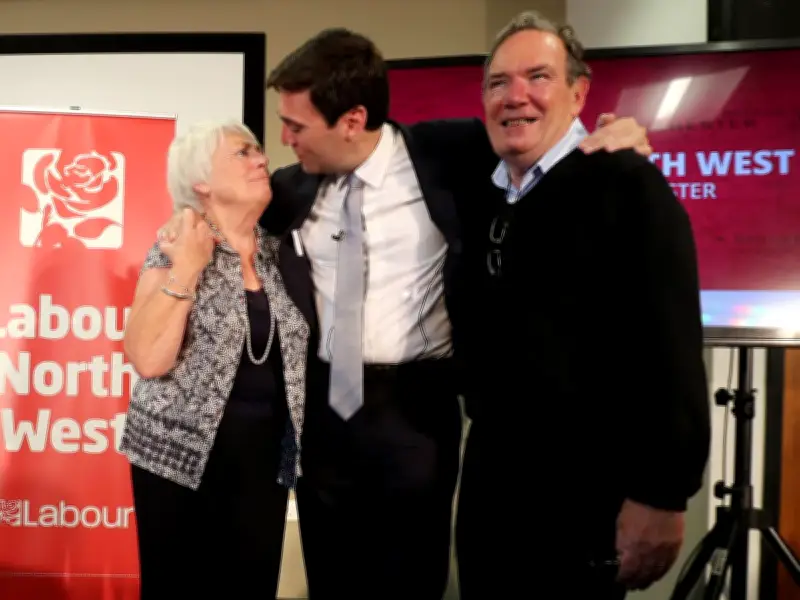
Incoming Prime Minister Andy Burnham has revealed that his father, Roy, does not know he is on the brink of becoming the UK's next prime minister because of Alzheimer's disease. The admission came as Burnham outlined his ambition to reform the adult social care system, drawing on his family's personal experience.
Burnham, who will make his first speech as prime minister on Monday, told The Times that his father is unaware of his son's imminent rise to power. "That's a sadness because he would be (proud)," Burnham said. Attributing his success to his family, he added: "The way I look at it, it's his achievement as well. A whole family achievement although he doesn't know it."
Father's Unawareness of Political Shift
Burnham also noted that his father remains unaware that his son has come around to the idea of proportional representation (PR), which was one of Roy's political passions. "I don't think he's ever realised, because of his condition, that I've come round to PR, which is one of his missions - to get me to accept that," Burnham said.
Burnham recounted a family visit to his father's care home last Sunday, which included his mother, two brothers, and youngest daughter. "We were at his care home. My two brothers were there, my mum was there. So, all five of us together, which was a nice thing," he said.
Social Care Reform as a Priority
Reform of the social care system is unfinished business for Burnham, who set out plans for change while he was health secretary in Gordon Brown's administration. He described the "broken social care system" in England as "the worst of all worlds" and insisted it is a "massive" priority for the public.
Burnham, who will formally take up his role in Number 10 on Monday (July 20), acknowledged that reform will "require something difficult," after his efforts to do so more than a decade ago failed. His 2010 plans to overhaul social care for the elderly with the creation of a national care service for England were turned against Labour by the Conservatives, who claimed they would levy a "death tax" to pay for it. "The minute that poster landed with the gravestones, that was it. My reforms were dead," Burnham later admitted.
Pledge to Expend Political Capital
Burnham has now pledged to "expend political capital" during his premiership on what he said has been a long-neglected sector, accusing Westminster of having "flinched" from such big decisions for too long. Addressing the issue in his first speech after formally replacing Sir Keir Starmer as Labour leader, he told a special conference in London on Friday: "Let's take a problem-solving rather than a point-scoring approach. Let's have the courage to fix the big things that politics has neglected, like social care, and have the conviction to go out there together and argue for our plans."
How adult social care works and is funded in England has been a thorny issue for many governments. Unlike NHS care, social care is not free at the point of use, and high costs sometimes mean people are forced to sell their homes to pay for what they need. People with savings worth more than £23,250 are not entitled to help with the cost of care from their local council.
Previous Reform Attempts
Baroness Louise Casey, who is leading an independent review into the sector and is expected to publish her first report later this year, noted in a speech earlier this month that there have been no fewer than 22 attempts since 1997 at reforming the sector, none of which she said had "fixed the foundations." In 2019, in his first speech as prime minister, Boris Johnson said the Conservatives would "fix the crisis in social care once and for all," something that failed to come to fruition. Labour faced criticism after the party was elected in 2024 for scrapping plans for an £86,000 cap on the amount anyone in England would need to spend on their personal care over their lifetime, having argued the proposals were not "deliverable" in the time frame.
Personal Experience Driving Reform
After becoming Labour leader on Friday, Burnham referred to his family's own experience of the system due to his father living with Alzheimer's. "I think it's about being prepared to grasp the nettle," he said. "I've got personal experience of the system. My dad has Alzheimer's and you see what the staff have to put up with. It's not their fault. The system's broken. You can't leave social care like this."
He said that while reform "will require something difficult," he believes the public want a better system. He added: "The NHS won't get back to where it needs to be when you have a broken social care system that can't keep people out of hospital. So this is massive when it comes to the things that people care about. And I'm not going to do what Westminster has traditionally done, which is to kick the can down the road on this important issue. I will expend political capital on bringing forward a plan to fix social care, and I'm not going to waste time because every time that we waste another year, thousands and thousands more people don't get the care that they need."
Burnham said that with the system as it is, people are "paying for care in the most unfair way possible," likening it to "the American healthcare system." He continued: "The more vulnerable you are, the more you end up paying, so that's the worst of all worlds and people lose everything that they've worked for. So you start from there and then you look at the options as to how you make a universal social care system, because that's what I believe, a national care service, how do you fund that? And we'll come to those options in due course."
Speaking in May, before he became an MP, Burnham said he did not "resile" from previous comments he had made about abolishing inheritance tax in favour of a care levy.




