
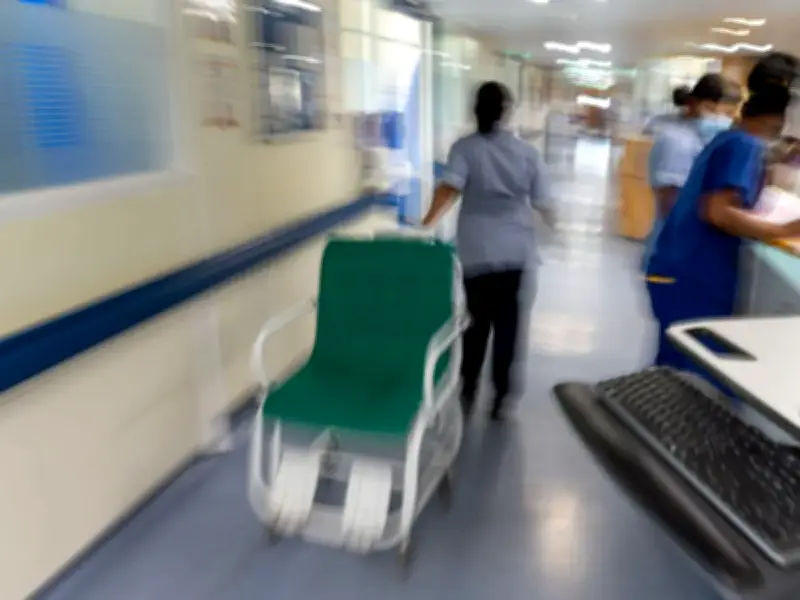
Medics have warned there is "no longer a quiet season in the NHS" as extreme heat has led to a "summer surge" in A&E attendances, putting the health service under similar pressures to those it faces in winter.
New figures show the number of patients in England being cared for in hospital corridors or makeshift areas has remained above 3,000 a day for the second month in a row.
Health officials said there has been a record 2.5 million A&E attendances last month amid two heatwaves, with Health Secretary Yvette Cooper warning the health service must start planning for summer pressures in the same way as winter.
Corridor care figures remain high
An average of 2,300 patients received corridor care in A&E departments in England each day in July, along with 728 patients elsewhere in hospital wards, totalling 3,028. This is down slightly from an average of 2,439 patients in A&E departments and 749 in hospital wards each day in June, totalling 3,188.
It is the third time corridor care figures have been published by NHS England, and the second consecutive month they have remained above 3,000 a day. The data covers patients who have been receiving corridor care for at least 45 minutes.
This means care did not take place in a clinically appropriate and safe setting where patients have privacy, access to food, water and toilets, and lights can be turned off and noise levels minimised to allow sleep.
Heatwaves and health alerts
The figures come after a series of extreme heatwaves across the UK, with temperatures topping 38C in southern parts of England on Thursday (August 13). A number of heat health alerts have been issued across the country by the UK Health Security Agency (UKHSA) throughout the summer, including a rare red alert in June.
Heat warnings are issued when extreme temperatures are expected to impact health and care services - and with so many heat health alerts issued throughout summer 2026, some medics say this suggests there is "no longer a quiet season" for the health service.
Dr Ragit Varia, president-elect of the Society for Acute Medicine, said: "From permawinter to permaheat, there is no longer a quiet season for the NHS. Month after month, patients are left waiting far too long in overcrowded emergency departments, corridors and other unsuitable spaces."
He added: "The latest figures show that 47,438 patients waited more than 12 hours from the decision to admit to admission in July – up 34 per cent on the same month last year. That is 1,530 people every day experiencing delays that should never become normal."
Performance and response
In emergency departments, some 75.4 per cent of patients were seen within four hours last month, up from 75.0 per cent in June. The number of people waiting more than 12 hours from a decision to admit to actually being admitted stood at 47,438, down from 49,466.
Ms Cooper thanked NHS staff for "their extraordinary efforts over this hugely challenging summer".
She said: "Despite the extreme heat and record demand that NHS staff have faced, more than three quarters of patients were seen within four hours in A&E, a record 2.65 million diagnostic tests and checks were carried out in a single month, and the waiting list has fallen in the month of June for the first time since 2011."
She continued: "But today's figures also show how much of an additional burden is placed on the NHS during periods of extreme heat, and I have made clear that we must start planning for summer pressures in the NHS in the same way we do for winter."
Ms Cooper said she is working closely with NHS leaders to put those plans in place, ensuring that staffing, beds and emergency services are prepared for the demand likely to come, so the health service can keep delivering for patients, no matter the weather.




