Emergency care leaders have told MPs that under-pressure medics are “gaming” the system by leaving sick patients “tucked away” in waiting rooms lying on plastic chairs so they do not count towards corridor care statistics, since Labour launched a crackdown on the practice this year.
Corridor care became widespread in the NHS under the Tories after the Covid-19 pandemic and sees patients treated in non-clinical spaces such as corridors. Healthwatch recorded more than 280,000 cases of corridor care over the summer, driven by record heatwaves and an average of 2,300 daily cases in July, but the new warning suggests the real picture could be even worse.
Patients 'being tucked away'
Dr Ian Higginson, president of the Royal College of Emergency Medicine, welcomed the government's commitment to phasing out corridor care but said the definition is “open to gaming”. He said: “It does not count patients who are in ambulances, or waiting to come into hospital, and those can be used by some organisations as pseudo cubicles.
“It does not count patients who are potentially in waiting rooms, waiting on our plastic chairs, or in what are called ‘off the clock’ units, waiting on hard plastic chairs for admission. There are some anecdotal reports to suggest that counting corridor care is driving an increase in the number of patients who are being tucked away in that sort of environment.”
The Labour government has committed to phasing out corridor care and is the first to start counting it. NHS England introduced its first national definition of corridor care in March as a patient spending at least 45 minutes in a clinically inappropriate area of an emergency department.
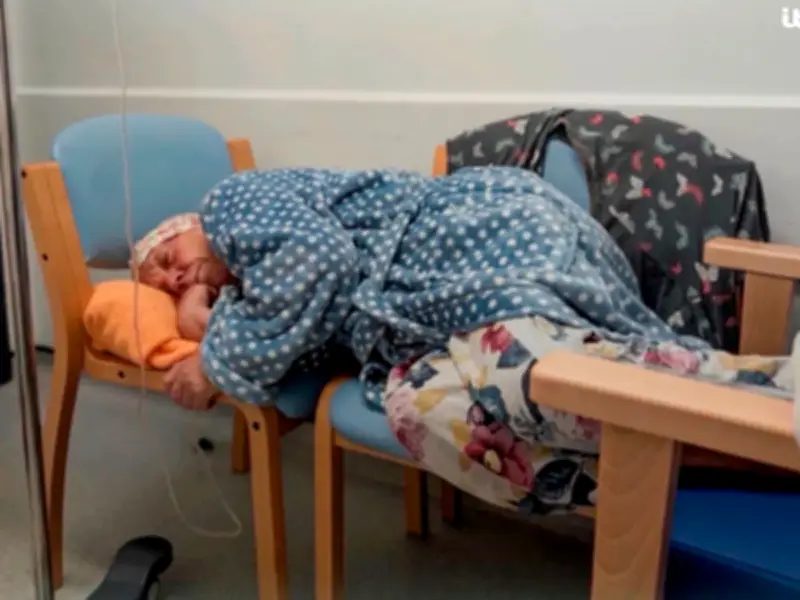
There has been a string of shocking stories about long A&E waits, including an 81-year-old woman with terminal cancer who was left lying on plastic chairs in an A&E storeroom for 48 hours. Pam Smith, who has stage 4 cancer, went into Royal Gwent Hospital in south Wales suffering from a fever after undergoing chemotherapy but was told there were no beds available. There is no suggestion the Royal Gwent was gaming the statistics.
Patient felt 'abandoned'
Retired teacher Pam Smith was diagnosed with cancer in August having spread from her bowel to her stomach and liver. A month later the grandmother-of-seven was undergoing chemotherapy but developed a high temperature and was told by medics to go into hospital.
She initially waited on a chair in a public area at the Royal Gwent Hospital in Newport, but when her family said they were concerned about infections because she was immunosuppressed, she was moved to a storeroom. Pam, who is now receiving palliative care, said she felt “abandoned” by the NHS during her two-day ordeal, telling ITV News: "We had three plastic chairs. I was tired so we set them out so I could lie down and sleep. There was just no one there for me at that point in time."
Her daughter Rebekah said: "It was very, very upsetting. No one at that age when they feel that ill should be lying on a chair for hours, especially when going through cancer and being on chemo. It can rapidly go downhill and become life-threatening."
The Royal College of Emergency Medicine polling published this week suggests a fifth of A&E patients are being treated in inappropriate spaces such as corridors and storage cupboards. Its survey of clinical leads in 119 hospitals found that two-thirds believe pressures are already higher than this time last year.
'You have patients absolutely everywhere'
Dr Higginson told MPs: “What makes emergency departments unsafe is where you have patients absolutely everywhere and you cannot do your job properly.
“If you describe a typical shift… in the old days, my job was to answer questions from less experienced practitioners, go and see patients with them, teach, support and supervise. My job now is essentially traffic control and risk management.
“So we're trying to find spaces for the next patient… Resuscitationary [rooms] might be full. We're trying to work out which patients we need to prioritise if we've got very long waits. I might be going to the waiting room to apologise to our poor patients who have been waiting there for hours.”
Matthew Hopkins, director of acute and ambulance services at the NHS Alliance, said: “So our membership are very much saying that given the challenges during the summer, given the demand, there is now no longer a kind of summer lull.”
Dr Emma Rowland, executive director of performance at NHS England, told the committee that the answer was linked to better social care and discharging patients as soon as they are fit to leave hospital. She said: “We have called out corridor care and we now measure it. I completely accept that there are questions around the definition of how one measures it, but for the first time, we are measuring it.
“The second thing is, we are clearly stating that we wish to eradicate it. That is our intent for exactly the [reasons] everybody's alluded to - it causes increased harm, increased length of stay and it has no dignity to it.”
Karin Smyth, minister for secondary care, said: “Don't underestimate [that] for the staff at the front end dealing with this… it's very pressured. We don't shy away from the fact that this is a pressurised system and clinical colleagues are feeling that very much at the front end. But I would say that we are grasping it and making improvements.”
Corridor care became commonplace before Labour came to power in 2024 after a decade of increasing A&E and 999 waits. The Mirror previously revealed the practice was quietly rolled out across the NHS in England in 2022 to get ambulances queuing outside A&Es back on the road quicker.
Health board apologises
A spokesperson for Aneurin Bevan University Health Board, which runs Royal Gwent Hospital, said: "We are truly sorry for Mrs Smith's experience and the distress this caused her and her family. Our services are caring for very high numbers of patients and are under significant pressure.
"However, this is not a standard of care that we accept - no patient who needs a bed should have to spend time in such uncomfortable conditions.
"As soon as this was brought to our attention, we contacted the family, apologised for their experience and we are grateful that they shared their concerns with us. As a result, we have taken immediate steps to increase the availability of recliner chairs and other comfort items, including pillows, at the Royal Gwent Hospital."
Britain has issued the first cold-health alert of the winter as temperatures drop in the next few days and hospitals come under more pressure. The UK Health Security Agency UKHSA is calling on people to check on elderly friends, family and neighbours as winter begins to bite and overnight temperatures drop to around zero degrees for much of the country. The yellow cold-health alert has been issued for the North West and West Midlands from 9am on Thursday to 12pm on Saturday. Under the Weather Health Alerting system introduced by UKHSA and the Met Office, yellow Cold-Health Alerts may be issued during periods of heat or cold which could impact those who are particularly vulnerable.