

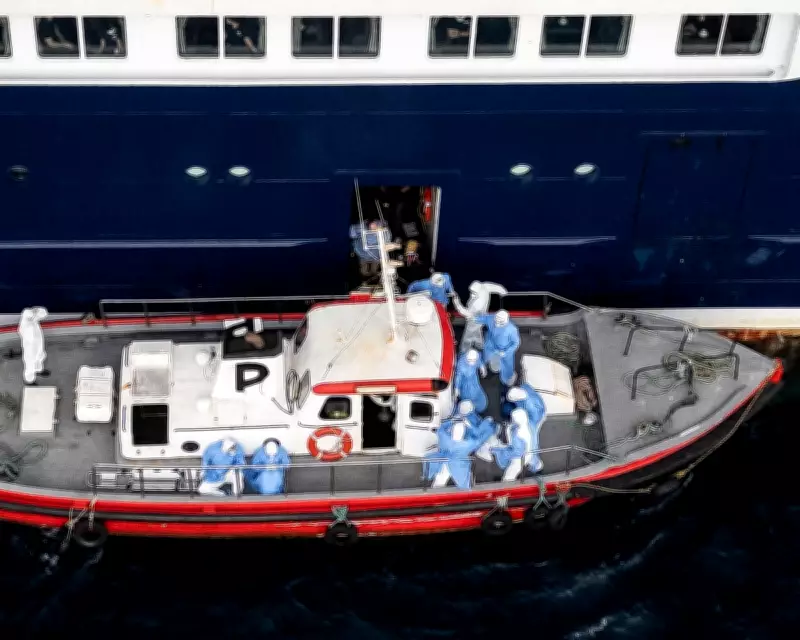
Health authorities around the world are urgently working to locate dozens of passengers who disembarked from a cruise ship at the centre of a deadly hantavirus outbreak before isolation measures were put in place. It was revealed on Thursday that at least 29 passengers of 12 nationalities left the MV Hondius on 24 April, following the first fatality, prompting a scramble to identify and monitor their movements since then.
WHO Confirms Cases and Low Risk
The World Health Organization confirmed that five of the eight suspected cases linked to the ship have been verified, with additional cases possible. “Given the incubation period of the Andes virus, which can be up to six weeks, it’s possible that more cases may be reported,” said WHO Director-General Tedros Adhanom Ghebreyesus. “While this is a serious incident, WHO assesses the public health risk low.”
Disembarkation and Tracing Efforts
The Dutch health ministry reported that a woman who had not been on the ship is being tested for hantavirus and is isolated in an Amsterdam hospital after showing symptoms. If positive, she would be the first known person not on the MV Hondius to become infected in this outbreak. Oceanwide Expeditions, the Dutch cruise operator, stated that 29 people and the body of the first fatality disembarked at Saint Helena on 24 April, with the first confirmed case not reported until 4 May. The disembarked passengers, including six US and seven British citizens, have been contacted, and most are believed to have returned home.

A Spanish passenger still on board told El País: “The Australian went back to Australia, the one from Taiwan to Taiwan, the Americans to all corners of North America. The Englishman to England, the Dutch to their homes.” A man who travelled to Switzerland is being treated at a Zurich hospital after testing positive, with Swiss authorities saying there is no public risk. In the US, the CDC is monitoring passengers who went to Georgia, California, and Arizona, with none showing symptoms.
UK and Other Countries Respond
Two passengers who returned to Britain and are self-isolating show no symptoms, according to the UK Health Security Agency. Chief Scientific Officer Prof Robin May suggested they and other passengers would be asked to self-isolate for 45 days. “For the broader public, not directly involved in this cruise ship, the risk here is really negligible,” he said. Singapore officials reported two residents from the Hondius are isolated and being tested, while a Danish citizen is in self-quarantine with no symptoms.
Outbreak Details and Ship Movement
The outbreak has killed three people and caused global alarm. Hantaviruses, primarily found in rodents, can infect humans, causing flu-like symptoms, pulmonary syndrome, and respiratory failure. The Andes hantavirus can spread through close contact but is less contagious than Covid-19. There are no vaccines. Three medically evacuated individuals with symptoms are being treated in the Netherlands: a 41-year-old doctor, a 65-year-old German passenger, and 56-year-old British expedition guide Martin Anstee.
The Hondius, with 149 people on board, left Cape Verde waters after being denied docking and is heading to Tenerife in Spain’s Canary Islands, expected around midday on Sunday. Canary Islands President Fernando Clavijo expressed concerns about the central government’s decision to allow the ship and requested a meeting with Prime Minister Pedro Sánchez. Spain’s Health Minister Mónica García stated there is no public health threat, and the ship will remain at anchor, with passengers evaluated onboard and only disembarking for transfer or repatriation with protective equipment.
EU nations plan to begin evacuating citizens from the Canaries from 11 May. The 14 Spanish nationals on board will be transferred to the Gómez Ulla military hospital in Madrid. Spain’s opposition People’s Party accused the government of mixed messaging over quarantine procedures, as the defence ministry said it would be voluntary while García noted legal tools to make it mandatory.

Origins and Investigation
The polar vessel sailed from Ushuaia, Argentina, on 1 April, stopping in Antarctica and remote Atlantic islands. A 70-year-old Dutch man showed symptoms on 6 April and died five days later, initially attributed to natural causes. His body was removed on 24 April at Saint Helena, where other passengers disembarked. His 69-year-old wife flew to South Africa, transferred to a KLM flight, and died. A KLM stewardess in contact with her is in isolation at an Amsterdam hospital. The WHO is conducting contact tracing for those who shared the flight. The body of a German passenger who died on 2 May remains on the ship. One theory links the outbreak to a birdwatching expedition in Argentina by the Dutch couple before boarding. Argentina, with Latin America’s highest hantavirus incidence, will conduct rodent trapping and analysis in Ushuaia.





