Campaigners have described the test and trace system deployed during the Covid-19 pandemic as an "abject failure" that cost lives. The statement comes as Baroness Heather Hallett, chairwoman of the UK Covid-19 Public Inquiry, prepares to publish her latest report on measures taken to prevent the spread of the virus.
The Covid-19 Bereaved Families for Justice UK group said: "The UK's test and trace system was an abject failure that cost lives. Thursday's report must be honest about those failures and give bereaved families the truth about why their loved ones were left unprotected. It must hold those responsible to account and set out what needs to change so we are prepared for the next crisis."
£37 Billion Budget and Early Warnings
The government allocated a £37 billion budget to NHS Test and Trace, with an initial £22 billion spent followed by a further £15 billion. At the start of the pandemic in January 2020, health leaders said the risk to the UK population was "very low" and later that month that "UK public health measures are world-leading and our excellent NHS is well prepared to manage and treat new diseases".
As the situation unfolded, the World Health Organisation (WHO) declared the outbreak a "public health emergency of international concern", and officials raised the UK risk level from low to moderate. In March 2020, the government announced the nation was moving from the "contain" phase to the "delay" phase as the threat level rose again from moderate to high, meaning limited contact tracing stopped.
As of February 2020, Public Health England (PHE) was only equipped to deal with five new cases a week and the associated isolation of 800 contacts. Due to limited capacity, active contact tracing was directed at high-risk settings such as care homes and hospitals.
Lockdown and Testing Scale-Up
On March 23, 2020, the first national lockdown was imposed, with then prime minister Boris Johnson telling people: "From this evening I must give the British people a very simple instruction - you must stay at home." Days later, the government announced a "five pillar" strategy to scale up testing, with former health secretary Matt Hancock pledging 100,000 tests a day would be available by May 2020.
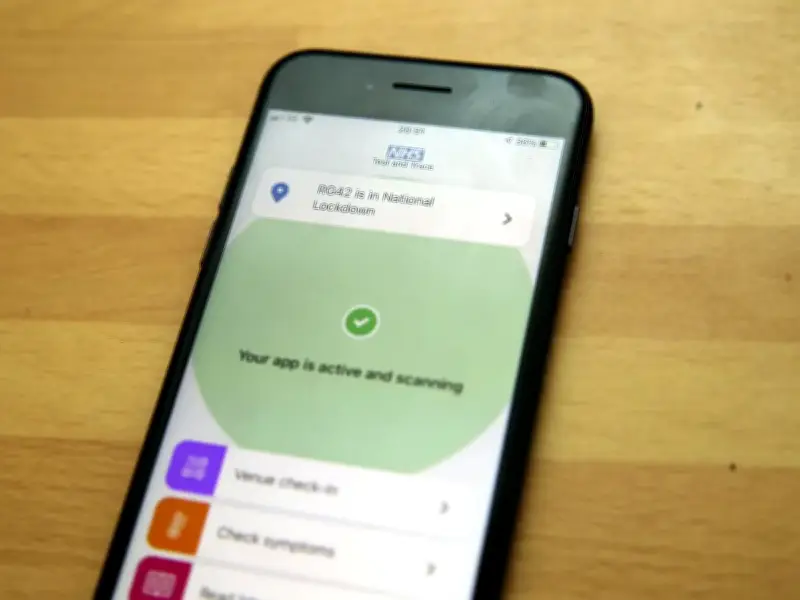
In April 2020, Mr Hancock announced a test, track and trace programme in England, including large-scale recruitment for contact tracers and the development of a new contact tracing app. Baroness Dido Harding was appointed lead for NHS Test and Trace, which launched in May. The tracing programme was telephone-based at first, and the app was released in September 2020 after being beset by technical problems.
Millions downloaded the NHS Covid-19 app. A paper published in the journal Nature Communications estimated the app's contact tracing function alone helped to avert one million cases of the virus, saving almost 10,000 lives.
Criticism and Aftermath
In September 2020, people in England were required by law to self-isolate if they tested positive or were contacted by NHS Test and Trace. Support was made available for people on low incomes through the £500 Test and Trace Support Payment. Lady Harding has previously told the Covid inquiry that if the government had provided more support for people to self-isolate, more lives would have been saved, adding that former prime minister Rishi Sunak would not budge on proposals to pay people more to isolate.
The probe also heard that Boris Johnson favoured an "authoritarian approach" to punishing people who failed to isolate. A January 2021 note by then-chief scientific adviser Lord Patrick Vallance said: "PM says: 'We haven't been ruthless enough. We need to force more isolation. I favour a more authoritarian approach'."
A Public Accounts Committee report published in October 2021 concluded that NHS Test and Trace had "not achieved its main objective to help break chains of Covid-19 transmission and enable people to return towards a more normal way of life". By June 2021, the service had sent out 691 million lateral flow tests, but results had been registered for 14% of them, the report stated.
PHE was later axed following criticism of its performance, with its responsibilities evolving into the UK Health Security Agency. The inquiry may also touch on ex-MP Owen Paterson's involvement with Randox, a company awarded a contract to supply millions of Covid tests. Clare Fletcher, a solicitor from Broudie Jackson Canter, which represents more than 7,000 families from Covid-19 Bereaved Families for Justice UK, said: "Test and trace was a shambolic and chaotic system that led to avoidable loss of many lives despite the eyewatering sums of taxpayers' money that were injected into the system. Our clients hope the chair confirms what many believe - it was fatally flawed and made many private firms and contractors rich, while too many innocent lives were lost. We call on the chair to recognise the true extent of the impact this had on so many families and agree to binding recommendations to ensure the same tragedies never happen again."