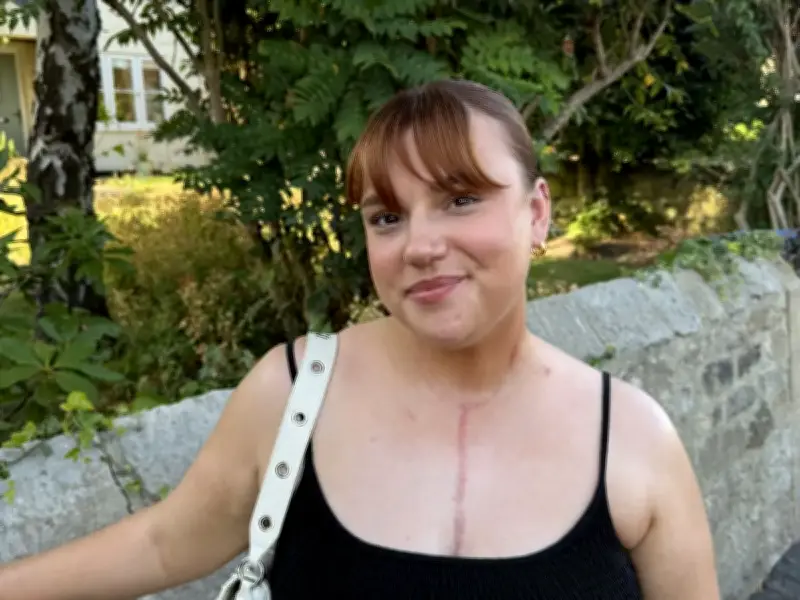
A 26-year-old woman living with a rare form of incurable cancer has spoken about how her symptoms were repeatedly dismissed as anxiety before she finally received a diagnosis.
Saskia Clark said she was "always unwell" as a teenager, struggling with extreme tiredness and bowel issues. She visited her GP on many occasions but was often told her symptoms were due to anxiety or that she would "grow out of it".
Diagnosis after student doctor referral
Two years ago, a student doctor took a closer look at her symptoms and urgently referred her for a CT scan. That scan led to a diagnosis of medullary thyroid cancer, a rare cancer that forms inside the thyroid gland.
Medullary thyroid cancer behaves differently from more common types of thyroid cancer. Saskia has been told by doctors that her cancer had probably been growing for more than a decade before it was diagnosed in August 2024.
Surgery and ongoing treatment
She underwent major surgery to remove her thyroid, a tumour in her chest and more than 200 lymph nodes. However, doctors were unable to remove all the disease, meaning she will need ongoing monitoring and treatment.
She now takes a targeted medication which has helped suppress the cancer. Her most recent scans showed that small nodules in her lungs had "completely gone" and other areas of disease had decreased.
Appeal for new scanning centre
Saskia has undergone around 15 scans at The Christie's scanning centre. The Christie Charity has launched a £42.5m appeal to create a new scanning centre at the Manchester cancer hospital.
The charity says the centre will increase scanning capacity and provide a better environment for patients, while supporting more precise diagnosis and treatment.
Saskia said: "For the rest of my life, I'm going to need diagnostic and surveillance scanning. And that's not something that is cheap. We are lucky to have the NHS, but it isn't enough."
"A donation is the difference between an anxious scan and a calm scan, and that makes all the difference."
Years of dismissed symptoms
Before her diagnosis, Saskia says she struggled to get through the school week because of exhaustion. She repeatedly visited her GP, trying to understand why she was so tired, but says her symptoms were often put down to anxiety.
She said: "They always told me I'll grow out of it, it's just anxiety, she's a shy child or it's stress. It was constantly fobbed off, I suppose, and it was something that I'd grow out of."
In 2023, she began experiencing severe chest pain so painful she feared she was having a heart attack. Doctors were unable to find a cause and put it down to anxiety and stress. She eventually left her job, partly because she felt the stress was being blamed for her symptoms.
Path to diagnosis
Another visit to her GP finally led to further investigation. A student doctor spent longer asking about her symptoms and followed up on details she had mentioned in passing. The doctor consulted a senior colleague, and the pair agreed she needed an urgent CT scan.
The scan revealed abnormalities around her windpipe, prompting a referral to the lung department. Following a bronchoscopy, in which doctors used a camera to examine her airways and took biopsies, she was diagnosed with thyroid cancer. She was then referred to The Christie, where specialists told her she had medullary thyroid cancer.
She said: "When I spoke to a specialist, he backtracked off what I spoke about when I was younger and said it was probably growing then. It's probably been over a decade of growth because it's so slow-growing."
"I got to a point where we were never going to get rid of it. It was more going to be a monitoring situation, and we would be trying to keep it at bay rather than trying to cure it."
Living with scans and anxiety
Now, repeated scans remain a significant part of her life, bringing anxiety as she waits to find out whether the cancer is stable. She says the existing scanning facilities at The Christie have become increasingly busy, with appointments often taking place early in the morning and late into the evening.
She said: "If the scanning centre was more optimised, it would alleviate a lot of anxiety," adding that the existing scanning rooms feel outdated compared with other parts of The Christie.
Since her diagnosis, Saskia has been documenting her experiences online, connecting with other people living with cancer, including patients with the same rare disease. She has also taken to leaving bouquets of flowers on patients' cars at The Christie car park, hoping to offer a small moment of happiness after difficult appointments.
The idea came from thinking about the times she and her partner of eight years, Danny, had sat in silence in their car after receiving difficult news. She wanted to "interrupt the pattern" of sadness and anxiety that can follow a hospital appointment.
Saskia said: "It might just stop that thought process, and instead in the car they're thinking about the flowers or talking about the flowers."
She hopes sharing her experiences will encourage other people to trust their instincts if they feel something is wrong with their health.