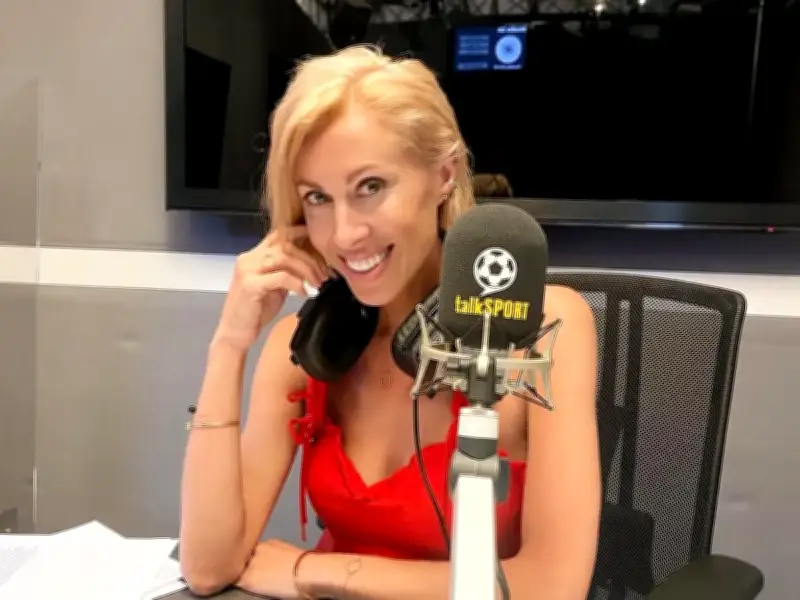
TalkSPORT presenter Rachael Downie has revealed she was diagnosed with a rare type of brain tumour after collapsing while on holiday. The 41-year-old was travelling to Greece with her husband, Simon, and their two-year-old daughter, Rose, when she suffered a seizure as the plane landed.
After being taken to a local hospital, Downie underwent a CT scan, which discovered a 6.7cm tumour on her brain's right frontal lobe. She said she had no symptoms before her seizure and was "in complete shock" as doctors showed her a scan of her brain.
Diagnosis and immediate impact
"When you hear brain tumour, you think of the worst case, so I think I just went in a state of utter denial from that point," she said. "I've got a little girl, I don't want her to see me get upset."
Downie spent the night in observation before being given the green light to return to the UK, where she was admitted to the National Hospital for Neurology and Neurosurgery. She explained that, because she was left fearing the worst, she started putting plans in place for her daughter, including thinking which women in her life could teach Rose about periods or about buying her first bra, and reminding her husband of what school she would like their child to go to.
Operation and recovery
"You think you have all the time in the world, but at this time, I had no idea what my future looked like," she told the Daily Mail. The presenter underwent a four-hour operation in September, during which the tumour was removed.
Downie explained that when Rose visited her, she pretended that she was dressed up in a Halloween costume to avoid scaring the little girl as she was covered in bandages. After five days on the ward, she was able to return home, and the following week she learned that the tumour was non-cancerous.
Long-term management
She also revealed that she had Grade 2 astrocytoma, a rare type of primary brain tumour, making up about 2% to 5% of all brain tumours. Because the condition carries a lifelong risk of returning, her ongoing management and recovery plan includes taking daily anti-seizure medication and undergoing routine MRI scans every six months to check for potential regrowth.
While she is now back home and recovering, Downie said she needs to be careful in her everyday life, as she revealed that the hardest part is not being able to pick up her daughter. She also revealed she cannot be alone with her in case she has a seizure, which means the family has had to hire outside help.
"I've not been able to pick her up and cuddle her and how do you explain that to a two-year-old?" she shared. "I just said to her, mummy's got boo-boos on her head and she understands to be gentle around my head. I also can't drive for a year because I'm at risk of another seizure and my main source of work is motorsports so it's been difficult."
Around 13,000 people are diagnosed with a primary brain, central nervous system, or intracranial tumour in the UK every year, according to The Brain Tumour Charity. Around 5,500 to 5,600 people lose their lives to brain tumours each year in the country, making it the 10th most common cause of cancer death, explains Cancer Research. Brain tumours are the biggest cancer killer of children and young adults under the age of 40 in the UK.