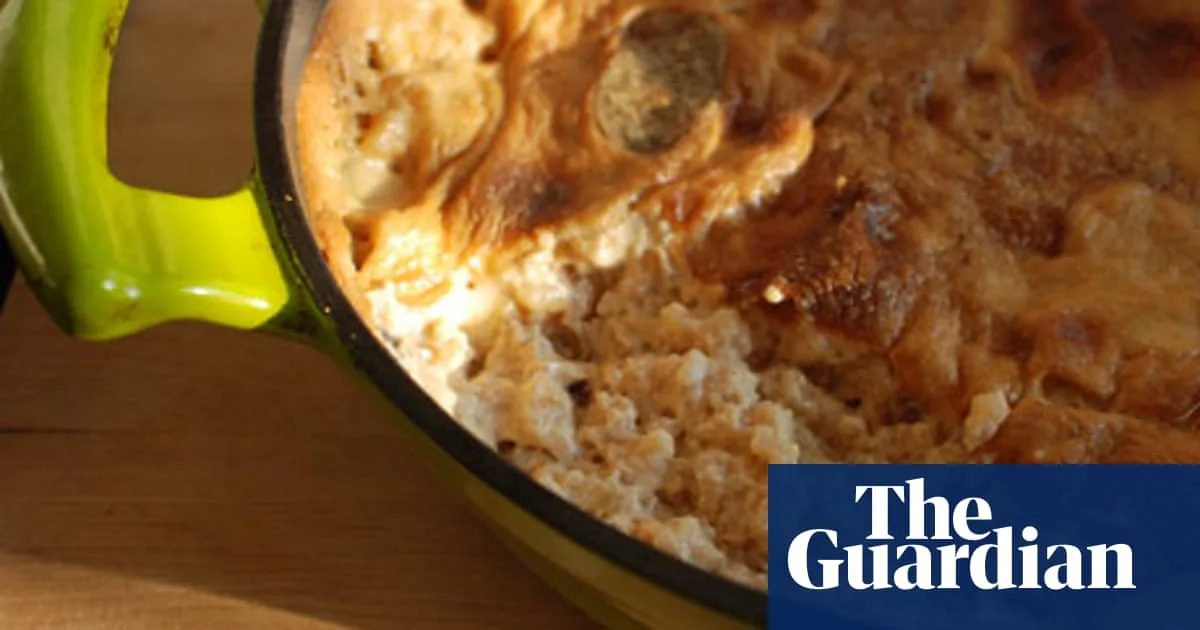
We all have things in life that we're not very proud of. Until last week, one of mine, along with the tartan trousers I sported for most of 1996, was the revulsion I harboured for rice pudding. This started some years before the plaid madness, and is entirely attributable to the stuff we were given at school, which was snow white, astonishingly bland, and served with a mean little dollop of chewy red jam slopped carelessly into the middle. Having made six different recipes in the past three days, however, I've finally realised the error of my ways: a bowl of rice pudding is one of the most wonderfully comforting sights on earth. Unlike a pair of checked flares.
The main ingredient in rice pudding isn't actually rice. It's milk. However, given rice's pivotal role in the dish, I decided to experiment with a few different varieties. The classic choice is, of course, pudding, or short-grain rice, but I found numerous recipes calling for other sorts, many prefaced with the excuse that the writer didn't keep any of the right stuff in the house. Tom Norrington-Davies provides a recipe for cheat's rice pudding using basmati rice. Intrigued by the claim that 'basmati actually makes a very fragrant dessert', I opt for that, and discover that he's right; despite containing no other flavouring than sugar, the dish is delicately aromatic. It's also, however, rather dry, and the rice is unfortunately stodgy.
Angela Hartnett uses arborio in her rice pudding, in a nod to her Italian heritage. It's much better than the basmati, but I still find it a little too robust; it doesn't slip down quite so well as the pudding rice used by Marcus Wareing. This is pleasing, as basic short-grain rice is by far the cheapest of the three varieties, which seems appropriate for such a fundamentally humble recipe. Both Wareing and Hartnett cook their rice puddings on the hob, as opposed to baking them in the traditional British fashion. Introduced as 'definitely not the kind you had at school,' Wareing's pudding certainly sounds promising. He's not wrong either; with as much double cream as milk, 5 egg yolks and a vanilla pod, it sounds like an entirely different dish, and tastes like it too. Overwhelmingly rich and heavy with vanilla – more like a rice custard than a pudding – I suspect it's designed to be served in teeny tiny Michelin-starred portions, rather than in a big bowl around the kitchen table on a Sunday evening. It may not be bland and slippery, but this isn't the pudding to change my mind.

For the same amount of rice, Angela Hartnett's version uses milk, a single egg yolk and half a vanilla pod, which bodes well. Creamy, but not overly so, and lightly flavoured, I could eat a bowl with ease. However, although the pudding is finished off under the grill, there's no sign of the skin that seasoned pudding lovers claim is the best bit of the dish. Given my fondness for custard skin (preferably Bird's), I decide baking is the way to go. Delia Smith may not boast any stars (although she does have a CBE), but I trust her to set me straight with a good traditional rice pudding recipe. In fact, she exceeds my expectations by including Eliza Acton's rich rice pudding recipe, first published in 1845, in her Complete Cookery Course, which seems appropriate for a very Victorian-sounding dessert. It starts off in just the same way as Angela Hartnett's: the rice is cooked in milk until just tender, then sugar and butter are stirred in, followed by beaten egg yolks. But where Angela's pudding needs a mere couple of minutes under the grill to finish it, Mrs Acton's still has 30 to 40 minutes of baking to do, in the grand English tradition of never cooking a cabbage for five minutes when 40 will do. The finished dish has a lovely caramelised skin, just as Delia promised, but what lies beneath is a bit odd: a wobbly milk custard on top of a layer of dense rice (something also promised by Delia, if only I'd turned the page – apparently it can be corrected, if desired, by thickening the mixture on the hob before putting it in the oven). It's not bad, and the skin is definitely a plus point, but I'd prefer something a bit more uniform.