Palestinian Child Receives Lifesaving Care in Britain After Gaza Trauma
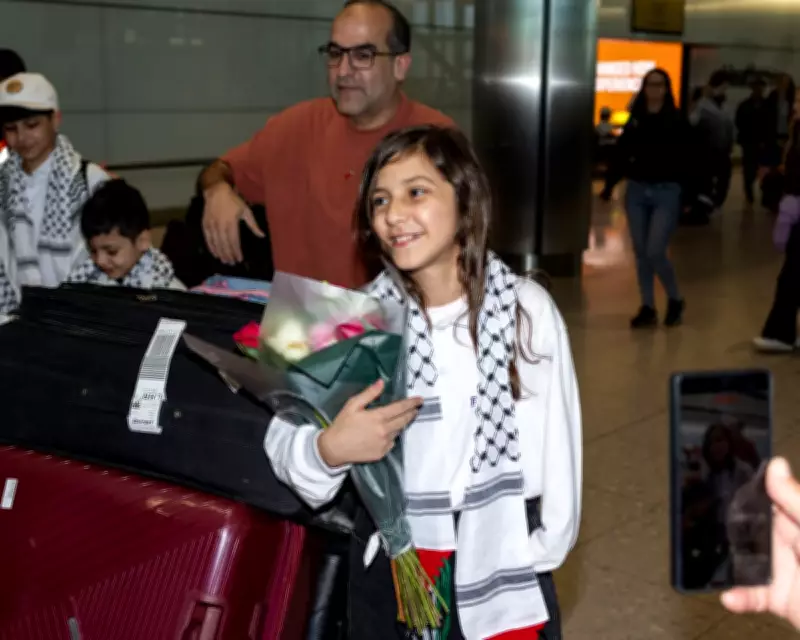
A young Palestinian girl, whose arm was amputated following an Israeli missile strike on her family home in Gaza, has safely arrived in the United Kingdom to receive critical specialist medical treatment. Mariam Sabbah, aged 10, landed at Heathrow Airport with her mother and two brothers, marking a poignant moment amid ongoing international efforts to evacuate injured and ill children from the conflict-ravaged territory.
Journey from Gaza to the UK Amid Visa Hurdles
Originally, Mariam and her family had hoped to travel to the United States for her care. However, those plans were thwarted when the Trump administration suspended visitor visas for all Palestinians in August of last year, leaving them stranded in Egypt. "We're happy that we're here, we never thought we would actually be here in the UK," said Fatma Salman, Mariam's mother, as her children smiled broadly nearby. "They were a bit nervous at the beginning, but now when they feel like everyone is around them, they are happy and excited."
Mariam is one of over 11,000 patients who have been evacuated from Gaza, according to the World Health Organization (WHO), which estimates that a staggering 18,500 patients still require urgent medical attention unavailable locally.

Private Efforts and Government Schemes in Parallel
While the UK government launched a medical evacuation scheme last year, Mariam's arrival was facilitated through privately funded specialised treatment. This was made possible with assistance from the US-based NGO FAJR Global and the UK charity Project Pure Hope (PPH). Notably, PPH has been evacuating patients and their families to the UK since 2025, and its model served as the blueprint for the government's parallel initiative.
At Heathrow, the family was welcomed by a small crowd bearing gifts, balloons, and bouquets, including three families previously evacuated by PPH and Soad Abuhemaida, a 28-year-old scholar from Gaza who arrived in the UK in November. "When I heard that there was a girl coming in a few days and she's going to get medical care from the UK it really made me feel happy," said an emotional Abuhemaida, whose family remains in Gaza. "I feel what she's feeling now because I was in her shoes."
Challenges and Calls for Increased Humanitarian Action
The evacuation process is often long and arduous, requiring coordination from the WHO and Israeli authorities. This has resulted in an extremely limited number of medical evacuations, a situation exacerbated by the WHO's recent announcement to suspend such operations after a contracted worker was killed. Mosab Nasser, co-founder of FAJR Global, warned that more lives would be lost due to this decision, citing halted evacuations since the war on Iran and closed border crossings with Gaza.
Rohan Talbot, director of advocacy and campaigns at Medical Aid for Palestinians, emphasized the fragility of evacuation pathways without a real ceasefire. "The UK government and other governments must move beyond limited evacuation pledges and exert meaningful pressure on Israeli authorities to permit the unrestricted entry of aid, reopen all crossings and allow humanitarian agencies allowed to operate at scale," he stated. "Without urgent action to uphold international law, we will see more preventable illness and deaths."
Government Response and Future Prospects
The UK government scheme, designed to provide critically ill and injured children in Gaza with NHS care, relies on the WHO to identify priority cases. So far, 50 children and their immediate families have been evacuated, falling short of initial hopes for up to 300. A government spokesperson did not comment on how the scheme would be affected by the WHO's suspension.
Omar Din, a co-founder of PPH and an NHS primary care healthcare executive, expressed gratitude for the government's efforts but called for more action. "I think it would be great for the UK in its tradition of being a charitable and humanitarian-focused country to do more of this work," he said. "We've certainly done it recently with Ukraine. There's no reason why we shouldn't do more of it here."

Since October 2023, Egypt, the United Arab Emirates, and Qatar have assisted the most patients medically evacuated from Gaza, followed by EU countries, Jordan, and Turkey, highlighting the global scale of the humanitarian crisis.