
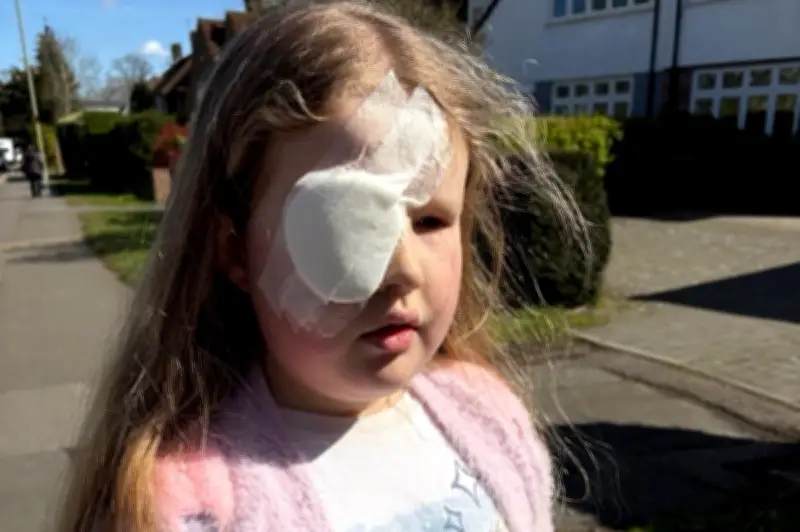
An 11-year-old girl has become the first UK patient to have innovative gene therapy for a rare condition that robs children of their sight.
The treatment, which had only been performed on one other person in the world, involves injecting healthy copies of a gene directly into the eye.
Catherine L'Estrange, from North Acton in west London, is hopeful the move will allow her to continue one of her favourite hobbies – reading books.
If the therapy works, her sight will be stabilised or may even improve, according to the surgeon who treated her.
Diagnosis and condition
Catherine was diagnosed with Bardet-Biedl syndrome (BBS) when she was just a baby. The condition is caused by mutations to one of 20 different genes and impacts around one in 100,000 births in the UK, leaving patients blind by their late teens or early 20s.
As well as vision loss, BBS can also cause kidney problems, learning difficulties and obesity, and patients sometimes have extra fingers or toes.
The gene therapy procedure
The gene therapy, developed by biotechnology company MeiraGTx, was given to Catherine as part of an hour-long procedure at St Helier Hospital in March. Surgeons removed the jelly inside her eye and injected healthy copies of a gene into the retina, the light sensitive layer of tissue at the back of the eye.
In people with BBS, small cells in the retina die, leading to blindness.
Neruban Kumaran, consultant eye surgeon at Epsom and St Helier University Hospitals NHS Trust, told the Press Association: “By giving a healthy copy of the gene, it helps save those cells, and the hope is to either stabilise or improve vision.”
Catherine said: “If this treatment works, it will help me to carry on seeing things around me, and most of all I will be able to carry on reading books, which is one of my favourite things to do.”
Family's perspective
Her father, Reverend Timothy L'Estrange, said most children with BBS do not get diagnosed until they are in primary school, but Catherine was diagnosed at a few weeks old, allowing the family to plan her future.
“Our policy was to develop her independence and resilience as much as possible, ready for the inevitable loss of her sight, which began with her becoming night-blind, then colour-blind, and continued with her losing her peripheral vision,” he said.
“We were told that possible gene therapy was many, many years away, and was likely to arrive after Catherine had entirely lost her sight – so we were surprised and delighted when we learned this treatment had become available, and that Catherine would be one of the first patients in the world to receive it.”
Treatment details and future
Just one of Catherine's eyes has been treated with the new gene therapy, with the team now waiting to see the results. The treatment is designed specifically for patients with a BBS10 gene mutation, which is one of the most common among BBS patients.
The team at St Helier worked with experts at Great Ormond Street and Moorfields Eye Hospital to identify eligible patients, as youngsters with BBS have genetic tests to pinpoint which of the 20 genes is mutated based on their symptoms.
Only one other person – a 17-year-old girl from Canada – had received the treatment before Catherine. Her procedure took place at St Helier in August last year.
The parents of the girl, who wishes to remain anonymous, said: “This treatment has given our daughter a precious chance to preserve her vision, and we hope it will become a life-changing therapy for children with BBS10 all over the world.”
Since Catherine, the procedure has also been performed on one other younger child with BBS.
Outlook and hopes
After having the therapy, patients are seen in clinic and have various sight tests, such as reading from a chart and identifying different shades of colours. Mr Kumaran said some have already said their vision is better in dim light and the feedback so far has been positive, though it will take years before the full results are known.
“There is a hope that it may improve vision slightly, but it's difficult to say,” he told PA. “It's not going to leave someone with perfect vision. But the hope is to stabilise and/or improve vision. Only time will tell.
“There's been some very positive feedback from a mixture of the patients and the families that suggest their vision may be better. Early reports from the families have been very promising, and it gives us lots of hope. But in practice, it will take many years before we're sure.”
Reverend L'Estrange said: “Our whole family has been so grateful for the opportunity to save Catherine's vision – it will be absolutely life-changing for her to retain any vision at all.”
Mr Kumaran is hopeful there will be other children out there eligible for the therapy, as well as babies who have not even been born yet.
He told PA it has been a “real honour” to have the opportunity to help these children, adding: “These families and the children have a lot of difficulties as it is, just because of all the other conditions they're affected by.
“And one of the things that causes a lot of anxiety is the worry that these children lose vision and possibly lose their independence. There's no other treatment for this, and so the opportunity to protect vision or improve vision, or give them hope that they won't lose their vision and they can maintain that independence, it really means a lot.”
Mat Shaw, chief executive of St George's, Epsom and St Helier Hospitals Group, said: “As a father, I can't imagine how it feels to watch your child slowly go blind, and I'm so proud that our teams are offering hope to these children and their families, which aims to stop childhood blindness in its tracks and change what's possible for the future of children with this devastating condition.”




