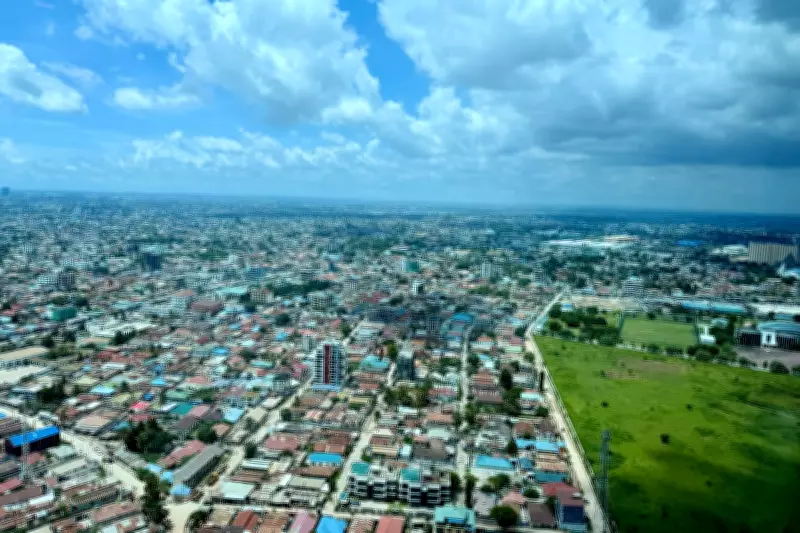
On an oppressively hot day in Dar es Salaam, Tanzania's largest city, Leka Tingitana, director of Tanzania Flying Labs, launches a $20,000 Swiss-made drone from a university cricket field. The device precisely maps a one-kilometre square section of the city, contributing to a larger project that identifies mosquito breeding sites across the metropolis of roughly eight million people. This map is becoming a crucial tool in the fight against malaria as climate change heightens the disease's threat.
Climate Crisis Fuels Malaria Surge
Warming temperatures are having a 'catastrophic' impact on Africa's malaria caseload, according to Dr Sarah Moore of Tanzania's Ifakara Health Institute. 'The weather on the continent is expected to be wetter and warmer,' she explains. 'More water will mean more breeding sites for mosquitoes, while warmer weather will allow the parasite to develop faster.'
Dr Yeromin Mlacha, a Tanzanian research scientist leading the drone mapping project, describes how data on typical breeding sites from thousands of locations is combined with drone imagery and analysed by machine learning at the University of Copenhagen. The result is a high-resolution map of potential mosquito breeding habitats. 'With limited resources, we have identified where malaria exists in scattered pockets across the city,' says Dr Mlacha. 'We have found breeding habitats people had not known about, like discarded tyres on roofs containing standing water. We can then introduce measures to address this risk.'

Changing Patterns and New Threats
Public health measures had dramatically reduced Dar es Salaam's malaria caseload in the 2000s, but new risk factors have emerged. The city's population has doubled in the past two decades, and a more urban-dwelling mosquito, Anopheles stephensi, from Asia, may be arriving. Climate change is also disrupting long-established patterns of malaria spread across endemic regions. The disease currently kills more than 600,000 people annually worldwide.
According to researchers, climate change increases malaria risk in two main ways. Gradually warming temperatures disrupt weather patterns, making it harder to track mosquito breeding. Additionally, major flooding events provide prime breeding habitats and hinder health services. For example, after severe floods in Pakistan four years ago, malaria cases surged from 2.6 million in 2021 to 3.7 million in 2022. A landmark 2024 study projects that an additional 550,000 people could die globally from malaria due to climate change between 2030 and 2049.
Water Storage and Flooding Risks
In Dar es Salaam, Dr Mlacha notes that water supply challenges during drought lead to widespread water rationing, prompting families to store water in buckets around their homes—prime mosquito breeding sites. 'We can see that this kind of water storage influences malaria prevalence,' he says. 'It is hard to tell people to find another way of storing water during drought.' Informal settlements, where most residents live, are particularly susceptible to floods as heavy rainfall becomes more common. 'If there's three hours of continuous rainfall in the informal settlements, you can expect flooding,' explains Dr Mlacha. 'Standing water for a week is all the time needed for mosquitoes to appear.'
Dr Aina-Ekisha Kahatano, who oversees malaria vaccine clinical trials at Ifakara, says similar challenges are replicated across Tanzania. 'In some parts where malaria was very high, it is now low, and in areas where it was very low, it is now higher. The disease has become much more difficult to track and control based on previous knowledge.'
Potential Return to Higher Latitudes
Climate change could also influence malaria spread beyond Africa. Dr Moore notes that malaria once existed in the UK, Scandinavia, and Italy. 'In a world of three degrees or more of warming, it's not inconceivable that malaria could return.'
New tools such as malaria vaccines and mosquito genetic engineering offer hope, but with donors like the US and UK slashing foreign aid for health programmes in Tanzania, there is real concern that the impact of these innovations may be limited.