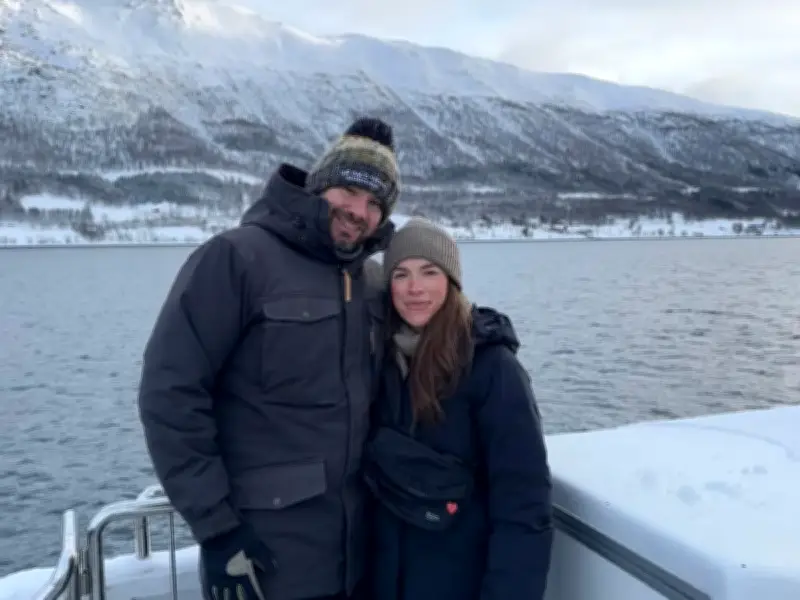
Chris Dawson, a fit 27-year-old sergeant in the British Army, was living with a potentially deadly disease without knowing it. He had been experiencing unusual fatigue but put it down to being a new dad. However, when he was put forward for a promotional course, he unexpectedly failed the required fitness test.
“I couldn’t understand how it had happened,” said Chris, now 38 and living in Chelmsford. “I was exhausted and dizzy. But instead of thinking something was wrong, I was embarrassed and assumed it was my fault. I just thought ‘I need to train harder’.”
Diagnosis after training injury
During a training session, Chris was asked to perform a fireman’s carry and prolapsed a spinal disk. He was sent to the army doctor, where a blood test was done after an unusual lump was spotted in his abdomen. That night, he was woken by a call telling him to go immediately to hospital. He was admitted to Colchester Hospital and diagnosed with chronic myeloid leukaemia (CML), a rare, slow-growing blood cancer that produces abnormal white blood cells. It is more common in older adults, with a typical age at diagnosis of around 60–65.
“I was in complete shock,” said Chris. “The doctor told me he didn’t know how I was still standing because I was that unwell. I remember calling my brother and crying, and he told me to keep my chin up and that we’d sort it out.”
Treatment and leaving the army
Treatment began immediately with chemotherapy followed by targeted drugs known as TKIs (tyrosine kinase inhibitors), which stop the production of abnormal white blood cells. As his long-term prognosis was unclear, Chris became classed as non-deployable by the army. “It broke me,” he said. “The army defined me, I’d joined at 16 and it was all I knew. But the whole point is to be deployable, and as I had a mortgage to pay and a one-month-old baby I decided to leave.”
He took on hard physical jobs like scaffolding while adjusting to treatment. Within six months, Chris had become a dad, been diagnosed with cancer and abruptly exited the army. His mental health started to deteriorate. “I’m sad to say that I didn’t really believe in mental health issues before,” he said. “I had this mentality that it was weakness, but it absolutely isn’t. The army had my life mapped out in front of me and suddenly that structure and my whole sense of identity was gone.”
Recovery and raising awareness
Over a number of years, Chris slowly regained his strength. At an appointment in 2022, he was told there was no reason he shouldn’t expect a full life expectancy. Recently, he was offered the possibility of treatment-free remission, but has decided to stay on treatment for at least a few more years to collect more data on CML treatment.
In 2026, Chris’s wife Laurie arranged a 66km canoe paddle along the Thames with her employer, tech HR company Zinc, to raise money for Leukaemia UK. She said: "Everyone thinks their partner is incredible, but Chris is truly remarkable. The bravery he has shown through more than a decade of uncertainty, is beyond anything I think I’d personally be able to match."
September is Blood Cancer Awareness month, and Chris is sharing his story in support of Leukaemia UK. Every day, 28 people in the UK are diagnosed with leukaemia. The most common symptoms are extreme tiredness, bruising, unusual bleeding, and repeated infections. Leukaemia UK is urging the public to contact their GP and ask for a full blood count test if something doesn’t feel right.
Fiona Hazell, Chief Executive of Leukaemia UK, said: "We’re so grateful to Chris for sharing his story to help raise awareness of leukaemia. Most of the signs and symptoms are not specific, so can often get mistaken for other illnesses or be explained away. Early diagnosis saves lives. That is why we encourage anyone with symptoms to make sure it’s nothing serious by speaking to their GP and asking for a full blood count test."