
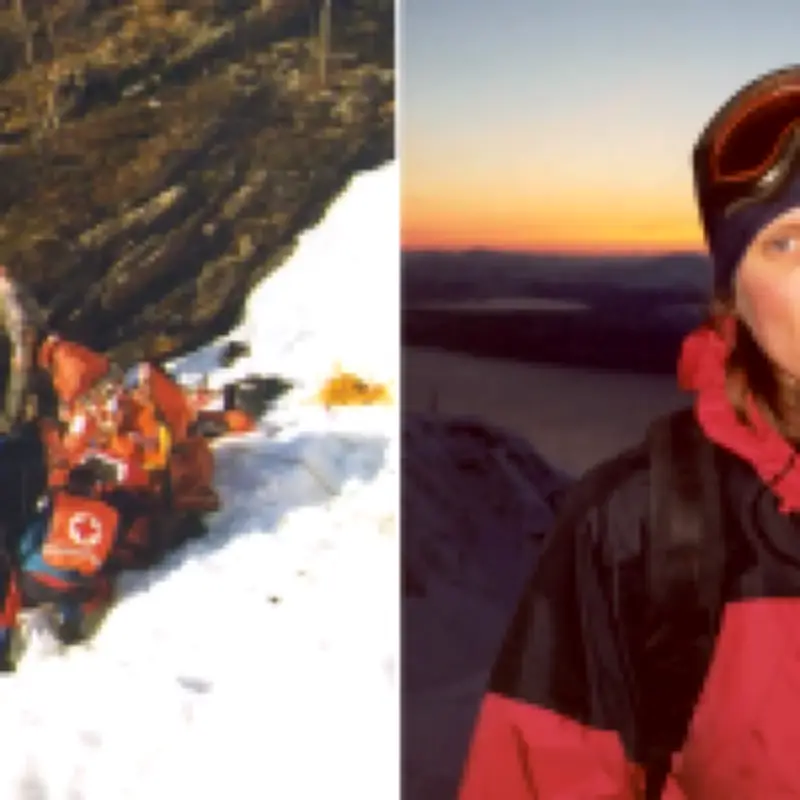
Anna Bågenholm, now 56, survived being trapped under ice for nearly 80 minutes in May 1999, with her heart stopped for two hours and 45 minutes. Her remarkable recovery was made possible by the profound hypothermia that slowed her body's functions, allowing doctors to rewarm her successfully. Experts say her case highlighted the protective role of cold in certain situations, while also warning of the dangers of cold shock for swimmers.
The Accident and Rescue
At the time, Anna was a 28-year-old junior registrar skiing in Narvik, Norway, with friends and fellow junior registrars Torvind and Marie. The trio had hiked 30 minutes from the ski lift to a frozen waterfall gulley, a spot they had descended many times before. Anna recalls: 'It wasn’t a dangerous spot, but I started to slip, turned on my back and slid with my skis uphill. I hit a hole in the ice, my head went under and the water filled my clothing, pulling me down.'
Anna remembers nothing after getting trapped; the details were later filled in by Torvind. Wedged between rocks and thick ice, the area around her head flooded with icy water. Marie grabbed Anna's hands until the cold made her lose her grip, then she and Torvind tried to pull her out by her ski boots, without success. The running meltwater pulled Anna under, and the ice was 30cm thick, too thick to break. After seven minutes of struggling, the friends called the nearest hospital, 100 miles away, and nearby volunteers.
Clinical Death and Rewarming
Anna struggled beneath the ice for 40 minutes before stopping. Her body temperature was later recorded at 13.7 degrees Celsius. After about 60 minutes, helpers arrived on skis with a rope, but pulling her out by the legs failed. A local volunteer brought a steel shovel, enabling a hole to be made further down in the ice, so she could be let down and brought back up through the new hole. By the time she was pulled onto the ice, she was clinically dead, with no heartbeat or respiration.
Torvind and a volunteer started CPR. A rescue helicopter arrived, a medic intubated her, and the team took her to the University Hospital of North Norway in Tromsø, 100 miles away, continuing manual CPR throughout the hour-long journey. Medics, led by Dr Mads Gilbert, decided to take her straight to the operating theatre, where they connected her to a cardiopulmonary bypass and life support machine, and a blood rewarmer. Her heart had stopped for two hours and 45 minutes.
Dr Beat Walpoth, professor of Cardiovascular Surgery Emeritus at the University of Geneva, explained that 50 years ago, such victims were often declared dead. He noted that cardiac pioneers cooled children's body temperatures to around 20°C for surgery, and his team applied the same rewarming technique to hypothermic mountaineers, with many making full recoveries. This opened a new era of treatment for accidental hypothermia.
Recovery and Legacy
Anna's recovery was remarkable. After nine hours in the operating room and help from around 100 medics, she regained consciousness about a week later. She was among the first people saved following cardiac standstill after hypothermia, and the method has since been used on many others, with a survival rate of around 40%. She notes that awareness of hypothermia is crucial, as people can be declared dead without being rewarmed.
Anna was paralysed from the neck down when she regained consciousness and couldn't breathe by herself. She thought she had been hurt on a sailing trip. She recalls: 'You are so ill. You have no energy. But I was really well taken care of.' When she could talk, she told Torvind she thought it was a bad decision to save her because of the cost of hospitalisation and paralysis. But Torvind and Marie read her Dr Walpoth's article to reassure her of a full recovery.
Four months after the accident, she was walking in the mountains again, and two months later, she was skiing. She returned to work after a year. In 2002, she and Torvind started dating and now lead an active life. Anna used her experiences to inform her PhD in 2015, in tribute to the hospital that saved her. She says she was largely unaffected psychologically: 'I was dead. And then I was awake. Things got normal again pretty soon.'
Cold Shock Dangers in the UK
Professor Mike Tipton, an expert on human survival in cold water, explains there are at least 200 accidental drowning deaths in the UK each year. He warns that when air temperatures rise above 26 degrees, people head to water that is still around 13 degrees, provoking a powerful cold shock response. 'What kills is that gasping and hyperventilation you get when you first go to cold water. The cold shock response kills at least 60% of those that die going into cold water.'
He advises: 'Stop and think before you start charging into water that’s freezing cold. If you must go in, go in slowly. If you find yourself in trouble, fight the instinct to thrash around. Instead, float to live. Roll onto your back, tilt your head back in the water, keeping your airway as clear as possible to stay afloat until you get your breathing back under control. And if you see somebody in trouble, phone the emergency services, because the time it takes to start effective resuscitation is directly linked to outcome.'




