
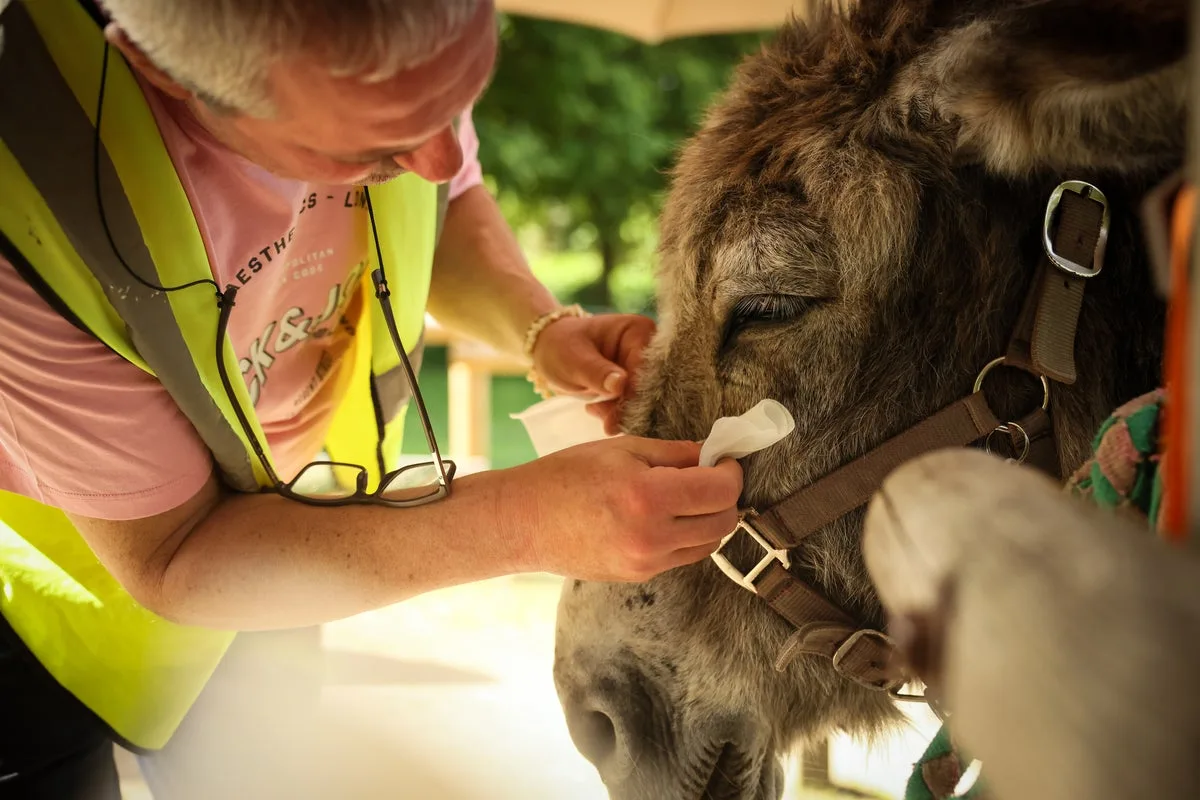
A psychiatric hospital unit near Paris is using therapy donkeys to help patients with mental health conditions, in a programme that is unique in France. The 19th-century farm buildings and wooded surroundings of the Ville-Evrard hospital complex in Neuilly-sur-Marne provide a calm setting where patients walk and care for five donkeys, often ending sessions with a hug.
“When you take medication that helps you relax … it’s exactly the same,” said Nathalie, a 60-year-old patient. “I’d call it animal medicine. It brings relief. You stop thinking about everything else.” Sessions are free and funded by France’s public health system. Patients are typically paired with a donkey—Nono, Pitou, Oscar, Manolo or Malraux—and gradually become familiar with their personalities.
The programme began in 2016, launched by Ermelinda Hadey, a nurse specialising in psychiatry, and her husband François, who trained the donkeys for therapy work. Some of the animals were adopted through shelters after experiencing neglect or mistreatment. “A donkey is very intelligent. It understands things very quickly, but you have to explain slowly,” François Hadey said. “They’re emotional sponges.”
Since 2022, the animal therapy unit has held official status as a healthcare unit within the hospital, allowing it to employ three full-time nurses. The programme has expanded to include guinea pigs, chickens, doves, goats, turtles and rabbits, and sessions are tailored to patients’ needs. Smaller animals can be brought to hospital rooms.
Health workers say the sessions help patients with conditions such as anxiety, depression, autism and schizophrenia, improving emotional regulation, communication, social interaction and self-esteem. Audrey Seffar, a nurse at the unit, described the progress of Nathalie, who initially stayed in a cart for people with physical difficulties but later stood beside her donkey. “The animal serves as a mediator,” she said.
Ermelinda Hadey noted that the therapy does not replace medical treatment but can help patients regain confidence. “It does not replace a doctor or a medical prescription, but it can help patients regain confidence and a sense of self-worth,” she said. She added that more scientific evaluation is needed to assess the benefits fully.




