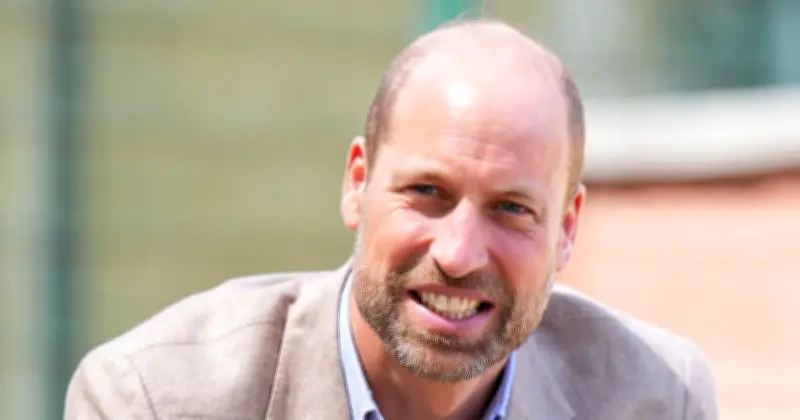
The Prince of Wales has urged people to “check in, listen and show kindness” as he speaks exclusively with the Daily Express to mark World Mental Health Day. William has spoken of the “extraordinary impact” of stopping to ask if someone is ok, adding that one conversation can make all the difference.
Mental health and suicide prevention have been a cornerstone of the future King’s public work for over a decade, as he focuses on destigmatising mental health, supporting men in crisis and encouraging open conversations.
William’s Call for Simple Acts of Kindness
“We do not always know what someone is carrying beneath the surface,” the prince told this newspaper. “Taking the time to check in, to listen, and to show kindness can make more of a difference than we often realise.
“Sometimes, a simple conversation is where hope begins. The moments that often matter most are the simplest ones: checking in on someone, listening without judgement, and reminding them that they are not alone. Small acts of kindness can have an extraordinary impact.”
William supports a range of charities and initiatives, bringing many of them together under his Royal Foundation for the National Suicide Prevention Network, which aims to understand more about the causes of suicide, provide support that can be accessed by anyone, and encourage more collaboration between different agencies.
Charities Praise William’s Impact
Leading mental health charities have said William’s work and commitment to improving mental health has had a profound impact, as it helps bring difficult conversations out into the open, normalise them and encourage people to speak out.
Ellen O’Donoghue, CEO of James’s Place, a charity offering free support for men experiencing suicidal crises, said the future king’s involvement with James’s Place has been “incredibly significant” for both the charity and the men that they help.
“What the Prince of Wales has done by being so open and vocal about the importance of suicide prevention is that he has made it easier for those men to speak out. We see that at James's Place, but I would expect that to be the same more widely, as well.
“That a topic that has, in the past, been seen as something to be kept a secret, to be ashamed of, has become something that we can really talk about.”
James’s Place, which has treated over 6,000 suicidal men since 2018, was set up by Clare Milford Haven and Nick Wentworth-Stanley in memory of their son, James Wentworth-Stanley, who took his own life aged 21.
Ben Brand’s Story: A Life Saved
Ben Brand, 34, who received help from James’ Place, a charity offering free, life-saving treatment to suicidal men, said William is doing incredible work breaking down the stigma. “Everyone’s going through something, and having someone like him talk publicly about it makes you realise it’s ok to talk,” he said.
The father-of-two from Bedford met the prince in Birmingham in May, when William opened the charity’s new centre. Reflecting on the meeting, he said: “It was a real open and honest conversation. You could 100% tell how passionate he is about it. He’s not just doing it because he should, he really does care.”
Mr Brand, who credits the charity for saving his life, added that William was keen to hear how we could help. “He wasn’t just listening, he was trying to problem solve as well.”
Mr Brand was suffering from stress and had just had a new baby when he quickly found himself in suicidal crisis. A friend introduced him to the charity and he was seen within 48 hours of making a referral.
“When I arrived it was nothing like a doctors surgery or hospital, it was really welcoming, calm and comfortable and the staff were really caring. I had about eight sessions with the same therapist. She was brilliant, taught me lots of coping mechanisms, ways to identify the way I'm feeling, because that's one thing I've always been really poor at. I was not understanding my own feelings and emotions very well.
Using the service helped me get out of that dark hole, giving me practical ways to cope. I'm much better now at spotting my emotions. I can understand when I'm starting to spiral.”
Asked what advice he would give to someone else who was struggling with their mental health, he said: “Don't just bury it under the carpet and hope it goes away, because it might not. And all you're going to do is just delay the problem for later in life.
“That's what happened to me. I just buried everything and delayed it, and when it all came out, it came out in one huge explosion rather than in manageable bite-sized pieces.”
William has opened all of the four centres in Birmingham, Liverpool, London and Newcastle, which offer face-to-face therapy within two days of a referral. Treatment is offered quickly, with around six to eight sessions taking place with a professional who helps them recover from crisis and see a way forward.
Radio 1 Appearance and New Toolkit
William’s mental health advocacy made a tangible difference to the charity when he appeared on Radio 1 in February to discuss male mental health and suicide prevention. He opened up in a frank conversation, encouraging people to share their feelings and admitting it took him “a long time to understand my emotions”. The prince appeared alongside host Greg James, musicians Professor Green and Guvna B, Allan Brownrigg, director of clinical services at James’s Place and one of the charity’s former clients.
After the show aired, James’s Place “immediately saw referrals from young men who had heard that programme”, Ms O’Donoghue said. “And that's so key because those people are at such a vulnerable point, and if they can just kind of find that little bit of hope to reach out, it is genuinely life-saving.”
The Royal Foundation has also made it possible for Welsh mental health charity Jac Lewis Foundation to open a mental health hub in Cardiff’s Principality Stadium that provides counselling and transport costs to hundreds of people who are at risk of suicide last September.
The charity’s CEO, Liz Thomas-Evans, said that without funding from William’s foundation, more than 250 people would have missed out on support. She said: “Because of the wonderful support from the Royal Foundation, there's no waiting list. So somebody who walks into the Cardiff Mental Health Hub can have counselling within the next couple of days once they've been in. It's immediate, near enough.”
Last month, the prince launched the On Your Side toolkit, aimed at helping the sports sector tackle serious mental health issues among players, coaches and fans. The Princess of Wales joined her husband at the event in Liverpool, knowing how important the campaign was to him and because she is also a mental health champion.
Jake Mills, founder and CEO of Chasing the Stigma, which co-produced the toolkit, said the response has been remarkable. Four weeks after the launch on September 10, he said that it’s not just been the influx of visitors viewing the toolkit on his website, Hub of Hope, but the conversation that the campaign has sparked. It’s not just sports players and clubs that have sought to get involved either, different sectors, and individuals have reached out wanting to get involved and know how it can be transferred to other areas.
And Mr Mills believes having the prince and princess there made all the difference, noting how powerful William’s speech was at the launch event. “It came across as somebody who genuinely cared, understood and wanted to do more. It came across as someone who was very, very genuine about wanting to make a difference.
“If the future King can set this tone and can stand in front of people in this way then it really sets that tone for others to follow suit and give permission to be vulnerable and to not be okay and to want to do something about it.”
The CEO, who created the charity following his own battle with depression and suicide attempt in 2013, added: “And that's how conversations change. That's how we change culture. That's how we change environments.”
Information and support can be found at the Hub of Hope, the UK’s largest mental health support directory hubofhope.co.uk. Text SHOUT to 85258; or call the Samaritans free at any time on 116 123. Lines are open 24 hours a day. You can also email jo@samaritans.org