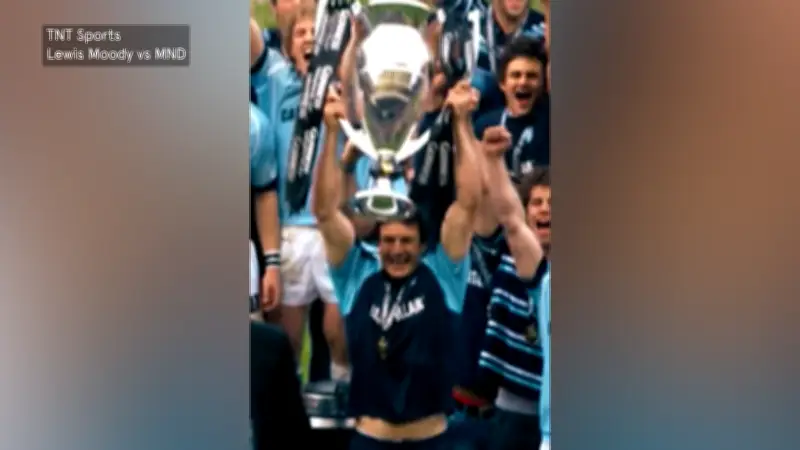
Lewis Moody's sons have spoken publicly for the first time about the emotional toll of their father's motor neurone disease (MND) diagnosis. The former England rugby captain and his family feature in a new documentary, with his wife Annie and their two teenage sons opening up about their shock at the diagnosis last year.
Sons speak of heartbreak and fear
Dylan, 18, a professional goalkeeper with Southampton, followed in his dad's footsteps by representing England on the international stage. He breaks down when describing playing for the Three Lions at the World Cup just a month after his father discovered he had MND.
Dylan explained: "A month after your diagnosis, I had the [Under 17s] World Cup, that was probably the best experience in football I’ve had. Just three weeks abroad in the heat playing at a World Cup for your country with all your mates. But the diagnosis makes you think more about what you’re missing at home. I don’t know what I’ll return home to. I just tried to make the most of it while I’m away. Every day was the hardest I’ve ever trained."
He tells his proud dad: "I was in an England shirt like you were, so it felt similar. I’d rather it be on my mind than it not be because it helps me day-to-day, having something to drive me."
Ethan's dreams and worries
Ethan, 16, dreams of playing Test rugby for England like his dad and is currently part of Bath's youth academy. But he admits that he "worries about the future".
"Sport helps because you can just let all your anger out, especially in rugby," he added. "It probably doesn’t sound great but you can hurt somebody."
Diagnosis and symptoms
After noticing weakness in his shoulder while exercising, Leicester Tigers legend Moody was told he had the life-limiting neurological condition in September last year. He went public with his diagnosis the following month.
MND affects motor nerves in the brain and spinal cord, causing muscle weakness, stiffness and paralysis and impacting a person's ability to walk, talk, swallow and breathe. While treatment can slow the progress of the disease, it is currently incurable.
Rugby league legend Rob Burrow and former Scotland international Doddie Weir are among those who have died from MND in recent years. Moody has thrown himself into fundraising challenges.
Family's fears and Moody's peace
Annie admits she notices physical changes in her husband "all the time" and acknowledges the future will be difficult for them, both physically and mentally. "I see change all the time, your shape or your fasciculations (twitches)," she says during an emotional heart-to-heart.
"I think mentally it will be very hard for you. Physically it will be hard for me, because I’ll have to physically support you as well as mentally." She adds: "It’s scary. We’re scared. I know it’ll be really hard. Hard for Lewis, he’s going to be trapped in his own body and that’s terrifying. That’s so upsetting."
Moody is "at peace" with his diagnosis, having received reassurances from a medical expert that it is not directly linked to his rugby career. "One of the questions that someone asked me recently was, ‘You must be devastated that rugby’s put you in this position?’ I was like, ‘Is he meaning motor neurone disease?' I was just baffled by it, but it made me ask the questions of the specialists, ‘Is that the reason I am here?’ I literally asked that direct question. And he said: ‘Rugby isn’t the reason you have MND.'"
"There are a number of things that come together, coincidentally or not, that you are more predetermined or disposed to than anyone else. It might be genetic. It might be lifestyle. I suppose it was a relief in many ways because I was almost angry at the person for asking that question. But it made me question it more and make sure that I checked in with the specialist."
Moody's career and MND statistics
Moody had a distinguished rugby union career, coming off the bench to help England win the 2003 World Cup in Australia. He started for England in the 2007 World Cup final defeat before going on to captain the team at the 2011 tournament.
In the UK, there are 5,000 adults with MND at any one time. Athletes studied were more likely to develop the condition. There is no evidence to show that sporting injuries are the cause. Instead, it is likely to be a complex mix of genetic and environmental factors, along with random 'damaging events' in cells more common with age. In about 5-10 percent of cases, known as inherited MND, there is a family history and a known genetic mutation.
Experts say MND is really several diseases at the same time which cause the death of motor neurons or nerve cells. While there is no cure, treatments are providing some hope. Some people can live for many years with MND; theoretical physicist Stephen Hawking was diagnosed at the age of 22 and lived to 76. Two studies from 2005 and 2009 showed professional footballers were at increased risk. Durham University found rugby players who had suffered multiple concussions have biological differences that may make them more prone to developing MND.