Paul Courtney, a veteran firefighter honoured by King Charles with a Humanitarian Award, has revealed he was secretly battling crippling PTSD, haunted by the horrors of the Grenfell Tower blaze. He spent 12 days scouring the charred tower block after the inferno left at least 72 dead in 2017.
The father-of-two, a member of the elite UK International Search and Rescue (UKISAR), discovered the bodies of a family huddled together among the blackened debris. In the days that followed, he learned their identities when their photos flashed up on TV screens as the true scale of the devastation emerged.
Faces that haunt him every night
Paul said their faces haunt him every night despite years of trying to come to terms with the trauma. Speaking just days after police handed files on 20 organisations and 54 people to the Crown Prosecution Service, Paul said he was sent to Grenfell just 24 hours after the fire to assess the structure.
He said: "I would wake up screaming at 3am in the morning thinking somebody had broken into the house because there's people standing at the end of my bed looking at me. But there was nobody there. It started to affect me, I couldn't sleep and I was tired. I'd let my wife go to sleep, I'd come down downstairs and put the TV on or read a book. Then I'd fall asleep on the sofa and wake up with my neck all crooked and uncomfortable and then I have to go to work and do it all again."
"I knew that that night I'd wake up and do exactly the same and it was just like Groundhog Day. It was just continuous and scary."
A career of disaster response
Paul signed up to the London Fire Brigade in 1997 before he was seconded to the elite UKISAR, travelling to Malawi and Kenya to carry out life-saving work. During his career he attended the 7/7 suicide bombing at Tavistock Square in 2005 to help forensic teams deconstruct the twisted wreckage of the number 30 bus where 13 people died and more than 100 were injured. He was deployed to Morocco in 2023 to scour remote settlements across the Atlas Mountains when a 6.8-magnitude quake left 2,900 people dead.
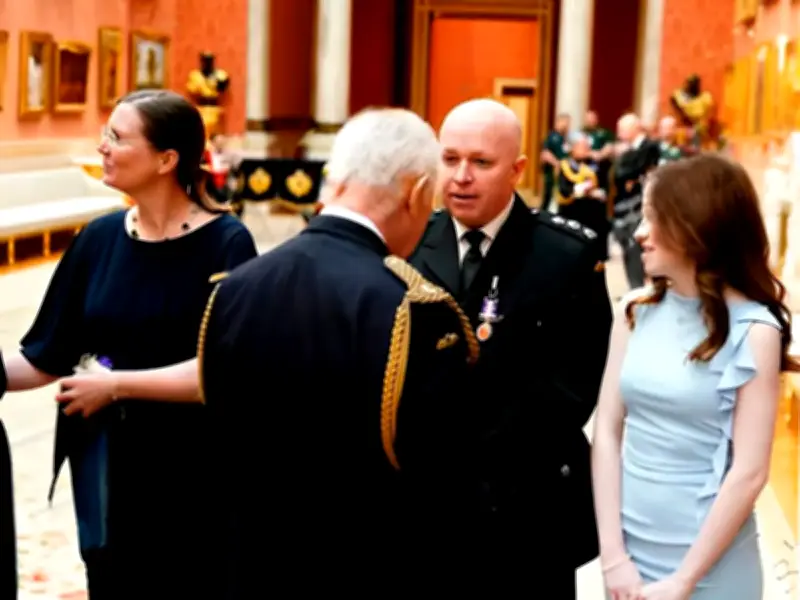
Paul was awarded the Humanitarian Medal by King Charles at Buckingham Palace in 2025 for his work in north Africa. But despite being deployed at disaster zones in the UK and abroad, it was the haunting aftermath of the 2017 blaze in West London that left Paul traumatised.
Widespread trauma among firefighters
Fire brigade heroes traumatised by the Grenfell Tower tragedy have taken more than 8,000 days off work due to PTSD. Figures show that even nine years on from the blaze, firefighters took 445 sick days last year because of the psychological trauma they suffered. A Freedom of Information request shows 8,218 working days have been lost due to firefighters suffering PTSD. Another 446 days were lost from 999 control room staff also affected by psychological trauma.
London Fire Brigade says 30 staff – 27 firefighters and three control operators – have been diagnosed with PTSD since the disaster. So far, 16 staff – 15 firefighters and one member of the 999 control room staff – have been retired because of their psychological damage.
Today Paul said: "Grenfell is constant, it's something I experience every evening, it's always a constant in the background. It's like the badge I bear for being there. It's a badge I don't want to have. I never want to do another Grenfell Tower ever again."
Reliving the chaos
Re-living his time spent at Grenfell, he said: "When I pulled up to it, it was pretty much like it looked like a scene from a movie set. It had a sort of ashen look, it almost looked like something out of a movie scene. It didn't look real. My first task was to inspect the structure so I walked every floor. Some of them were still smouldering away.
"Nobody could have survived the fire inside the tower. When I arrived everybody that had been lost in the fire was still in the building. Okay. All around the base of the tower and the stairwell, you stepped through the debris on the floor, and it was just an indication of the chaos. On the stairs there were car keys, glasses, false teeth, clothes, pets, walking sticks, bodies, all of those are indications of how chaotic it must have been trying to get people out. There was no borrowed light, it was just complete darkness. It is a tube with a staircase in it inside the centre of the tower.
"So initially the search was all by torchlight, going up and down stairs with that circular beam of light. It would light up a pet or a body. I'm 5ft 10ins, quite broad shouldered, but two of us couldn't pass on the stairs together."
Paul, who lives in Watford, Herts., said it took nine months to finally realise how traumatised he was by the experience of attending Grenfell. He said: "I was at work and a senior officer said to me, 'Are you OK Paul?' Because I just wasn't myself I think. And I went, 'No, I'm not boss, really'. And he went, 'Come on let's go and grab a cup of tea'. And we went for a walk and then I explained what was going on, and he said, 'Right, let's get you some help'. And, you know, he's the man that made the difference, because it was a dark old place without him. I thank him every time I see him."
Finding strength and supporting others
Paul, who became the training and assurance officer for the UKISAR team in 2021, has spent years trying to come to terms with what he witnessed at Grenfell, sharing his experience with colleagues and undergoing Trauma Risk Management sessions. But he still wakes up each night to the faces of those who died in the blaze – but says he has learned to live with their presence. It is only thanks to his wife, Rosalie, 46, a business relations manager in a care home, and his two children, Harrison, 25, and Delilah, 17, that he has found the strength to continue.
Speaking on World Mental Health Day, Paul, who retires on November 29, said: "I waited nine months to get help, which was stupid, I should have got help sooner." Paul told his story as he backed the Gratitude Games, designed to spark a national conversation about the mental health of emergency responders. The event is designed to highlight the mental health challenges of those who protect us from harm. Paul took part last year in the clay pigeon shooting event, raising £600 for charities that help first responders.
He said: "Money raised in the Gratitude Games can go a long way to help somebody, a fellow blue light responder." Sixty-six per cent of fire service personnel and 70 per cent of police officers have grappled with mental health issues, according to research from the charity, Mind. For ambulance workers, this figure rises to 76%. Meanwhile, anxiety, stress, depression and other psychiatric illnesses were the most reported reasons for sickness in the NHS, accounting for more than 610,500 full-time equivalent days lost and 27.5% of all sickness absence in March 2025.
The Gratitude Games, supported by Grenfell Tower firefighter Ricky Nuttall, takes place next year but organisers are now asking participants to register to take part. The 2027 event will mark 10 years since the Grenfell blaze and a decade since the Manchester Arena bombing. The brainchild of Mike Downard, a serving firefighter with Buckinghamshire Fire and Rescue, it was launched in 2018 when he saw a growing need for additional support for all the UK's emergency service workers. In June this year, the inaugural Gratitude Games saw athletes from all over the UK and across all services descend upon Manchester, the host city, to take part and raise money.
Organisers are shortly about to open registration for next year's games, again hosted by Manchester and in partnership with E.J. Churchill, Forces Equine, Scimitar and Tour De Manc. Next year the games will be even bigger with the exciting addition of a huge 7-a-side football tournament alongside Clay Shooting, Equestrian, 10k road run, Cycling and more. Participants are asked to raise funds with every penny going to charity partners Police Care UK, The Ambulance Staff Charity, The Firefighters Charity and The Blue Light Card Foundation.