
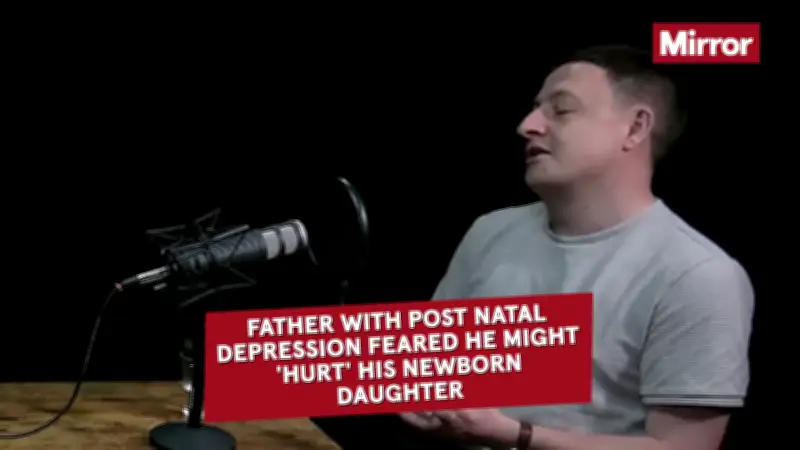
Steve Sharman, 35, from Stoke-on-Trent, experienced intense rage and suicidal thoughts after the birth of his daughter Florence in August 2023. The crying triggered overwhelming anger, leading him to fear he might harm her.
"I've never been an angry person," Steve said. "But I felt this overwhelming anger. I wanted to throw her on the floor, scream at her, harm her. I never acted on those thoughts, but they were so strong. It felt like I was becoming someone else."
A traumatic birth and a sudden onset
His wife Emily endured an 18-hour labour before an emergency caesarean section. Although Florence was born healthy, concerns about her heart kept the family in hospital for five days. When they brought Florence home on their wedding anniversary, Steve's world changed.
"It was the crying that triggered something in me," he said. Alongside anger came crushing depression. "I felt completely useless to the world. I'd lock myself away in the spare room and not want to do anything," he said. "I had moments where I contemplated suicide. I genuinely thought the worst-case scenario was I'd either end up in prison or end my own life."
Hidden struggles and societal pressure
Steve hid his feelings, masking his pain to appear as a happy new father. He returned to work as a Communications Officer in the NHS just four weeks later, feeling pressure to be the family anchor.
Dr Anna Machin, author of The Life of Dad, said social expectations are a primary reason men fail to seek help. "We expect men to step into the role of supporter and emotional rock which means that they should negate their needs and feelings to support their partner," she explained.
Different symptoms and biological factors
Male postnatal depression often manifests differently than in women. "Men tend to show less obvious low mood but much higher anxiety, anger, irritation and frustration. They're also more likely to withdraw from family life or self-medicate with alcohol or drugs," Dr Machin said.
Biological factors also play a role, as a new father's testosterone levels can drop by up to 30 percent. Higher testosterone appears to protect against depression, so this hormonal shift can increase vulnerability.
A turning point
Steve's turning point came when his sister-in-law suggested contacting the charity PANDAS, which supports families affected by perinatal mental illness. He joined a Zoom call for dads, where he shared his story and, for the first time, felt understood.
"They shared experiences that were almost identical to mine. When the call ended, I burst into tears because it was the first time I didn't feel broken," he said.
With PANDAS encouragement, Steve wrote a letter to his parents about his struggles and suicidal thoughts, and later shared his story publicly on social media to break the stigma.
Lack of support for fathers
Dr Machin noted that there is no routine screening programme or diagnostic tool for perinatal depression in men, unlike for mothers. "That means many fathers simply fall through the cracks," she said.
Elliott Rae, founder of Parenting Out Loud, said workplaces need to support men after having children. "One of the key risk factors for dads experiencing postnatal depression is not bonding with their baby," he said. "If the dad goes back to work too soon, the baby cries when they are picked up, they don't feel as confident with the baby independently."
Life today
Three years later, Florence is thriving, and Steve no longer feels overwhelmed by toddler meltdowns. The couple is even discussing having a second child.
Steve now volunteers with PANDAS, speaking on podcasts, contributing to research, and delivering talks to healthcare professionals. "If my story helps just one person, then it's worth it," he said. "I want dads to know there is absolutely no shame in speaking up."
For emotional support, the Samaritans can be reached 24 hours a day on 116 123, or via email at jo@samaritans.org.




