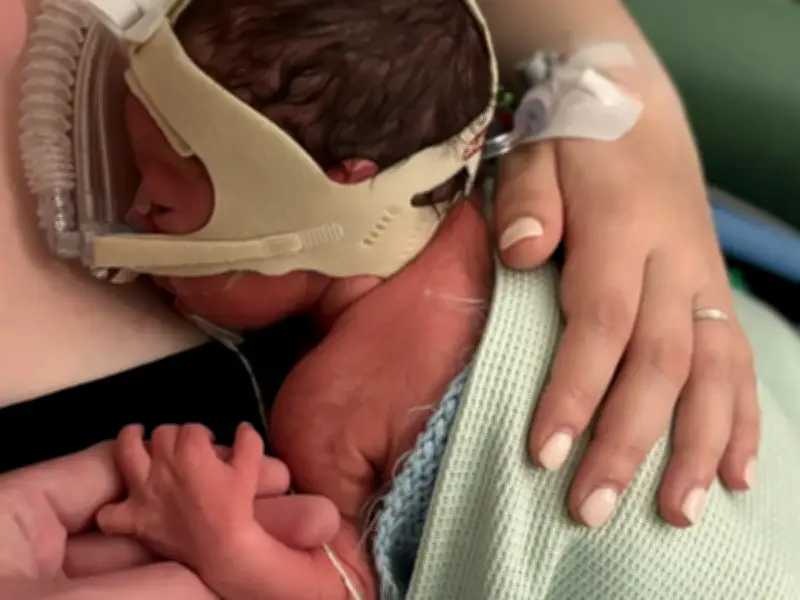
Lauren Mulhern, a children's nurse at Royal Manchester Children's Hospital, has completed her first half marathon, raising £500 for the Local Neonatal Unit at Wythenshawe Hospital, after her son Jensen spent three weeks there following his premature birth at 33 weeks. She now hopes to take on the Manchester Marathon next year to support other families facing similar experiences.
Premature birth and hospital care
Jensen was transferred to the Local Neonatal Unit at Wythenshawe Hospital immediately after his birth in May 2025, where he received specialist support with his breathing and feeding before being able to go home. Lauren, who has worked as a children's nurse at Royal Manchester Children's Hospital since qualifying in 2017, said her pregnancy had been far from straightforward, with concerns meaning she and her husband were aware Jensen would probably arrive early.
She said: "The whole pregnancy was just a little bit unexpected. Especially with it being that first one, it wasn't what people sell pregnancy to be like, that whole magical thing." Lauren was monitored closely at Wythenshawe Hospital, attending appointments two to three times a week at its specialist placental clinic. Eventually, the family were told Jensen needed to be delivered, and Lauren remained in hospital for a further two days to receive steroids before giving birth on the bank holiday Monday in May 2025.
Navigating fear and understanding
For Lauren, her medical background brought both reassurance and additional anxiety. While she understood much of the terminology and knew what to expect from neonatal care, she was also aware of the potential complications that could lie ahead. She said: "I found myself almost going onto autopilot and going into that nurse mode."
She added: "At the appointments when they were explaining things, I knew what they meant, and sometimes my husband would be sat there thinking, 'I have no idea what they're explaining'. From one part of it, it was comforting that I understood and knew a little bit of what that NICU experience was going to be like. But that did also create quite a lot of fear as well, because rather than the uncertainty that other parents have because they don't have the knowledge, mine was almost the opposite. I knew what some of the complications were going to be and I was quite scared of what that was going to mean for us and for him."
After Jensen was born, he was transferred straight to the Local Neonatal Unit at Wythenshawe, part of Saint Mary's Managed Clinical Service, where he would spend the next three weeks. Despite being familiar with hospital environments through her work, Lauren said becoming a parent of a baby in an incubator was an entirely different experience.
Moments of support and turning points
Lauren recalled how one nurse arranged for Jensen to be taken out of his incubator so she could hold him and enjoy some skin-to-skin contact, recognising that these were experiences she had missed out on following his premature arrival. She said: "She was clearly very aware that they were things that people got normally in birth, and it was something that I was obviously very upset that we didn't get to do. Without me even having to ask for it, she knew that was something I was going to want. It just felt like you were so understood without having to feel vulnerable and ask for those things."
Lauren said the team also made sure she and her husband were included in discussions about Jensen's progress, encouraging them to take part in his day-to-day care wherever possible. She added: "I remember very much at the start not feeling like his mum, because he was in an incubator. But when it's that involvement in his care, and being able to change his nappy, albeit through the little holes in the incubator, it was doing things that are important. It takes away that fear of not feeling like you can do anything for him, or not being able to handle him and hold him or comfort him."
Although his blood test results suggested he might not yet be ready, a nurse called Anna felt his clinical presentation told a different story. Lauren said the nurse advocated for Jensen, ensuring the doctor came to assess the bigger picture rather than relying solely on the test results. After further discussion, the team agreed to try removing his breathing support – and Jensen did not need to go back on it. Lauren believes the decision helped mark a turning point in his recovery, with his feeding and weight also beginning to improve.
She said: "Thanks to her that day, and the doctor being very clear that they could see what she meant, they gave it a go. Actually, he never went back on it after that. That was where everything started to pick up, like his feeding and everything else. I just think if it wasn't for her being so confident and advocating for him, and involving me and my husband in that decision, that stay could have been even longer."
Coming home and giving back
After three weeks in hospital, Jensen was finally well enough to go home. Lauren described the moment as a mixture of relief, joy and fear, admitting she had struggled to believe they would actually be leaving with their baby until they were walking out of the hospital with him in his car seat. She said: "That whole three weeks, it was just that constant viewing him, wanting him to come home, and the feeling of having to leave him every day was awful. I don't think I was really convinced that he was going to come home the next day until we were walking out with him in his car seat. Then I thought, 'My God, this is it. He's actually coming home.' It felt pretty surreal, to be honest."
Now, around 18 months on, Lauren said Jensen is doing brilliantly and that people would never know what he had been through in those earliest weeks. Lauren said becoming a parent herself has made her even more passionate about ensuring families feel supported and understood while their children are receiving hospital care. She said: "There are certain things that I find myself even more passionate about than I was before. I know how important breastfeeding support is, and I know how crucial that was to me. There were times when I could have given up, but it was thanks to the nurses on NICU that gave me that support that we carried on. Actually, 18 months later, we're still doing it. If it wasn't for them, we wouldn't be able to. If I can give one of these mums an extra bit of my time, and that means their journey continues, then fine. It's almost repaying it, isn't it, for what they were able to do for me? I can do that for somebody else."
Having enjoyed running before becoming pregnant, she decided to take on her first half marathon and raise money for the neonatal unit. Lauren said: "When we came home, I always said there was something I wanted to do to be able to give something back to them because it almost feels like I'm forever in their debt for what they did for us. If this means that they can get extra things for other families, whether it's a new type of equipment or something that's going to make a positive impact for somebody else who goes through the exact same thing, then it's the least I could do." She is also keen to find a way to support the placental clinic team who cared for her throughout her pregnancy.
As Christmas approaches, Lauren knows just how important it is for families with children in hospital to feel some sense of normality during what can be an incredibly difficult time. In her role at Royal Manchester Children's Hospital, she said staff do everything they can to help young patients spend Christmas at home where possible, even arranging home leave if they are not quite ready to be discharged. For those who have to remain in hospital, staff work hard to make the festive period special, with presents, Christmas decorations, films and even visits from Santa.
Lauren said: "Nobody wants to be in hospital, but it's just trying to normalise and make the most of that experience for them. There's always somebody who will dress up as Santa. Through donations through the charity, we have presents, and we'll do that on Christmas Eve night. They'll go around and leave them at the end of the children's beds for any of them that don't get to go home. It's making sure that they don't feel like they're missing anything. Because why should they?" She added: "It takes a whole team to make it so special for everyone. Little things might seem really little to us, but they make all of the difference for them."