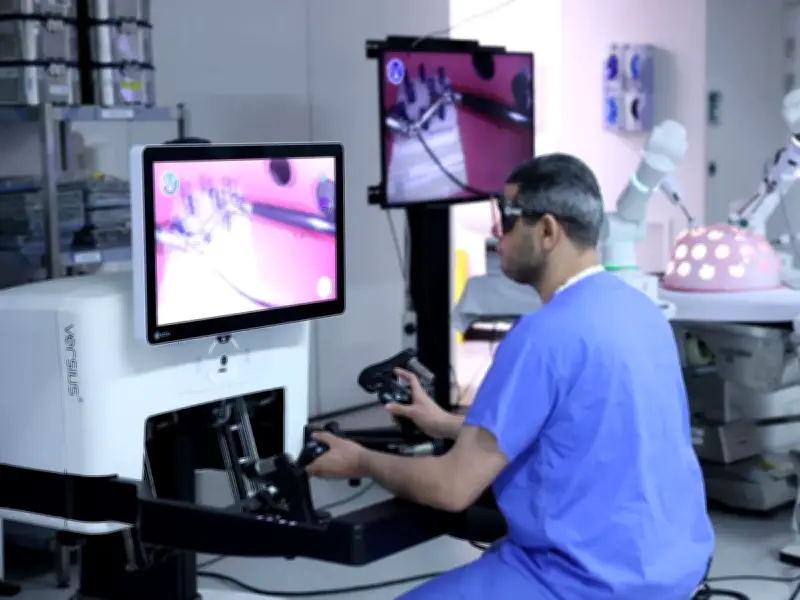
The Freeman Hospital in Newcastle is set to become a national centre for robotic surgery, with a £7.4m government-funded project aiming to make the city a hub for the technology.
The Newcastle Surgical Training Centre (NSTC) at the Gosforth hospital will lead the initiative, which is designed to help NHS trusts across the country adopt robot-assisted surgery more widely.
Funding for a national robotics adoption hub
Innovate UK, a government agency under UK Research and Innovation (UKRI), announced last month that it would fund the project, making the NSTC a "robotics adoption hub". The centre will bring together best practice from around the UK and work to help NHS trusts "overcome barriers" to introducing robotic surgery safely and efficiently.
Professor David Deehan, consultant surgeon and co-director of the NSTC, said: "We built and have nurtured the NSTC since the first course ran in 2007. We have accommodated advances in surgical technology and our role is to facilitate the training of surgeons, anaesthetists, theatre staff and all who are involved in the delivery of expert care to the patient."
Training and benefits for patients
The new project aims to incorporate advanced surgical robotic technology into theatre workspaces and address current barriers so that all patients have access to the latest surgical technology. Prof Deehan described receiving the funding as "humbling", noting that research in the UK and internationally shows robot-assisted surgery can lead to improved outcomes.
Co-director and fellow consultant surgeon Prof Alan Horgan said: "The challenge is not simply introducing new technology but understanding how it can deliver the greatest benefits for patients and clinicians." He added that the hub would help hospitals make informed decisions, prepare their surgical workforce, and learn from others' experiences, ensuring robotic surgery is introduced safely and sustainably.
Prof Horgan noted that robotic surgery opens up "huge opportunities", allowing surgeons to operate with greater precision and efficiency. He said: "The robots are very useful to us. The surgery is still performed by surgeons but using the robots allows us to do the surgery much more precisely and efficiently - and technically it opens up huge opportunities for us to do things that we could not do before in a standardised manner."
NHS England projects that half a million operations each year could involve surgical robots by 2035. For some patients, robotic surgery can mean smaller incisions, less pain, reduced blood loss, and quicker recovery.
START (Surgical Training in Advanced Robotic Technology) is a collaboration between the Newcastle Hospitals NHS Trust and the wider Shelford group of trusts, of which it is a part.