
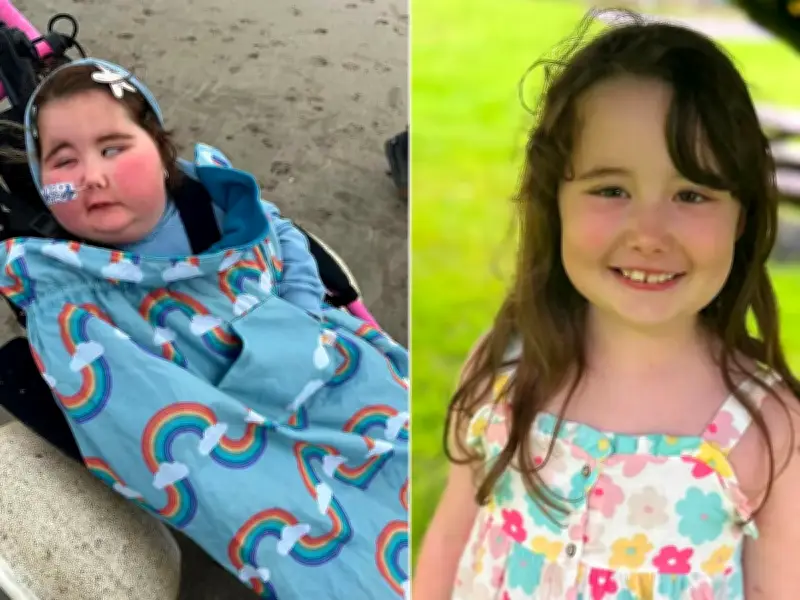
A mother who refused to leave A&E after medics allegedly claimed her daughter's symptoms were "attention-seeking behaviour" was told the next day that her seven-year-old had just weeks to live.
Jennifer Lees had spent months fighting to have Harlyn Rose Hawke's worsening condition taken seriously. When her symptoms rapidly deteriorated in June 2024, Jennifer took her straight to A&E - only to be told they could go home.
"The only test they did was an ECG," she claimed. "They watched her walk up and down the corridor and then told me they were happy for us to go home."
"They said it was attention-seeking behaviour because she'd been saying she felt sick every morning. We now know morning sickness can be a symptom of a brain tumour."
Refusing to leave
"I was furious, and I said, 'I'm not leaving until she's been seen by paediatrics,'" Jennifer, from Cornwall, said. "The paediatric doctor said, 'Thank God you dug your heels in. We need to give her a CT scan.' They saw something straight away. I knew from everyone's faces that something was very wrong."
The following morning, Jennifer and Harlyn were transferred by ambulance from Royal Cornwall Hospital to Bristol Children's Hospital. An MRI confirmed the seven-year-old had diffuse intrinsic pontine glioma (DIPG) - a rare and incurable brain tumour growing in her brain stem.
A devastating diagnosis
"They told me it was in her brain stem and there was no treatment for it," Jennifer said. "The only thing they could offer was a short course of radiotherapy to buy her a bit more time and manage her symptoms. When we first arrived, they told me she probably had between two and four weeks to live."
Jennifer immediately phoned family members, urging them to come to the hospital to say goodbye. Against all expectations, however, Harlyn responded remarkably well to steroids, allowing doctors to proceed with a short course of radiotherapy.
She later became one of the first children to receive an experimental drug, which her mum believes helped extend her life. Instead of weeks, Harlyn survived another 17 months.
Months of missed signs
"We were incredibly grateful for every extra day," Jennifer said. "She outlived so many of the children we'd met with the same diagnosis."
Looking back, Jennifer believes the warning signs had been present for almost a year, with symptoms starting in August 2023. Harlyn had previously undergone treatment for a squint, but after being discharged, her eye suddenly turned dramatically inwards again.
"There were no appointments after Covid. I kept ringing different eye clinics, even Specsavers," Jennifer recalled. "It was actually a locum optician in Asda who took it seriously enough to refer us back to hospital."
Over the following months, Harlyn developed increasingly alarming neurological symptoms. The previously active youngster, who loved swimming and gymnastics, became unsteady on her feet, slurring her words and gradually lost strength down the right side of her body.
A mother's determination
"It was like she'd had a stroke," Jennifer said. "She could only get up by dragging herself up the sofa. She was getting headaches, being sick every morning, and her right-hand side kept collapsing."
When Jennifer tried to book an urgent GP appointment, she was offered a slot almost two weeks away. Desperate, she called NHS 111 as Harlyn's condition rapidly worsened. When they took six hours to call back, she took her daughter to A&E.
Since her daughter's death, Jennifer has attended a child death review meeting, where she claims several failings in Harlyn's care were acknowledged. While an earlier diagnosis would not have changed the outcome, Jennifer says it would have given them time.
"The outcome was always going to be the same," she said. "But if we'd known a year earlier, we'd have stopped worrying about school and started making memories while she was still well enough. Time became so precious, and that choice was taken away from us."
A final goodbye
After giving up work to care for Harlyn full-time, the family relocated near Bristol Children's Hospital. Despite suffering a stroke in May 2025 that left her using a wheelchair, Harlyn continued to make memories with her family.
On October 30, 2025 - the day before Halloween, her favourite holiday - Harlyn spent the afternoon making decorations before going to the children's hospice to adjust her pain medication.
"I was chatting to her, she'd just had a jelly, and then she simply stopped breathing," Jennifer said. "There was no warning at all." Harlyn died that evening, aged nine. "It was such a shock, but at the same time it was a blessing that she didn't suffer or struggle to breathe."
Jennifer is now determined to ensure other families are not forced to fight as hard as she did. "I'm forever shocked by how many families tell me they've been dismissed," she said. "These symptoms are obvious when you know what you're looking for. I had to film Harlyn for evidence, because I felt like nobody believed me. If we don't make a noise, nothing will change."
Hospital response
A spokesperson for Royal Cornwall Hospital said: "Our thoughts are with Harlyn's family and friends as they try to come to terms with her tragic loss. The death of a child is utterly devastating, and we fully understand Jennifer's determination to raise awareness of this rare type of brain tumour."
"Harlyn's condition was more difficult to diagnose due to her underlying eye condition, and very sadly this type of tumour has a poor outcome. We would urge Jennifer to contact us if she would like a further review of her daughter's care and her own experience."




