
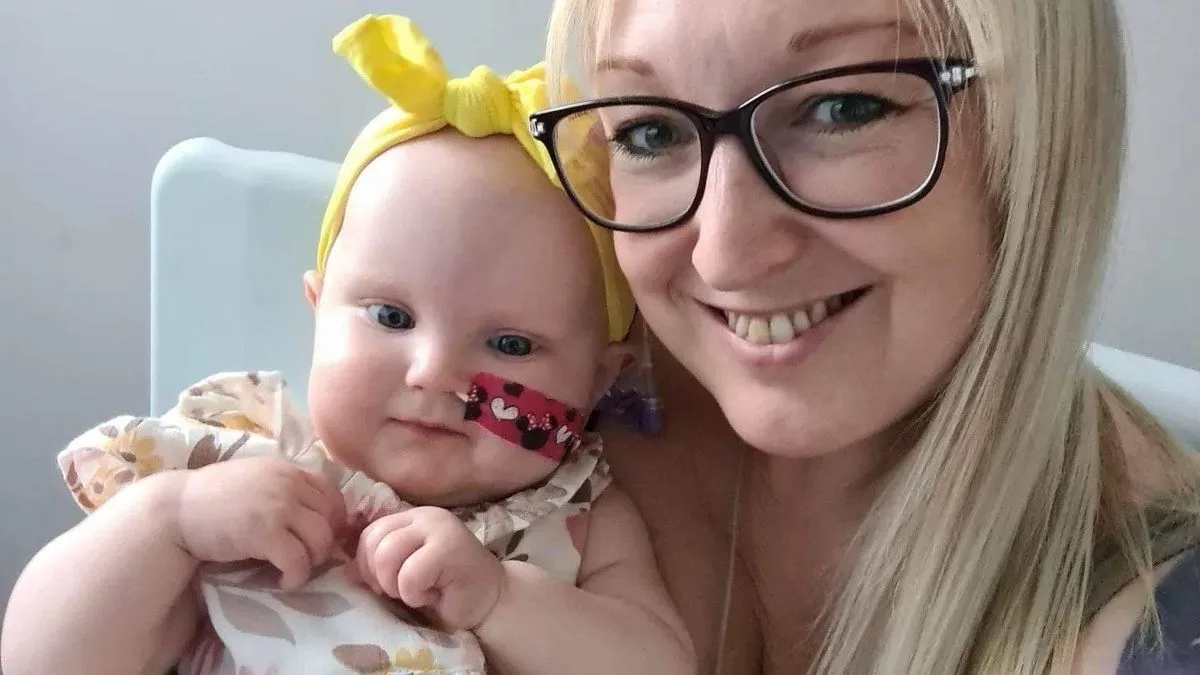
A nurse has described how her daughter's brain tumour was initially dismissed as common newborn behaviour. Corinne Wardle, 40, gave birth to Molly Wardle-Hampton in 2022, but within weeks the baby began experiencing seizures, vomiting, a fixed gaze, and a head tilt. Ms Wardle, a community-based staff nurse covering Flintshire and Wrexham, said she repeatedly raised concerns but was reassured.
She told NorthWalesLive: 'Every time I raised my concerns with doctors and nurses about Molly they were dismissed. She would scream every time I put her down as if she was in pain. Then both her eyes started turning outwards.' When Molly's head growth charted off the scale, a CT scan revealed a brain tumour. Molly was rushed to Alder Hey Children's Hospital in Liverpool, where doctors feared she would not survive the night. After a nine-hour emergency surgery, the tumour was removed.
Following recovery, Molly took part in an international clinical trial, and in January 2023 an MRI showed no signs of regrowth. However, a routine scan in January 2025 revealed the cancer had returned. On February 20, surgeons found and removed two tumours at Alder Hey. Doctors suggested 33 sessions of radiotherapy under general anaesthetic, but warned it would affect the processing part of her brain. Ms Wardle said: 'It was an impossible decision. We decided to watch and wait.'
Now three years old, Molly has global development delay, high-frequency hearing loss, and wears a hearing aid. Ms Wardle said: 'We've watched her battle through more in her short life than many adults ever do. But we now face a lifetime of challenges and uncertainty. As a nurse I've read the research – or rather the lack of it. Ependymoma is so poorly understood.'
Brain tumours kill more children and adults under 40 than any other cancer, yet just 1% of national cancer research spend has been allocated to brain tumours since 2002. Ms Wardle is supporting Brain Tumour Research's Christmas Appeal. Letty Greenfield, community fundraising manager at the charity, said: 'Molly's story is both heartbreaking and inspiring. With more funding and awareness, we can improve outcomes and one day find a cure.'




