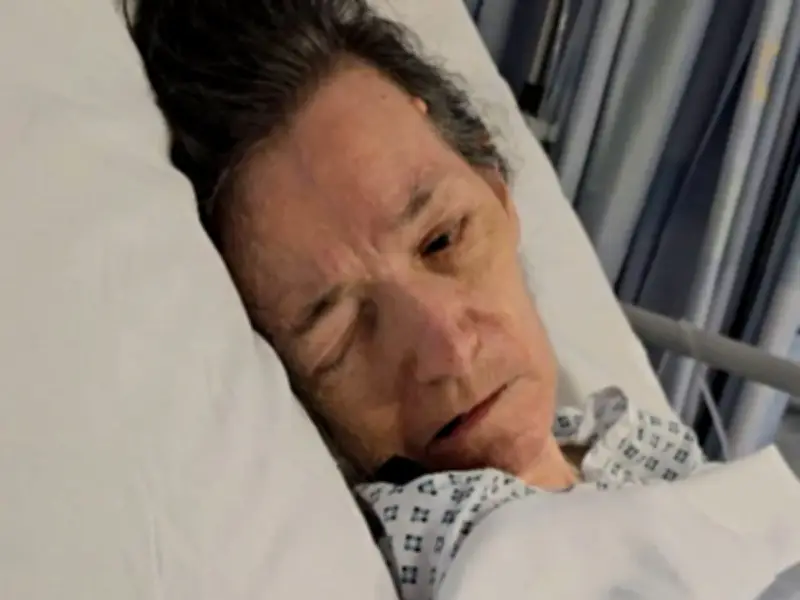
A brother who watched his sister slowly die over a month after doctors withdrew food is calling for families to have more say in hospital care. Marjorie Evans, 79, suffered a severe stroke leaving her unable to eat, drink or speak and was moved to hospital.
Doctors stopped treatment eight days after admission
Doctors at the Royal Glamorgan Hospital determined the mother-of-three wouldn't recover from the haemorrhage. Doctors noted that she was not a candidate for an NG tube to be fitted through her nose to deliver nutrients to her because of risks of her inhaling it and medics determined it was not in her best interests to feed her.
Eight days after she was admitted, doctors said it was in Marjorie's best interests to stop trying to administer treatment, and put her on end-of-life care.
Her devastated brother Brian Sides, 74, said her demise took weeks - and he sat by her bedside watching her grow weaker and weaker until she died. He has accused doctors of ignoring his pleas to attempt to feed or treat her in other ways.
Family calls for legal change
Brian, a retired computer programmer, wants the law changed so that families have a greater say when patients lose mental capacity, particularly in decisions about withdrawing artificial nutrition, with a quicker route to taking cases to the Court of Protection.
Cwm Taf Morgannwg University Health Board's investigation into Marjorie's care concluded they did "not consider that a qualifying liability exists" under the relevant NHS regulations and maintained that "decisions were made collectively in her best interests, focusing on comfort, dignity, and symptom control".
Marjorie's certificate states the cause of death was a spontaneous intra-cerebral haemorrhage. Brian, from Bridgend, said: "Marjorie might have recovered, there's now no way of knowing. I feel she wasn't ready for end-of-life care, she could've gone to a hospice."
"They had made up their mind right at the beginning, but all the problems or risks they mentioned had solutions. I couldn't get anyone to acknowledge the risk of malnutrition. Surely that's just common sense. We as a family have all been shocked and distressed at what has happened. I believe she could have been fed."
Timeline of care and complaints
Widow Marjorie, a retired secretary, was living in a care home when she had a stroke and was rushed to hospital on September 24, 2025, where tests revealed a brain bleed had caused severe damage.
Doctors told Brian they wouldn't be able to insert a feeding tube due to Marjorie moving around and attempting to dislodge it when she became distressed, and it risked infection, he said. During a meeting with her care team on October 1 doctors explained her condition wouldn't improve and recommended focusing on keeping Marjorie comfortable and administering end-of-life care.
Brian said: "Her eldest son applied for deputyship but it took too long." He argued Marjorie should be fed as going without food would worsen her condition. Brian said: "They refused to feed Marjorie or fit a tube, with each doctor or clinician giving me a different reason." Brian claims Marjorie's condition was improving, with her beginning to open her eyes and becoming more responsive to touch, but the decision remained the same - to withdraw her nutrition.
Brian said he contacted Patient Advice and Liaison Service (PALS) and filed complaints with the hospital, disputing the care plan. The hospital eventually put in an application for a Court of Protection Order (CPA) in order to resolve the dispute, because there was no Lasting Power of Attorney (LPA) document in place, but Marjorie passed away on October 27, before anything had gone to the court.
Under the Mental Capacity Act 2005, if a person lacks the mental capacity to make decisions and has not appointed a LPA, and there is no Court of Protection order in place, the responsibility for making medical treatment decisions rests with the healthcare professional.
Brian filed a complaint with the hospital on November 1, accusing them of re-packaging the now-banned Liverpool Care Pathway for the Dying Patient (LCP). He complained that further efforts should have been made to feed her through different means than a GI tube, such as a PEG tube into the stomach. He argued that doctors "ignored the risks of giving no nutrition" which he feels is the real cause of her death.
Health board response and ombudsman findings
In the health board's response to his complaint, it was explained that an NG tube "was not considered safe" due to the risk of aspiration, because she couldn't sit upright, and the risk of pulling it out. They said it "would not improve her quality of life" and fluids could have made brain swelling worse.
The health board said continuing nutrition would cause "unnecessary suffering" as "recovery was highly unlikely given the extent of the brain haemorrhage", in a response to Brian's filed complaint. The response said: "It might be helpful to explain that when someone is sadly nearing the very end of their life, their body naturally slows down and no longer needs food or fluids in the same way."
"Continuing to give nutrition or fluids through drips can sometimes cause more harm than good; such as swelling, breathing difficulties, or discomfort - rather than helping." After reviewing the case, the health board concluded that the decisions made about Marjorie's care were in her best interests and that her treatment was appropriate.
Still unhappy with the outcome, Brian took the case to the Public Services Ombudsman. The Ombudsman upheld parts of his complaint, finding that the hospital had not properly documented all of its treatment decisions, including those relating to the decision not to insert a nasogastric (NG) feeding tube. It also found that an application to the Court of Protection could have been made sooner.
The ombudsman said "the case for not inserting a NG tube may have been strong from the outset, with this case becoming stronger as [Marjorie's] condition deteriorated". They added: "However, the lack of appropriate documentation of very important decisions regarding capacity and best interests means that this cannot be fully established in retrospect."
The health board was instructed to apologise to Marjorie's family for shortcomings in its record-keeping and to review how it documents decisions about artificial nutrition and hydration for patients who have suffered a severe stroke and have reduced levels of consciousness.
Brian still feels justice has not been done following Marjorie's death - demanding change to the policies in place to give greater weight on the opinions from the next of kin of a patient over medical professionals. He said: "I don't feel the health board were held to account enough."
A spokesperson for Cwm Taf Morgannwg University Health Board said: "We extend our sincere condolences to the family of Marjorie Evans. The care received by Marjorie was reviewed by the health board and the case was subsequently independently investigated by the Public Services Ombudsman for Wales."
"We fully accept the ombudsman's findings and recommendations and have apologised to the family for the shortcomings identified. We are committed to strengthening documentation standards, reinforcing compliance with the Mental Capacity Act, and improving how treatment decisions, concerns and differences of opinion are properly documented, considered and escalated."
"We will ensure that the learning from this case is embedded in practice and will use the findings to improve the experience of patients and their loved ones."