A Belgian man who was critically injured when a car struck his electric scooter now lives with a 3D-printed skull implant, after a friend recognised him at the scene only by his shoes.
Vincent Van den Broeck, 34, from Brussels, cannot remember being hit by a car in October 2024. His brain injury was so severe that it also erased his memory of the minutes leading up to the collision. But his friend vividly recalls arriving at the scene moments afterwards.
Vincent was travelling across the city on an electric scooter when he was struck by a car in a 30mph zone. The braking speed was later assessed to be 55mph. The impact threw Vincent into the air and left him critically injured.
Friend recognised him by his shoes
"My friend Ismaïl found me 11 metres from the car," Vincent said. "Apparently it was disgusting to see. It was a strange coincidence, as he had been on his way to visit his aunt, along a road he normally never takes. He saw cars ahead making U-turns and, as he got closer, he saw someone lying on the road."
"He and his cousin saw a guy wearing Nike Air Force Ones - the shoes I've worn since I was 16 - suffocating with his skull open. My face was too badly damaged to be recognised, but as they got closer, he realised it was me and took me into his arms."
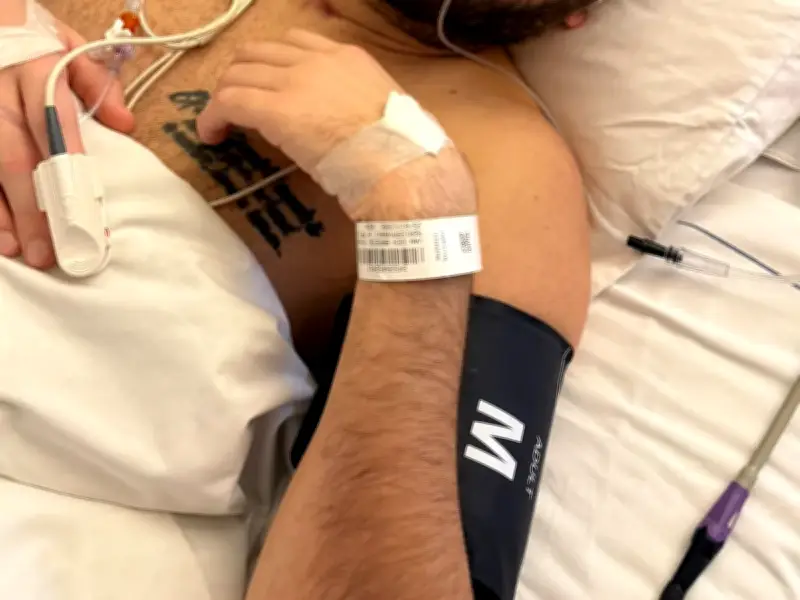
The collision left restaurant worker Vincent with a broken neck, wrist, collarbone and skull. He spent three weeks in a coma and underwent four operations.
Recovery and rehabilitation
"Apparently my head was like a rugby ball - it became hugely swollen," he said. "They had to remove part of my skull to relieve the pressure on my brain. My family were told that only ten per cent of people who suffer this type of collision survive."
After a clean MRI, Vincent made a remarkable recovery, but the early days were incredibly difficult. When he first regained consciousness, he hallucinated that he was on a tour bus, in a different hospital, or that cameras were watching him and people were trying to steal his identity. His wife Zeineb slept beside his hospital bed and rarely left his side.
"I couldn't talk because of the tracheotomy," Vincent explained. "I wasn't able to walk, so Zeineb had to help me go to the toilet and wash myself. I couldn't put on my shoes, feed myself, open a bottle or even open a door. I had to learn everything again.
"In the early days, I kept asking why it had happened to me. But then I realised thinking like that would take me to a dark place, so I decided to focus on my rehabilitation instead."
3D-printed skull implant
The section of Vincent's skull that was removed was too badly damaged to be reattached, so he had to wait months to be fitted with a bespoke 3D-printed replacement produced in Finland. Made from fibreglass, the implant is slightly larger than the palm of his hand. However, there are still two holes in his skull - drilled to relieve pressure after the crash - that will never be filled because doing so is considered cosmetic surgery.
Until surgeons could fit the custom-made prosthesis, Vincent said he had to wear a protective helmet and was not allowed to walk alone in case he fell. "My head looked strange, dented and uneven. Even basic things like going to the toilet I wasn't allowed to do on my own. They had put side rails on my bed 'for safety', they said. It didn't feel safe to me. It felt like a prison."
Due to his prosthetic skull implant, Vincent can no longer ski, play football or take part in sports where head injuries are a risk. But he says it is a small price to pay.
Looking forward with gratitude
Vincent now experiences seizures as a result of the accident, although he says he is sure they will eventually stop. Despite everything he has endured, Vincent says he feels no anger towards the driver, who is awaiting sentencing over the crash. Instead, he says the experience has left him feeling grateful, positive and optimistic about the future.
He said: "My goal now is to live to 110 in the best shape possible. I go to the gym every day, I eat well, I practise intermittent fasting and I go to the sauna four times a week.
"I've been through the most difficult period of my life, but I have so many lovely memories of my rehabilitation and everything that came afterwards.
"There are mornings when I find myself smiling for no reason. It might be while tying my shoes before heading to the gym, or walking into the restaurant and hearing the familiar clatter of plates and chatter of guests. These little moments of normal life - things I once took for granted - are now my greatest source of happiness."
Vincent's book Everything Feels Impossible Until It's Done: How the Life You Build Becomes the Life That Saves You is available to pre-order now.