
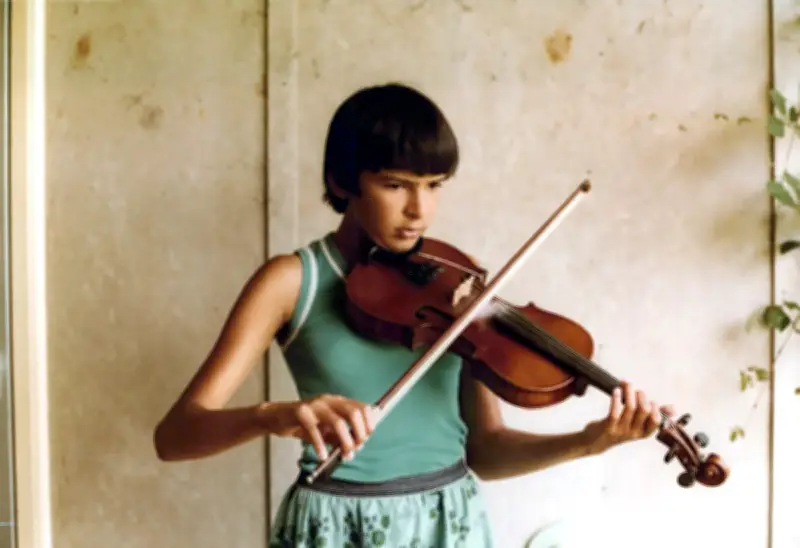
When multiple sclerosis began to affect her fine motor skills, Shakira Hussein found a way to redesign her dream, rather than give it up altogether. The disease, diagnosed 20 years ago, eroded her balance and fine motor skills, ending her violin playing. But she has now taken up the tabla, a pair of traditional hand drums, and is learning to play again.
A gradual decline
At first, Hussein failed to recognise the significance of the deterioration in her violin technique. She was preoccupied by other concerns – the crushing exhaustion she described to her doctors as “not normal tiredness” and unexplained falls from her bike. Only when the right side of her body detached itself from her central nervous system to the point where she could no longer pick up a pen or walk without a stick did the words “this feels neurological” cross her mind.
By the time the neurologist told her the MRI results, she had self-diagnosed with everything from a brain tumour to stress. The official diagnosis of remitting-relapsing multiple sclerosis was almost a relief. Her then eight-year-old daughter was not about to be orphaned. There were disease modifying therapies which would hopefully reduce the number and severity of the attacks.
The loss of music
Eventually the disease went into remission and her body returned to close to its previous condition. She was able to put aside the walking stick (at least between relapses) and resume typing her long overdue PhD thesis. But her balance and fine motor skills had been permanently eroded. She never rode her bike again, and her violin languished in its case.
Violin had never been her main occupation, but she could not imagine a life without impromptu jam sessions with friends, family and sometimes total strangers. No more playing catchy tunes to entertain young children. No more scraping out a Vivaldi concerto or Handel sonata when she needed to boost her mood. She consoled herself with the knowledge that she had only ever been a very ordinary violinist, but the loss still stung.
Finding a new instrument
At the rehabilitation clinic, the occupational therapist asked patients to list the activities that multiple sclerosis was preventing them from doing so he could help them find a way to resume them. “Field research in Pakistan” was at the top of her list, but the OT chose to ignore that particular ambition in favour of “playing the Bach double with my daughter” and “riding my bike”. There were plenty of alternatives, he told her – a tricycle instead of a bike, a guitar instead of a violin.
Hussein tried the guitar, but it soon became frustrating rather than fun. The frets helped her stay in tune, but her fingers still fumbled the instructions from her brain. She gave the guitar away to a friend. Then, 20 years after the diagnosis, the thought of the tabla came to her. She had seen tabla players during childhood visits to India and had vivid memories of a performance by tabla legend Ustad Zakir Hussein. She had even bought herself a dholak – another type of south Asian drum – during her Pakistan travels. The tabla, she realised, is a far more forgiving instrument for those with reduced manual dexterity.
A new musical journey
For the past 18 months, Hussein has been taking lessons. She is learning the correct finger positioning for the strokes, how to recite the bols, or notes, and how to play simple compositions. Playing music – even on an unfamiliar instrument – feels like a homecoming. On the violin, she was painfully aware of how far backwards she had slipped. On the tabla, she can take pleasure in her slow but steady improvement.
She will never play the Bach double with her daughter. But that does not have to mean that they will never make music together again. Violin and tabla can be a very beautiful combination.




