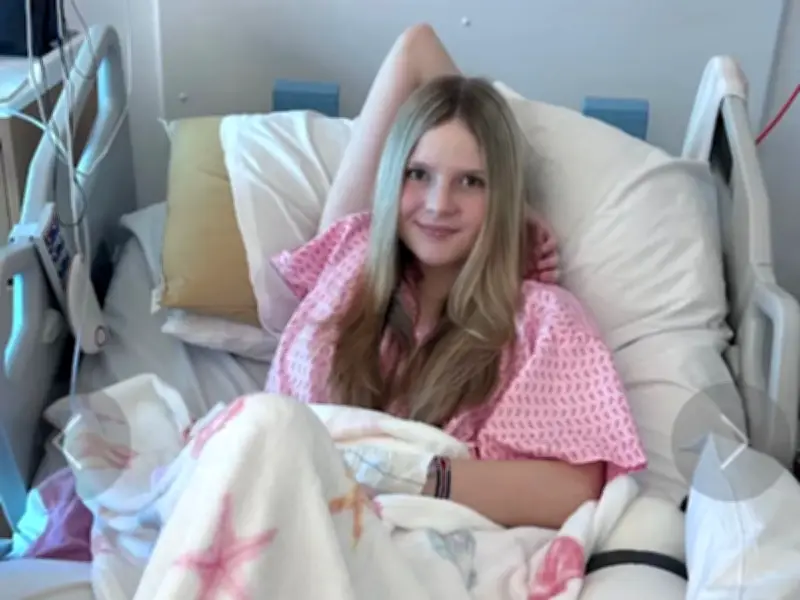
An 18-year-old woman with Ehlers-Danlos Syndrome (EDS) says she has to punch herself in the face to relocate her jaw, after feeling let down by doctors.
Tallulah Robertson, from Daventry, Northamptonshire, was diagnosed with EDS at 14, after suffering multiple debilitating joint dislocations. The condition, according to the NHS, causes joint hypermobility, loose and unstable joints, and digestive problems. She says her condition is becoming harder to manage, with hundreds of dislocations every year, so painful they cause functional seizures.
Frequent hospital visits with no answers
Despite frequent hospital visits, sometimes making multiple trips to A&E on consecutive days, Tallulah says she feels dismissed by medical professionals who offer no answers, leaving her to manage her dislocations and pain alone.
“Because I’ve been to hospital so much for (my dislocations) they’ve ended up leaving them dislocated,” Tallulah said. “My right shoulder has been dislocated for a year and my left has been out for months, which means I can’t lift my arms or anything like that.”
“They’ve left my jaw out before, stuck open and stuck shut. I’ve got gastroparesis, so I am sick a lot, and when they left my mouth shut and I was vomiting solids, I had to take the head off the shower and rinse my mouth out – I had to clear my airways because I was choking.”
“I’ve had multiple people saying, ‘If we put it back into place, it’s just going to come out again because it’s so loose’. But my shoulders, when someone actually bothers to relocate them, can stay in for eight weeks or even longer. I just think I’d much rather have eight weeks of being able to use my arms normally and have a bit more of the normal life that an 18-year-old should be having. But they don’t seem to understand that perspective.”
Diagnosed at 14
Tallulah was diagnosed with EDS in September 2022, having experienced her first dislocation at nine, before her shoulder began repeatedly dislocating from May 2022 onwards. Over the past four years, her mother, Heidi Schimmel, says Tallulah has been “passed from pillar to post” across multiple hospitals, eventually being told by doctors at Northampton General Hospital that “there’s nothing more that we can do”.
Since her diagnosis, Tallulah has experienced countless dislocations of her shoulders, hip, jaw, fibula and even her fingers. On October 31, 2025, she dislocated her shoulder and was left with her arm above her head for six months; the joint remains out of place. She spent almost three months in hospital from March 18 to June 2 this year with an undiagnosed hip issue, and fully dislocated her hip several times in August, with Tallulah and her mum saying they were left to relocate the joint themselves, despite having no formal training.
Her gastroparesis – a condition where the stomach empties more slowly than normal and is often a comorbidity with EDS – leaves her vomiting at least three times a day, sometimes as much as 20 times, which also means the 19 different regular medications she takes do not have a proper chance to work.
Education affected
Tallulah’s EDS is also affecting her education; she has missed large amounts of time at college, where she is studying law, due to acute pain. Over the course of 2026, she has spent four months as an inpatient in hospital without any long-term plan. In March, she began experiencing non-epileptic functional seizures, which she believes are due to the severe, constant pain caused by her EDS, and she was diagnosed with Functional Neurological Disorder (FND).
The NHS describes FND as a problem with how the brain receives and sends information to the rest of the body and can cause fainting and seizures. As her body spasms during a seizure, it can cause further dislocations, and she has had to reset her own jaw by “punch(ing) myself in the face”. There have been occasions where all of her fingers have been dislocated during a seizure.
In May 2026, Northampton General Hospital referred her to UCLH in London for specialist help with her FND, which persists. On September 1, Tallulah fell at home and dislocated her hip again, causing immediate seizures; as she was rushed to hospital by ambulance, she dislocated her fibula while trying to relocate her own hip.
Upon arrival at Northampton General Hospital, Heidi said doctors refused to treat the knee issue as they believed her pain was caused by FND, not a dislocated joint – but Heidi said she saw “clear disfigurement” in Tallulah’s knee and she remained bedbound. After she self-discharged on September 24, Tallulah went to Coventry Hospital, where she was diagnosed with a dislocated fibula and within 18 hours after treatment she could walk again.
Unhappy with treatment
Heidi claimed that “Northampton General Hospital just wanted to send her home, unable to walk, with no plans to get her moving at all”, with Tallulah adding that one doctor simply told her to “go home, have a bed downstairs, use dry shampoo and have a commode and bed baths”. Heidi said she has made seven formal complaints to Northampton General Hospital and the Patient Advice and Liaison Service (Pals), but none of the issues had been addressed satisfactorily.
Now, Tallulah feels she has come to the end of the road with NHS treatment. A friend has set up a GoFundMe fundraiser to help her explore other treatment avenues, which has raised £795 so far – enough for her to arrange an appointment with a private, EDS-aware doctor.
“We’ve been through the whole NHS system, into however many hospitals, and I’m just not getting the right help,” Tallulah said. “I’m an adult now and all my friends are going out, getting jobs, going to uni, and I just feel left behind. Everyone’s having their normal lives and I’m limited to what I can do - everything’s so unpredictable because I don’t know what’s going to happen each day… I want to be normal like my friends.”
Chief Nurse for the University Hospitals of Northamptonshire, Robin Binks, said: “We are aware of the concerns raised by Tallulah’s family and have worked to address them through our Pals and complaints system. We always aim to provide high-quality care for everyone and apologise if their experience did not meet our high standards. As these matters relate to an individual patient, it would not be appropriate to comment on the specific details of the case. We take all feedback extremely seriously and strive to provide safe and compassionate care.”