

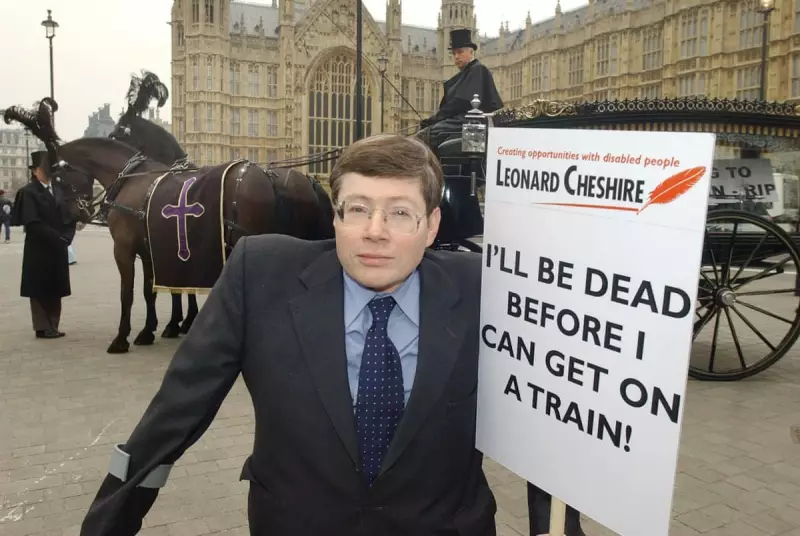
The disability rights movement has lost one of its most effective and charismatic campaigners with the death of John Knight at the age of 67 from sepsis. Knight, whose own profound disabilities from birth shaped a lifetime of advocacy, is widely credited with securing a crucial legislative victory that brought forward the deadline for fully accessible UK rail travel by fifteen years.
A Landmark Campaign for Accessible Transport
As head of policy and campaigns at the charity Leonard Cheshire during the passage of the landmark Disability Discrimination Act 2005, Knight led the high-profile "All Aboard" campaign. At the time, train operators were lobbying for a 2035 deadline to make carriages accessible, a timescale that would maximise the use of existing, inaccessible rolling stock.
Knight's campaign successfully persuaded the House of Lords to back a critical amendment to the legislation, setting a far more ambitious deadline of 2020. This change was subsequently accepted by the then Labour government, ensuring that disabled people would not have to wait an extra generation for basic access to the rail network.

A Mischievous and Memorable Tactician
Knight's approach was as creative as it was effective. At the climax of the All Aboard campaign, he orchestrated a striking piece of political theatre. A horse-drawn hearse delivered thousands of postcards to MPs and peers in Westminster. On each card, a disabled person had written the age they would need to live to in order to benefit from the proposed 2035 deadline. The campaign's powerful slogan for the day was: "I'll be dead before I can get on a train."
This tactic perfectly reflected Knight's mischievous personality and penchant for pranks, which he brought to his sixteen-year tenure at Leonard Cheshire. Friends recall his love of fireworks and a party trick where he would adapt his crutches into makeshift mortar tubes. He was seen by many within the organisation as a refreshing influence, helping to shake off a traditional, somewhat patrician culture and champion the inclusion of people with disabilities at all levels.
A Life of Overcoming Adversity
Knight's drive was forged in a childhood of extreme challenge. Born in Bristol with significant disabilities, his parents struggled to cope. After ten weeks in hospital, he was transferred to a specialist home in Essex where his severely twisted legs were amputated and he was fitted with prosthetics. At 18 months, he was placed into the care of Barnardo's.
He described this experience as "transformational," particularly due to the influence of a staff member, Judith Hocking, who became a mother figure. He flourished at Chailey Heritage special school in East Sussex, where he became head boy, and later at Hereward College in Coventry. It was at Chailey that he developed a lifelong passion for opera through trips to Glyndebourne.
Building a Career in Advocacy
After graduating in zoology from Nottingham University in 1982—where he researched urban seagulls despite, by his own admission, never spotting one—Knight had a brief stint in banking before joining the civil service in 1985. He served for five years in the Department of Health before moving to Hammersmith and Fulham council as a principal disabilities services officer.
In 1994, he joined Leonard Cheshire to build its policy and campaigns function, a role in which he would make his most lasting impact. Beyond the rail campaign, his achievements included pioneering disability equality training for London bus drivers and securing safeguards for disabled people during Labour's 2008 welfare reforms.
A Prolific Public Servant
Knight's expertise was sought across the public and voluntary sectors. After leaving Leonard Cheshire in 2010, he held numerous appointments, including as a commissioner for the Commission for Social Care Inspection (2004-2009), a board member of the Charity Commission (2009-2013), and a key figure on the National Council for Voluntary Organisations board (2003-2008). He served as a magistrate in north-east London for 28 years until 2020 and was made a CBE in 2011.

In later years, he again demonstrated independent thought by openly supporting legislation for assisted dying for the terminally ill, serving as a board member and patron for the group My Death, My Decision. He claimed to represent a silent majority of disabled people on this issue.
Personal Life and Legacy
Knight met his wife, fellow campaigner Ruth Hall, through Guardian Soulmates in 1996. They married in 2021 and were together until his death. The couple regarded a young adult, Shuxin Dai, as a daughter, and Knight cherished a grandparental relationship with her son, Jonathan.
John Knight's legacy is one of tangible, life-changing progress. By shifting the deadline for accessible trains from 2035 to 2020, he ensured that millions of disabled people gained independence and mobility years earlier than they otherwise would have. He combined strategic acumen with a rebellious spirit, proving that working within the establishment could yield radical results for social justice.





