
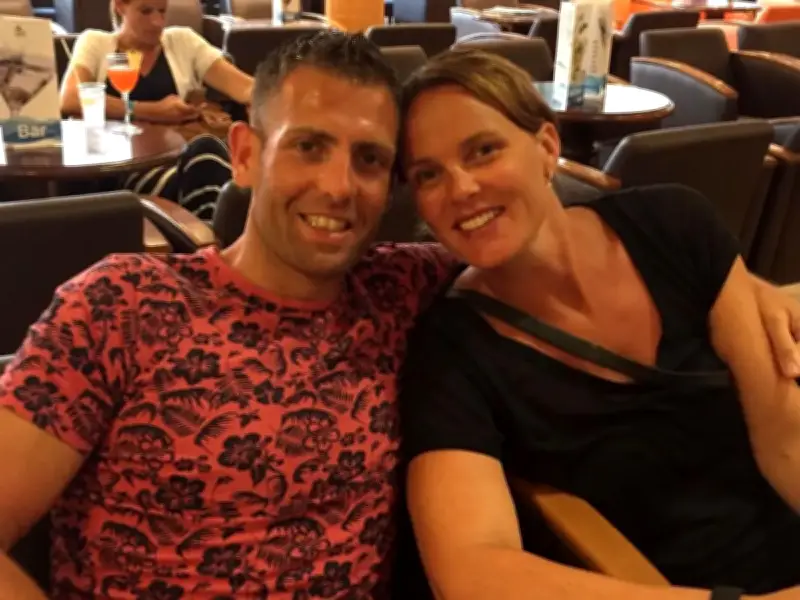
Leigh Manley, a fit and healthy 39-year-old, was running on a treadmill at his local gym in Cardiff when he collapsed backwards off the machine five kilometres into his session. He was unconscious for around three minutes and initially thought he had collapsed due to dehydration.
Fellow gym-goers at The Gym on Newport Road rushed to help, placing the father of three in the recovery position until he regained consciousness. Ambulance crews arrived and checked him over, but his heart had almost immediately returned to its usual rhythm. It was assumed he had collapsed because of dehydration, but in fact his heart beat had sped up so fast it could have killed him.
Diagnosis After Months of Tests
Leigh declined to go to hospital that Saturday evening, but when he got home his wife Zoe was shocked at how ill he looked. He changed his mind and later saw his GP, which led to months of tests and investigations and a life-changing diagnosis of arrhythmogenic cardiomyopathy (ACM), a rare genetic condition where the wall of the heart can become weak because the cells of the muscle tissue do not develop as they should.
Leigh, a manager at Admiral who had just started a postgraduate course, said: "I had never been ill doing exercise and was fit. The cardiologist told me later that my fitness probably saved my life." The diagnosis was made even more difficult because Leigh had lost his father to sudden cardiac arrest just 15 months before his own collapse, though this turned out to be unrelated to his condition.
Living With a Rare Heart Condition
Leigh's condition meant he needed an implantable cardioverter defibrillator (ICD). He has undergone multiple surgical procedures and endured numerous periods of ill health and stays in the University Hospital of Wales. Doctors advised him to stop running, swimming and exercising at the levels he had enjoyed for most of his adult life.
Leigh was fitted with an implantable defibrillator which checks his heart rhythm 24 hours a day, sending data to alert doctors if there are any changes. He now sees his cardiologist every six to 12 months for checks. He has been admitted to hospital several times, with his heart beating at 130 to 180 beats a minute on occasions, two to three times faster than the normal 55-65 beats a minute. That has not happened since 2020 thanks to medication and surgery, but Leigh remains alert to potential symptoms.
A New Purpose Through Writing
The condition forced Leigh to reassess almost every aspect of his life. He cannot exercise as he did, left his job as manager at Admiral in 2022, and is now a freelance poet and storyteller. He began writing as a way to cope, starting a journal about his health, sport, resilience and everyday life. He now runs workshops in libraries, schools and care homes sharing his love of language and writing.
When he collapsed in 2016, his three children were aged 10, eight and six. Olivia is now 20, Sophia 17 and Lily 16, and Leigh is glad he has been there for milestones that at one point were far from guaranteed. He is grateful for the help he has received from the British Heart Foundation Cymru and the research it helps fund.
Leigh said: "I've celebrated birthdays, GCSE results, AS Levels and A Levels, and I've watched one of my children head off to university. I've been to countless swimming galas, football matches and music concerts. A lot of that is down to innovations and the type of research that BHF Cymru funds."
BHF Cymru said that in Wales, the number of people dying under the age of 75 from cardiovascular disease is still higher than it was before the pandemic, and in 2024, the death rate was 17% higher in Wales than in England.




