
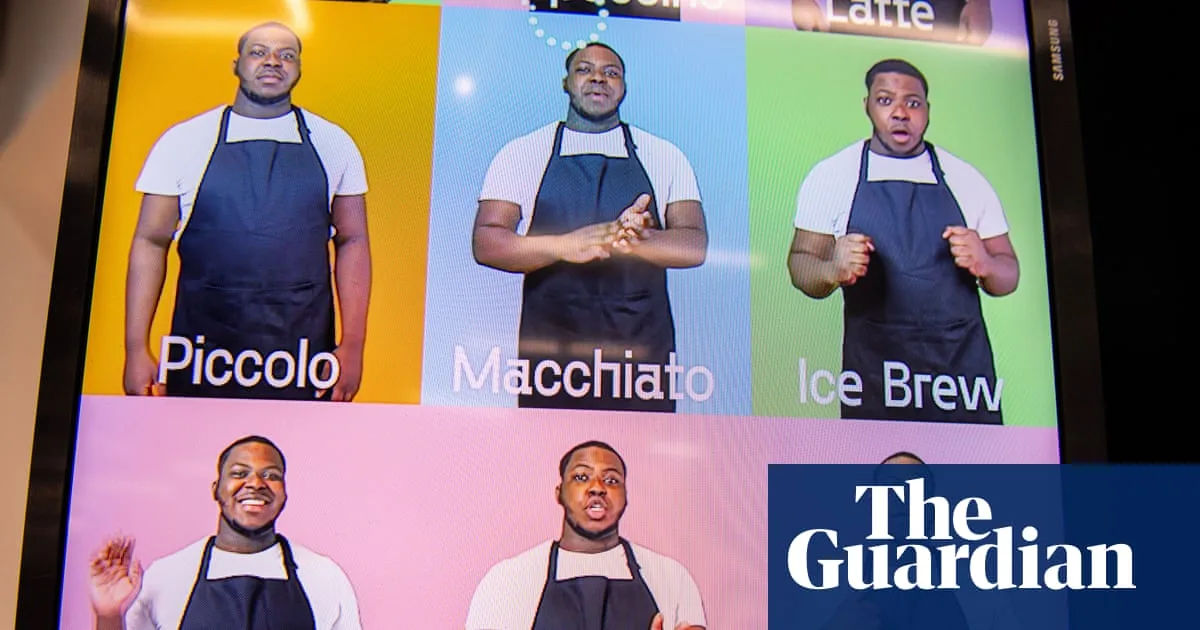
A deaf-run cafe in east London is encouraging hearing customers to use British Sign Language (BSL) to place their orders, breaking down communication barriers through in-person interaction. Dialogue Cafe, based at the University of East London, features touchscreen menus that display videos of BSL translations for each item, helping customers like Wesley Hartwell, a university lecturer, overcome initial anxiety about signing.
Hartwell, who has no hearing problems, successfully ordered a latte using BSL with the help of the video menu. 'I have to be honest: when this cafe first opened near my office, I avoided it because the whole idea made me anxious,' he said. 'But now I’m fascinated. Sign language is amazing. I’m thinking of taking a course so I can learn more.'
Victor Olaniyan, the deaf barista who has worked at the cafe for five years, expressed mild amusement at hearing customers' reactions. 'I was brought up by hearing people, so I have no problem in the hearing world,' he signed. 'But hearing people often feel anxious communicating with us. If this technology helps them, that’s great, but I’m fine as I am.'
The cafe's approach comes amid a surge in digital and AI products aimed at bridging the communication gap between deaf and hearing people. UK startup Silence Speaks has built an avatar-based system that converts text into BSL, while the British project SignGPT, backed by £8.45m in funding, is developing models to translate between BSL and English in both directions. A new £3.5m UK-Japan research project is also training systems on natural deaf-to-deaf conversation data.
However, sign language researchers caution that current tools still struggle with linguistic nuance, regional variation and context, particularly in high-stakes settings such as healthcare and law. Prof Bencie Woll, a co-investigator of the SignGPT project at University College London, noted that historically, technology has often failed the deaf community due to a lack of understanding. 'All of these were doomed to failure because they were designed by people who did not understand sign languages and did not ask deaf people what they wanted,' she said.
Despite these challenges, the need for solutions is significant. About 70 million people worldwide are deaf or hard of hearing, and in the UK, census data records approximately 151,000 BSL users. For roughly 25,000 of them, BSL is their primary language.




