
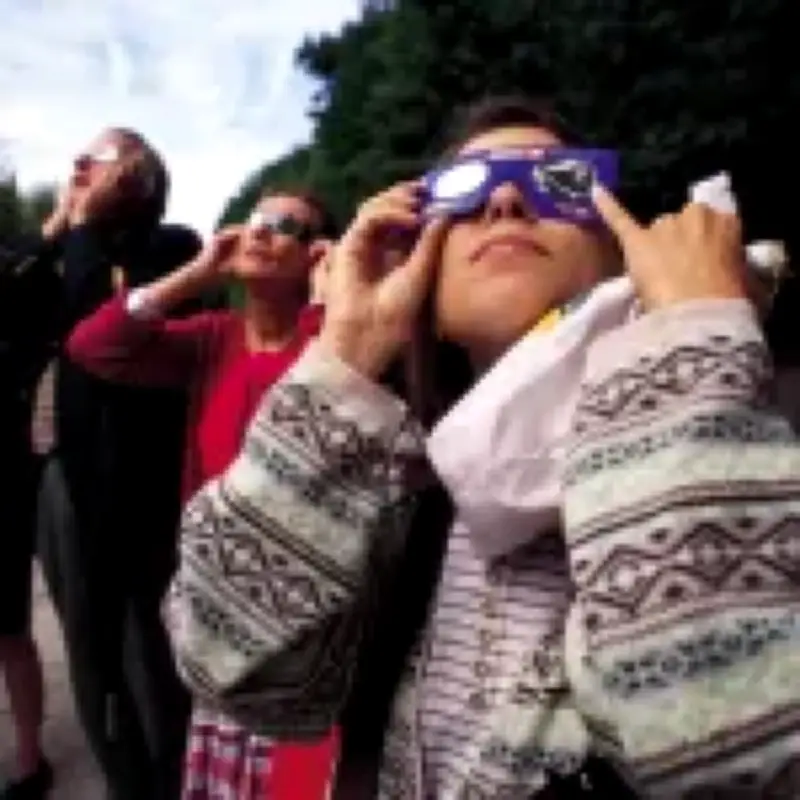
The moon will take a massive bite of the sun today, leaving just a frowny face-shaped sliver of the star left. The most dramatic partial solar eclipse the UK has witnessed in three decades will happen tonight. Yet the most important thing to remember is that it’s unsafe to stare directly at the sun until the moon has covered its surface, called totality. In other words, everyone in the UK has to wear protective eye gear called eclipse glasses, or look at it indirectly with DIY tools like a pinhole camera.
But shops, opticians and museums selling eclipse glasses have largely sold out, leading to queues and people wondering if they even need them. As Reddit users have said, why is it so bad to look up when so much of the sun is covered? Can’t we just ‘rawdog’ it and look with the naked eye?
The hidden dangers of looking directly
No, you seriously do need them, and the reason why is simple, Reena Dave, an ophthalmologist, or an expert in eye diseases and disorders, tells Metro. ‘The eclipse tricks your eyes into feeling comfortable looking at the sun, which is exactly what makes it so dangerous,’ Dave says.
When you look at the sun, you instinctively turn away. During an eclipse, though, the sun being blotted out almost lures you into a false sense of security. While less of the sun is, indeed, shining, ultraviolet and infrared light – rays from the sun we can’t see – can still damage your eyes. Eclipse glasses have a special film in the eyeholes that filters out these harmful rays.
‘Retinal damage from UV exposure happens silently and painlessly, so people won’t notice damage until several hours later,’ says Dave, the clinical director at the eye clinic, Newmedica. Dave worries that today will be a repeat of the historic solar eclipse of 1999, which was followed by nearly 2,500 eye-related injuries, according to the British Medical Journal. ‘It’s really important people are aware of the potential risks posed by the eclipse and take the appropriate measures to protect their eyes,’ she adds.
What could happen to your eyes
Tania de Sales Marques, a senior astronomer at the Royal Observatory Greenwich, stresses that looking at the sun can cause ‘permanent’ eye damage. ‘Even during a solar eclipse, the sun’s light is intense enough to harm the sensitive cells in the back of your eye,’ she adds.
By this, de Sales Marques means the light could burn a hole through your retinas, which convert light into nerve signals, allowing you to see. The extent of the burn, which would be shaped like the sun’s outer edge, depends on how long you look, but even a few seconds can be destructive.
People who have suffered eclipse burns report seeing black spots in their vision, colouring seeming less vibrant or objects appearing blurry and distorted – you might not even be able to see the massive ‘F’ at the top of the eye chart. Their eyes, meanwhile, become watery and sensitive to light.
What alarms Dave is that, when looking at the eclipse straight-on, you might not feel a thing at first. ‘Symptoms often take a few hours to appear and include blurred vision, a missing spot in central vision and sensitivity,’ she says.
Safe ways to watch the eclipse
Like hundreds of others, if you weren’t able to grab a pair of solar eclipse glasses due to stock issues (they really are sold out everywhere), you don’t need to worry, as there are plenty of other safe ways to watch the eclipse: Make a pinhole camera, use your hands or a colander, use paper, or watch an official livestream.
Brits have been warned from using their phone to watch the eclipse, so try one of the safer methods above instead.
One study followed 20 people aged 15 to 82 who reported seeing black spots after witnessing the 1999 eclipse in England. Four used eclipse glasses; one used sunglasses, and the rest looked with naked eyes. Of them, five had visible damage to their retinas and all but four were better after seven months.
Among those who saw the eclipse in 1999 was Peter Smith, from Taunton. He caught a glimpse of the cosmic ballet by looking through a welder’s mask, he told the BBC, which singed his retinas. ‘Make sure it’s got the right protection and filters to stop any damage because any damage you get, it’ll never heal,’ said Peter. ‘It’s not like cutting your hand.’




